After co-teaching a workshop on yoga and other movement practices in our social movements, I have been watching folks talk online about Yoga Journal and the state of American yoga these days. There's a lot that can be said in this regard, from the continued influence of colonialist narratives, to the heavy commodification of the practice. However, today I'd like to focus on this:
Much of the modern American yoga world avoids suffering.
Thinking that people are already challenged enough, yoga teachers, studios, and the like spin everything towards bliss, or its poorer cousin comfort.
Which seems to be a balm for the mundane stress of office jobs, traffic, or dealing with upset children, but leaves people absolutely stranded when something like loosing a parent happens. Or how to process the ongoing imperialist war machine. Or how to face, and possibly effectively challenge systemic racism, sexism, or homophobia. Or how to be and act in ways that resist eco-cide, and promote eco-centricism on an individual and societal scale. In other words, how to be a liberated being in the world.
For several years now, I have regularly said this verse at or near bedtime from the 8th century Buddhist monk Shantideva:
There's nothing that does not grow light
through habit and familiarity,
putting up with little cares,
I'll train myself to bear with great adversity.
These four lines have been more useful to me than a thousand yoga platitudes. But they also are, if you actually put them into practice, challenging words to swallow. When I bitch and moan and fuss about the "little cares," I'm forgetting them. When I fake being happy, or dismiss something bothering me as "nothing," I'm forgetting them. When I indulge in easy hatred towards the folks in power positions that are creating so much hell in the world, I'm forgetting that buddhanature is boundless, and that my liberation is bound up with everyone elses'.
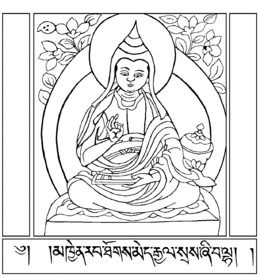
Over the years, I have worked with perhaps four or five excellent yoga teachers. All of them gave suffering a fair shake; all of them understood the balance between challenging people to face their lives as they are, and also to be kind to yourself and relax; and the majority of them saw the teachings not just as individual tools, but also as gateways into understanding and acting in the world around us. In this, working on a political campaign or being part of a collective effort to develop new alternatives was just as worthy of a dharma talk as facing emotional challenges, or becoming more intimate with the breath or some other object of meditation. Along these lines, taking up Warrior Pose (see teaching image above) can more easily be seen as a training ground for cultivating the strength to stay grounded in the midst of a protest, or picket line, or heated meeting with a public official.
As I see it, American Yoga is not devoid of bodhisattvas - to use Buddhist language - it's just flooded with people who are essentially trading in the destructive addictions our our society people use to cope, with something that is more beneficial, but ultimately is still just a coping mechanism.
Being able to cope without destroying yourself is a big plus. But what happens when the bottom falls out on the coping mechanism? What if, in being able to cope more, you're also aiding the continuation of the systems of oppression and suffering that brought on much of the very misery you sought relief from in the first place?
The best medicine goes straight to the roots, taking out that which feeds all the surface-level disorders. Sometimes, it acts swiftly; other times, it slowly seeps in, like Shantideva's words above have for me.
In any case, perhaps American yoga can take a cue from the Buddha and turn more directly towards suffering, individually and collectively. This won't solve the myriad of issues with the American yoga scene, but in my book, it would be a step in the right direction.
Showing posts with label Shantideva. Show all posts
Showing posts with label Shantideva. Show all posts
Sunday, September 14, 2014

Thursday, July 17, 2014
Seeking Peace
There's nothing that does not grow light
through habit and familiarity,
putting up with little cares,
I'll train myself to bear with great adversity.
I chanted these lines from Shantideva daily for about four years, and still bring up them up from time to time.
Those "little cares" that arrive in our lives have the ability to muck things up greatly, if we can't meet them as they are in the moment. The pain in your back, for example, easily can lead to tension, and then irritation, and then angry acting out of some kind. So it often goes.
Many people come to Buddhism seeking relief from all of this. Seeking something they call "peace" and "calm." But how many of us really understand what peace and calm actually are?
It's easy to mistake a kind of relaxed dullness for peace and calm. Some think things like television, video games, comfort eating or drinking, and other such commonplace activities will bring them peace and calm. Others reject such notions, and try to avoid those activities all together, thinking that a certain "purity" will bring peace and calm. Of course, neither way "works."
I had a period of the latter during my early years of Zen practice. In some ways, I think the extreme of cutting out and avoiding all together many commonplace activities was helpful. A form of renunciation needed to gain clarity. However, it wasn't true renunciation, because I was still attached to "not doing" those activities. My identity of being a Zen student seemed tied to it in some ways in fact. Not eating meat. Not watching TV. Not drinking a drop of alcohol for a period. Never playing video games and similar "distractions."
Avoidance based renunciation is useful for breaking old habits, however in the end, it becomes a cage. It also ends up being a way to stall or push away the little cares of life. You can hide out in your meditation practice. Hide out in your view that you are a "good Zen student." And you can rationalize away whatever problems that arise, blaming others or dismissing them as not existing at all.
Those who are mostly lost in comforts and dullness, and those who live in ivory Zen towers, are easily thrown off balance when adversity arises. And this is often when learning to "put up" with little cares can slowly lead one to the peace and calm that is our birthright.
Monday, November 4, 2013
Peace Isn't What We Tend To Think It Is

Photo credit: krosseel from morguefile.com
There's nothing that does not grow light
through habit and familiarity,
putting up with little cares,
I'll train myself to bear with great adversity.
I've been working with these lines from Shantideva's Guide to the Bodhisattva's Way of Life for many years now. In order to keep them with me daily, I chant them silently to myself as I brush my teeth every night before bed.
Sitting here now, I can see where this teaching is a gateway into an utter calm and peace. All of those "little cares" that arrive in our lives have the ability to muck things up greatly, if we can't meet them as they are in the moment. Meeting them, however, isn't mere acceptance or some kind of resignation. It's not putting up with; it's allowing flow. Accepting what is in one breath, and then doing what you're called to do in the next.
In the cycle of samsara, the pain in your back during meditation, for example, can easily lead to tension, and then irritation, and then some kind of acting out. A few nasty words from some passerby on the street can easily lead to your own shouting, an escalation of conflict, and in some sad cases, violence and even death.
Many people come to Buddhism seeking calm and peace, but don't really understand what calm and peace actually are. And so whenever something disrupts what we've deemed to be calm and peace, we get upset and our lives are overturned.
I used to meditate like mad, associating calm with boredom, and thinking zazen was kind of an endurance contest I had to win somehow. Seems to me the "peace" I sought was otherworldly, some hyper chill state that couldn't possibly be located in the middle of this chaotic, suffering filled world.
In this, there was no room for the world to fully enter, to be "confirmed by the ten thousand things" as Dogen once said.
Things "growing light" does not depend upon outer conditions. As a social activist, I seek a more just, eco-centric, and peaceful world. However, if I get too attached to whatever is "lacking" now, or whatever vision I have for "the future," the flow of fully living stops. And the synergy of accepting what is and taking the next called for step can't happen.
Tuesday, November 13, 2012
Seeking Peace and Calm
There's nothing that does not grow light
through habit and familiarity,
putting up with little cares,
I'll train myself to bear with great adversity.
I've been working with these lines from Shantidevafor about four years now. In order to keep them with me daily, I chant them silently to myself as I brush my teeth every night before bed (for the most part).
Those "little cares" that arrive in our lives have the ability to muck things up greatly, if we can't meet them as they are in the moment. The pain in your back, for example, easily can lead to tension, and then irritation, and then angry acting out of some kind. So it often goes.
Many people come to Buddhism seeking relief from all of this. Seeking something they call peace and calm. But how many of us really understand what calm and peace actually are? It's easy to mistake "relaxed dullness" found through things like television, drinking, eating, and other such commonplace activities, as peace and calm. In fact, such dullness can become so pervasive in your life that you fail to notice the presence of actual calm and actual peace.
I used to meditate like mad, trying to break through the dullness, thinking zazen was kind of an endurance contest I had to win somehow. In this, there was no room for the world to fully enter, no room for the peace and calm that comes when being "confirmed by the ten thousand things" as Dogen once said.
Thursday, July 12, 2012
Yoga Platitudes and Great Adversity
I think all of us have an impulse to make everything alright, even if some of us override it most of the time. And some of us believe that every last ounce of misery in the world is part of some divine plan to teach us about ourselves, which perhaps is true, but there's absolutely no way to prove it.
This post takes on the sugary yoga babble that fills so many American yoga classes these days. It's one of the things I couldn't reconcile myself with during my yoga teacher training. The fact that people with 10, 15 or more years of yoga teaching experience could offer such drivel to their students, and that this is one of the main things that kept them coming back in droves. I get it. People are stressed. They want to feel comfortable and safe and perhaps held like children. But is that the purpose and function of these ancient spiritual traditions so many of us have entered into? I seriously doubt it. Which doesn't mean that there's no place for comforting, creating safety, etc. It's just that what I often witnessed and experienced was practice built solely around that.
The thing is, this take the edge off of everything and make it all ok approach is almost the exact opposite of Zen. Almost because there's still a sense of everything is ok, but it's a wide open field ok-ness, something completely beyond the reach of our little-self mind. Let's look at a few pieces of the post I linked to.
There's really nothing anyone can say to pretty up an experience like this. Nothing.
I never really have been able to. Believe this. The whole story and how it's packaged. I do believe that adversity can become resilience, but only if someone learns to face their life boldly, without flinching, and recognizes the much bigger picture present. Too much adversity in the hands of someone who can't do that at least some of the time leads to misery and destruction. Leads to variations of the author's mother.
There's a lot that could be unpacked here. The way a lot of yoga teachers have no idea about how karma actually functions. The blame the victim thread that runs through The Law of Attraction and similar stories.
But what I want to focus on is this: much of the modern yoga world avoids suffering. Thinking that people are already challenged enough, yoga teachers, studios, and the like spin everything towards bliss, or its poorer cousin comfort. Which seems to be a balm for the mundane stress of office jobs, traffic, or dealing with upset children, but leaves people absolutely stranded when something like loosing a parent happens.
For a good four years now, when I brush my teeth before bed, I say this verse to myself from 8th century Buddhist monk Shantideva:
There's nothing that does not grow light
through habit and familiarity,
putting up with little cares,
I'll train myself to bear with great adversity.
These four lines have been more useful to me than a thousand platitudes. But they also are, if you actually put them into practice, challenging words to swallow. When I bitch and moan and fuss about the "little cares," I'm forgetting them. When I fake being happy, or dismiss something bothering me as "nothing," I'm forgetting them.
Over the years, I have worked with perhaps four or five excellent yoga teachers. All of them gave suffering a fair shake; all of them understood the balance between challenging people to face their lives as they are, and also to be kind to yourself and relax.
American Yoga is not devoid of bodhisattvas, to use Buddhist language - it's just flooded with people who are essentially trading in the destructive addictions our our society people use to cope with something that is more beneficial, but ultimately is still just a coping mechanism.
Being able to cope without destroying yourself with the means is a big plus. But what happens when the bottom falls out on the coping mechanism?
*On the positive, there is a cool project being developed by a pair of yogis and scholars to collect the major yoga texts throughout history into a single English language volume. Please check out their Kickstarter campaign for more details.
This post takes on the sugary yoga babble that fills so many American yoga classes these days. It's one of the things I couldn't reconcile myself with during my yoga teacher training. The fact that people with 10, 15 or more years of yoga teaching experience could offer such drivel to their students, and that this is one of the main things that kept them coming back in droves. I get it. People are stressed. They want to feel comfortable and safe and perhaps held like children. But is that the purpose and function of these ancient spiritual traditions so many of us have entered into? I seriously doubt it. Which doesn't mean that there's no place for comforting, creating safety, etc. It's just that what I often witnessed and experienced was practice built solely around that.
The thing is, this take the edge off of everything and make it all ok approach is almost the exact opposite of Zen. Almost because there's still a sense of everything is ok, but it's a wide open field ok-ness, something completely beyond the reach of our little-self mind. Let's look at a few pieces of the post I linked to.
Five years ago my mother was diagnosed with Wernicke-Korsakoff’s Syndrome – a form of alcohol-induced dementia. That’s when she became a ghost. I was living in Dallas at the time – she in Austin – when one day my little sister called me in a panic, said she couldn’t find our mother anywhere. There’s blood all over the house, she told me. It looks like a murder scene.
I got in my car and made the four-hour trip to Austin that night, calling hospitals and jails on the way. Finally, I got a hold of the attendant at the gas station near her house. Do you know where my mother is? I asked him. She’s the little blonde lady, the one who comes in there all the time to get wine and a cup of ice. I think the police picked her up, he tells me. She walked in here with blood all over her face – I think she fell.
There's really nothing anyone can say to pretty up an experience like this. Nothing.
Yesterday in yoga class I was lying in pigeon pose, when I felt my mother sitting before me. Not the ghost mother, but my real mother. Holding my hand.
The yoga teacher started speaking: “Everything in life happens perfectly and synergistically so the soul can transform and know God.”
I wanted to scream. “Bull$#!&! How the #%& did drinking until her brain withered away teach this woman about God? Where’s the divinity in that?!
The phone in my bag lights up. Mommy Dearest.
“Our challenges,” the teacher continued, “are spiritual lessons that illuminate our disconnection from source and lead us toward awakening. This is karma. Spirit gives us the lessons we need to learn. This is how the soul wakes up.”
Don’t talk to me about Karma, I wanted to tell her. Don’t give me that crap about the Law of Attraction, about how if we just focus on our desires everything we want will come to us. Tell that to the ghost, I wanted to yell at her. Tell her all she needs to do is wake up and ask for what she wants to get better. Tell her she manifested this.
I used to believe that story. I used to believe that adversity inevitably becomes resilience, that the universe conspires to bring us toward transcendence, that if we don’t learn the lesson this time… well, there’s always the next life. But I don’t believe it anymore. I can’t.
I never really have been able to. Believe this. The whole story and how it's packaged. I do believe that adversity can become resilience, but only if someone learns to face their life boldly, without flinching, and recognizes the much bigger picture present. Too much adversity in the hands of someone who can't do that at least some of the time leads to misery and destruction. Leads to variations of the author's mother.
There's a lot that could be unpacked here. The way a lot of yoga teachers have no idea about how karma actually functions. The blame the victim thread that runs through The Law of Attraction and similar stories.
But what I want to focus on is this: much of the modern yoga world avoids suffering. Thinking that people are already challenged enough, yoga teachers, studios, and the like spin everything towards bliss, or its poorer cousin comfort. Which seems to be a balm for the mundane stress of office jobs, traffic, or dealing with upset children, but leaves people absolutely stranded when something like loosing a parent happens.
For a good four years now, when I brush my teeth before bed, I say this verse to myself from 8th century Buddhist monk Shantideva:
There's nothing that does not grow light
through habit and familiarity,
putting up with little cares,
I'll train myself to bear with great adversity.
These four lines have been more useful to me than a thousand platitudes. But they also are, if you actually put them into practice, challenging words to swallow. When I bitch and moan and fuss about the "little cares," I'm forgetting them. When I fake being happy, or dismiss something bothering me as "nothing," I'm forgetting them.
Over the years, I have worked with perhaps four or five excellent yoga teachers. All of them gave suffering a fair shake; all of them understood the balance between challenging people to face their lives as they are, and also to be kind to yourself and relax.
American Yoga is not devoid of bodhisattvas, to use Buddhist language - it's just flooded with people who are essentially trading in the destructive addictions our our society people use to cope with something that is more beneficial, but ultimately is still just a coping mechanism.
Being able to cope without destroying yourself with the means is a big plus. But what happens when the bottom falls out on the coping mechanism?
*On the positive, there is a cool project being developed by a pair of yogis and scholars to collect the major yoga texts throughout history into a single English language volume. Please check out their Kickstarter campaign for more details.
Monday, November 15, 2010
Suspend Your Love of...

There's nothing that does not grow light,
through habit and familiarity,
putting up with little cares,
I'll train myself to bear with great adversity.
Shantideva-"Way of the Bodhisattva"
These lines have been with me for a good three years now. I memorized them during a fall practice period class, and now silently chant them each night as I brush my teeth. Why then? Well, it's an everyday activity, so I know I'll hear those words running through my mind at least once a day, no matter what.
Why these lines? Well, "little cares" are everywhere. Even on the best of days, something tends to happen that isn't "what I'd want."
Lately, I have noticed how those "little cares" tend to be tied to wanting something or someone, and not getting that. Something goes wrong, or delays me, and I'm not able to achieve some goal I have in mind. Someone doesn't respond in the way I'd hope they would, and I feel a sense of loss. Something I own falls apart, and I have to fix it, do without, or get a new one. The weather changes, and I have to adjust my clothing, or way of getting around. Really, the opportunity for little cares to come up is almost endless.
How does one "put up" with little cares? Not getting hooked is one response. Another might be to suspend the love you have towards the particular storyline you bring to the moment. A third approach might be to simply accept that you don't know what the little care of this moment - the broken pencil, the unreturned phone call or e-mail- means in the grand scheme.
Another thing I've noticed lately is how the mind likes to conjure up the "great adversities," that we're probably hard wired to do so. And since the mind leaps to the big, dramatic place so easily, then the little cares of any given day get attached to the bigger narrative.
Each of us seem to have our own particular grand dramas that we go back to again and again, attaching the little cares of each day to them. When I am able to fall out of love with my particular dramas, those little cares cease to be cares at all. They are no problem really. The unreturned phone call isn't about me as a person. The broken spoon is just a broken spoon. It all grows light in this way, and you can feel that lightness in body, heart,and mind.
What is "great adversity"? Do you know? Sitting hours and hours of zazen might be great adversity for some, but for others it's just a source of pain and suffering. Chronic illness might be a form of great adversity for some, but for others it's just a road to hell. Loosing a job might be a form of great adversity, or just another tick on the "I'm fucked" clock. The death of a loved one might arouse great adversity, or it might be the tipping point of loosing your own life.
It's quite helpful, I think, to recognize that adversity isn't your enemy. That you need not apply the conventional meaning of any word to your experience. We can suspend that habit as well, and become familiar - perhaps - with whatever it is that's actually there, in this life of ours.
Thursday, October 14, 2010
Calm is Not Boring

To some extent, in our culture, we associate calm with a certain relaxed dullness, like lying in a hammock on a summer afternoon after a hard day's work. On the other hand, we are often alert but tense, as when we face danger or financial problems ... We associate alertness with a crisis mode. But this polarization is not intrinsic to human consciousness. What we are gradually learning in this practice is utter calm that is highly alert, like the frog that Suzuki Roshi used to talk about, sitting on a lily pad.
Larry Rosenberg, Breath By Breath: The Liberating Practice of Insight Meditation
I experienced this utter calm during our weekly class at the zen center last night. As people talked about their experiences, or ideas about the teacher's talk, I found myself listening simultaneously to what was being said and what was coming up within. I took in the visuals - the lights outside our zendo, the piles of dirt from the road construction, my dharma brothers and sisters, the jagged crack along the floor. And I sat with the rising and falling of my chest, the entering and fading away of every breath. Until a few lines from Shantideva's Guide to the Bodhisattva's Way of Life arose, I experienced the familiar anxiety that comes before wanting to share, and then I spoke them:
There's nothing that does not grow light
through habit and familiarity,
putting up with little cares,
I'll train myself to bear with great adversity.
I've been working with these lines for about two and a half years now. In order to keep them with me daily, I chant them silently to myself as I brush my teeth every night before bed.
Sitting here now, I can see where this teaching is a gateway into that utter calm I experienced, and Rosenberg and Suzuki were speaking about. Because all of those "little cares" that arrive in our lives have the ability to muck things up greatly, if we can't meet them as they are in the moment. The pain in your back, for example, easily can lead to tension, and then irritation, and then angry acting out of some kind. So it often goes.
Many people come to Buddhism seeking calm and peace, but don't really understand what calm and peace actually are. And since it's easy enough to get to that "relaxed dullness" through things like television, drinking, eating, and other such commonplace activities, some of us fail to notice the presence of actual calm and peace.
I know I used to meditate like mad, associating calm with boredom, and thinking zazen was kind of an endurance contest I had to win somehow. In this, there was no room for the world to fully enter, to be "confirmed by the ten thousand things" as Dogen once said.
Can you be like the frog, taking it all in, ready in a moment's notice to eat the meal that comes?
Subscribe to:
Comments (Atom)