Showing posts with label environmental justice. Show all posts

Tuesday, August 13, 2013

Zen Action

Another week has flown by. This summer has been a whirlwind, filled with lots of writing, adventure, gardening, biking and hard work. I find myself barely able to keep up with it all. An opportunity to let go of needing to be "on top of it all," to just do what I am doing thoroughly and completely.

On Sunday, I gave the dharma talk for morning service at zen center. It's always interesting to notice the differences between sitting in the crowd and sitting in front of the crowd. How various worries about self image arise, attached to fear in the belly. How meditation seems over in a split second when I'm on the teacher seat. How there's so much more going on than talking. How listening while speaking somehow seems to both happen, and be required for connection.

The talk was focused on anger and the ninth precept. If that intrigues you, I invite you to take a listen.

Meanwhile, I've been plugging away over at the Buddhist Peace Fellowship's website. Yesterday's post takes on the issue of fossil fuel addiction and how that impacts the way we view/practice the dharma. Another post, from last week, contains the follow lines that were incorporated into my Sunday dharma talk:

What I also find is that convert Buddhists on the whole are terribly averse to anger and rage. They’re highly prone to suppression, deflection, and other spiritual bypassing techniques. In my opinion, we need to actively experience the anger and outrage that comes from living in conditions of injustice, oppression, and environmental destruction. We absolutely must be willing to plunge into the depths of the despair, greed, hatred, and ultimately fears of various forms of annihilation that lay beneath the surface of that anger and outrage. We cannot simply toss around statements about love and expect to create a society built on love. Just as we actively work to dismantle forms of oppression and violence in the world, we also have to actively be vigilant on the anger and outrage that compelled us to do so in the first place. To transform it at the roots, and learn from it what might become steps towards a better society for all.

And there are multiple excellent interviews, including one posted today with dharma teacher Larry Yang on diversity in our sanghas and renouncing what he calls the "colonial self," as well as an interview I conducted a few weeks back with Lakota activist and hiphop artist Troy Amlee.

May you all be well. Talk to you soon!

Thursday, April 4, 2013

You Haven't Loved the World Enough to Let it Go

I saw an article about the recent spill in Arkansas this morning with photos of oil covered birds in it. Every time I see oil covered birds, I think of the Exxon Valdez. Pictures of oil soaked, choking birds from that spill turned me into an environmentalist. At age 13. And I never turned back.

Last year, there were 364 oil pipeline spills in the US alone. One a day, and that's only the reported ones. It's been normalized, the destruction of the planet in the name of profit and human fuel "needs." Most of us don't even blink anymore at photos like the one above. Oh, the poor birds. A twinge of pain before you get into your car to drive somewhere, anywhere away from thinking too hard about what photos like this really mean.

People who have lived through the devastating effects of oils spills tend to be more awake. Perhaps I should just hope for a doubling, tripling of spills. Maybe then there will be a mass ready to break the cycles of addiction and greed that have driven us to this place we call modern, American life. This blip in the historical record that has done more damage than anything else humans have done since our beginning.

I don't find a hell of a lot of solace amongst Buddhist circles either. The teachings may help me relax my outrage and concern a bit, but beyond that, it's just something I get to struggle with. We get to struggle with. Because this is our collective grief. Seeing bees and monarchs disappear so rapidly it's hard to even imagine. Recognizing that the water is poisoned to undrinkability in places all over the world, even large numbers of communities in a supposed "First World" nation like the U.S. Watching the learned helplessness of the majority of people who have been indoctrinated that this way of living is the "most evolved, never mind it's flaws," and who can't imagine an alternative worth making the effort to build. Recognizing that Buddhism can be just as much of an "opiate" or escape as any other religion or spiritual program. That humans are as much an invasive species gobbling up everything in our wake as we are interdependent, loving and compassionate. That some of us place 100 fold the amount of time and energy on fighting for the rights of unborn babies as we do on taking care of the planet. Which is ourselves.

I do believe that Buddha's wisdom eventually points to a certain letting go of all worries and attachments to the planet. While at the same time loving it completely, moment after moment. That seems to be the paradox that he taught, from what I can tell.

And yet, I think that most of us on the path short circuit the whole works. I've been lectured in the comments section a fair number of times by folks who claim some sort of calm detachment around social and environmental issues. That such concerns are simply trouble, and not particularly helpful in "waking up." To these folks, I'll say this:

You haven't loved the world enough to let it go. I see your words online. I hear your words in person. The many of you, those I've met and those I haven't. And frankly, you sound like disembodied liars. Perhaps you've realized something I'm still figuring out, but I seriously doubt you've touched the suffering of an oil soaked pelican. Have had your hands in the soil year after year after year, learning it's rhythms and recognizing both it's amazing resilience and also it's amazing fragility. I doubt your zazen has opened to the pit of nuclear energy and the countless grief producing realities that it represents. I doubt you've swallowed whole the life and death of the wolves being killed by sport hunters all over the Midwest. I doubt that you truly know from what and where you came from. Your original face if you will.

You are a small minority though. For the most part, what I see amongst my fellow practitioners is more benign looking. A lack of applying the teachings to how we live on the planet (beyond things like recycling that is.) Or an overall attitude that Buddhism is an individual path, and that what it's mostly about is how we deal with our individual emotions and thoughts. That it's something which happens mostly on our cushions, in pristine looking buildings far away from the mud of an early spring rain, or the toxic sledge from an overturned oil tanker. In a certain way, this it true. Our path is each of us alone. And yet it's not complete. This way of thinking that pervades the minds of privileged practitioners. Those who haven't had their lives totally altered or destroyed by environmental racism, for example, or simply by taking in the suffering of our planet deep to their core, to the point where there's no distinction - the suffering within and suffering outside of self.

To you all, my dharma brothers and sisters, I say: expand your view. Stop turning away. Be the grief that lingers within you. Let the outrage burn through you until it transforms into beneficial action.

I am not immune. I speak fiercely now, but sometimes it's all too much. I, too, am as cloudy about what to do next as I am full of ideas. There are times when I give in to convenience at times when doing so is really unnecessary. I feel like I have more work to do when it comes to intimacy with this miraculous place we call home.

I know in my heart that I have not loved this world enough to let it go in a truly liberated fashion. I would like to believe that Buddhas do not let go of their fierce compassion for all things living just because they've let go of being attached to all things living, including themselves. That the historical Buddha's numerous caring actions towards others post-enlightenment weren't just symbolic gestures on his way out of here forever. That the countless Buddhist poets and artists who have taken the natural world as their central source of inspiration and wisdom throughout the centuries weren't just using it all to get enlightened and get out. That this path is as vitally pagan as any indigenous spirituality if you look hard enough, and stop trying strip away everything that you can't explain as superstition or "cultural baggage."

When a bird is covered in oil, it's life is drasticallyaltered, sometimes forever. We are living in times where any of us can become that bird. Where the ways of living we accept as normal, even enlightened, are forms of oil themselves. Coating our wings. Destroying our hearts.

But we don't have to keep drowning. Either the birds or ourselves. It's time to learn how to love the world enough to truly let it go. This is my path. Come join me.


Thursday, February 23, 2012

Wild and Liberated


I have a new post about the Occupy movement up on one of my other blogs that might interest some of the readers here. It could have been originally posted here, but I want to revive that blog to offer poetry and other writings which might not fit what's been happening at Dangerous Harvests.

Thursday, February 16, 2012

Green Spirituality


readers will have noticed a down-tick in the number of posts here. There are a few reasons for this. First off, my offline life has been extremely rich over the past few months. Some of this richness has been challenging, but overall, the abundance of the world has been palpable and my gratitude for that has been unwavering. Secondly, I have been writing an essay looking at, among other things, how the physical environments we tend to practice Zen and yoga in reflect the general disconnection many of us have with the planet. The essay will be a part of a book being co-edited by two yoga bloggers that should be coming out later this year. I will share more details on that when they are official.

During the process of writing the essay, I experienced a major block and eventually recognized that the very form of the essay itself - a rational, point by point approach - was reflecting the very issues I was writing about. And while the the finished product will still have a fair amount of that kind of structure, it also includes a lot of personal stories and anecdotes. If I had a larger space to work with, such as book-length, perhaps I would have experimented much more with form.
Because that needs to be happening more regularly. Experimenting. Trying to touch different places within readers.

Frankly, I am coming to believe that we have reached the limits of the analytical, logical approach to understanding. More precisely, the limits of relying on it as the sole or even dominant approach. As I wrote my first draft of the essay, I kept thinking "Where is the wildness here? Where are the weeds? The trickster animals?" And I was asking myself questions like "How can the form itself bring in those missing elements?"

Much of what I see out there as spiritual writing is compartmentalized. Poetry in one corner for a taste of wildness and the unsayable. Memoir to touch the heart with what usually is a carefully constructed story. Well reasoned essay or blog post to examine critical issues, conflicts, or teachings. Interviews that sometimes cross boundaries like these, but which often are cut, edited, or over directed in certain directions by the interviewers.

I'm seeing something similar occurring in the ways many of us make collective decisions. Sitting at Occupy meetings, or in our Zen center board meetings - I have been noticing the headiness of it all. The way certain kinds of talking are privileged. The way we all sit around tables or in chairs and barely move for an hour or two or even more. The way even consensus itself is so often a rational, verbal agreement that ignores the body language, emotional status, wild parts of human and non-human stories, and whatever else is present.

Trying to use language to express all that I am/have been experiencing, becoming more aware of, is failing - but in the failing, I'll offer something I hope.

How do we heal our relationship with the Earth and ultimately with ourselves - since there is no separation? How can anyone speak of enlightenment without also being a life in tandem with the mountains and rivers, crows and dandelions?

In other words, the earth isn't compartmentalized and neither are any of our lives really. Intellectually, some of us know this. Now what?

Monday, September 26, 2011

On the Death of Wangari Maathai


Wangari Maathai, the first African woman to win the Nobel peace prize, died on Sunday night of cancer. She was 71.

A towering figure in Kenya, Maathai was renowned as a fearless social activist and an environmental crusader. Her Green Belt Movement, which she founded in 1977, planted tens of millions of trees.

Maathai's death was confirmed in a statement on the movement's website.

"It is with great sadness that the family of Professor Wangari Maathai announces her passing away on 25 September 2011, at the Nairobi hospital, after a prolonged and bravely borne struggle with cancer. Her loved ones were with her at the time."


I first read about this amazing woman's work maybe 10-12 years ago. She was not only a heroic figure in her native Kenya, but an inspiration to millions around the world. She was one of those unique people who was able to truly blend human rights efforts with environmental justice, to see the interconnectedness of it all.

Furthermore, she minced no words when it came to critiquing globalized capitalism, the great disparities between the "global north" and "global south," and also the ways in which those disparities lead to increased damage of the planet.

“We are very fond of blaming the poor for destroying the environment. But often it is the powerful, including governments, that are responsible.”

"The people at the top of the pyramid do not understand the limits to growth and they do not appreciate that they jeopardise the capacity of future generations to meet their own needs."

Personally, though, I found most attractive her ability to blend the social/political with the spiritual in a way that wasn't oppressive and demanding. Simple statements, like the following one, appear frequently in interviews with her, and her writings. And although the language is different from what I might use, I feel a resonance with what she says.

“All of us have a God in us, and that God is the spirit that unites all life, everything that is on this planet.”

Blessings to Wangari for being who she was. May she continue to inspire for generations to come.

Saturday, May 14, 2011

Tapping the Flow: Environmental Urbanism in Bogota, Colombia

Ahh, Colombia. The country that is. Most Americans, I would guess, think of drugs, guns, and violence when the name Colombia is brought up. There's certainly some of that there, but U.S. mainstream media is quite good at presenting reductionist pictures of Latin American nations which are "in crisis," in "need" of U.S aid, and/or are "sliding towards socialism" - not so subtle code for "enemy territory."

I, on the other hand, tend to think that mixed in with a level of stability and struggle, there is a hell of a lot of brilliant societal change going on in many Latin American countries, and Colombia is no exception. Consider all of this, done under the leadership of former Bogota Mayor Enrique Peñalosa:

In just three years, 1998-2001 (term limits prevented him from seeking a second term) Peñalosa’s administration accomplished the following:

Created the Trans-Milenio, a bus rapid transit system (BRT), which now carries a half-million passengers daily on special bus lanes that offer most of the advantages of a metro at a fraction of the cost.
Built 52 new schools, refurbished 150 others, added 14,000 computers to the public school system, and increased student enrollment by 34 percent.
Established or refurbished 1200 parks and playgrounds throughout the city.
Built three large and 10 neighborhood libraries.
Built 100 nurseries for children under five, and found permanent sources of funding.
Improved life in the slums by bringing water to 100 percent of Bogotá households, and buying undeveloped land on the outskirts of the city to prevent real estate speculation and ensure that it will be developed as affordable housing with electrical, sewage, and telephone service as well as space reserved for parks, schools, and greenways.
Saw the murder rate fall by two-thirds. (This was almost all conventional crime; contrary to expectations, terrorist acts are rare in Bogotá.)
Reclaimed the sidewalks from motorists, who traditionally saw them as either a passing lane or a parking lot. “I was almost impeached by the car-owning upper classes,” Penalosa notes, “ but it was popular with everyone else.”
Established 300 kilometers of separated bikeways, the largest network in the developing world.
Created the world’s longest pedestrian street, 17 kilometers crossing much of the city, as well as a 45- kilometer greenway along a path that had been originally slated for an eight-lane highway.
Reduced traffic by 40 percent with a system under which motorists must leave cars at home during rush hour two days a week. He also raised parking fees and local gas taxes, with half of the proceeds going to fund the new bus transit system.
Inaugurated an annual car-free day, where everyone from CEOs to janitors had to commute to work in some other way than a private automobile.
Planted 100,000 trees.


These efforts in such a short time should make a lot of North American's blush and perhaps cringe. Blush because we waste so damned much. And cringe because while other places with far less cumulative wealth are making REAL, substantial infrastructure decisions that are both better for the planet, and also improving people's overall quality of life.

Some people question my deliberate linkage between spiritual practice and social action, but one of the main reasons I believe it's imperative that more people step out of the zendo, out of the yoga studio, and into the public sphere is that the kind of visioning and intelligence needed to create massive changes like those in Bogota only comes from people who can tap into the flow that much larger than themselves.

I believe this ability can come from someone of any background, secular, religious, or spiritual, but I also think that practices like yoga and meditation are directly grounded in opening people to that flow. Furthermore, I think that having a deep awareness of the inter-connectivity of all life can lead to less possessiveness around any particular idea or effort. And in my view, the ability to actually manifest large-scale social change is directly tied to the number of people involved - especially at a leadership level - who aren't attached to power and control narratives, or a desire for great fame and wealth.

There are many more examples like Bogota, including in some places in the wealthy Global North. I'm planning on examining more closely how people are coming together, what lead them to their insights, and how those insights are turned into action.

Have a good weekend!

*Image of one of Bogota's Car Free Days.

Wednesday, November 24, 2010

Reflections on a Buddhist Environmentalism


Discussions and modern Buddhist teachings often feel a little too human-centric. Plenty of talk about interconnectedness, but not much movement beyond the human sphere of affairs. Obviously, being people, we're going to have a disposition towards people. There's nothing wrong with that. My own blog is pretty human centric, whether it's reflections on my own life and practice, or on social and sangha issues.

But perhaps the deep, disturbing disconnect that enough folks have these days, and which has led to environmental pillaging and poisoning, has also seeped into the way we view the dharma.

During a recent interview, Thai Buddhist teacher and activist
Sulak Sivaraksa said the following:

in the late 1960’s, the World Council of Churches requested that the Buddhists teach them. I shared everything from Buddhism. I taught them that living beings are not only animals, but also plants and trees, and that we must care for all. We are all interconnected; we are taught that without trees we could not live. The Buddha himself told us to look at trees as examples. Of course, the Buddha himself was one with the trees. He was born under a tree, enlightened under a
tree. He preached at night under the tree. He died under a tree. The tree is very important to us, and we must care for the forests and for the environment.
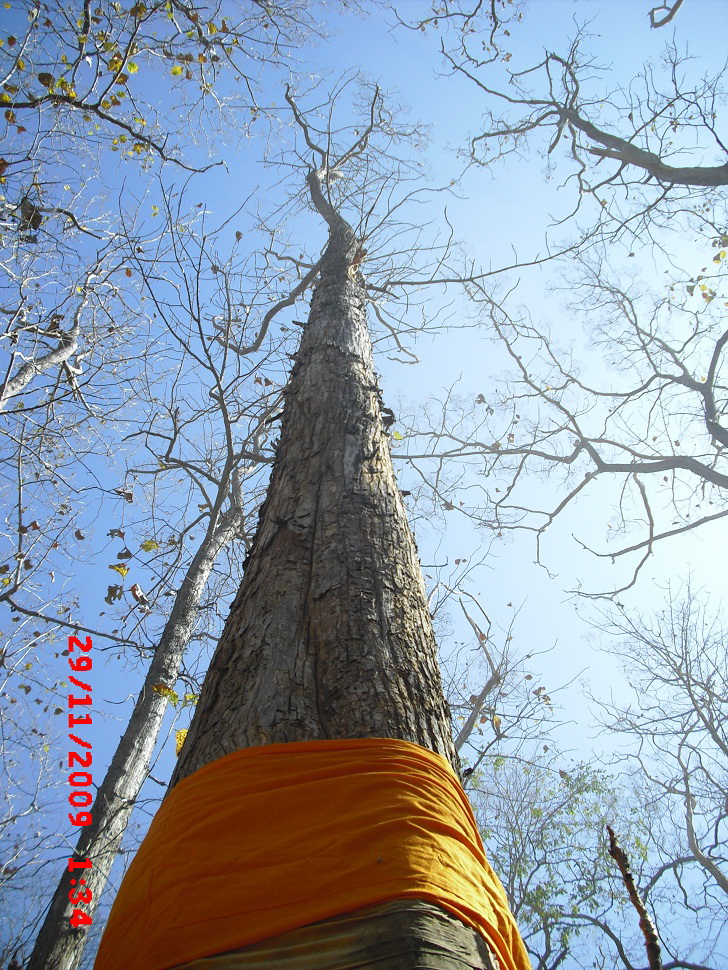
In my country, we have a movement for ordaining trees. Once trees are ordained, they cannot be cut. This movement helps to preserve trees. Max Weiner is a monk who has helped to spread a trend which is to ordain trees. He was from Harvard. When the tree is ordained,


Between 1936 and 1973, Thailand lost more than half of its forests. Similar patterns have occurred more recently in many other nations, including notably Brazil, where big agro-business has replaced rain forest with soybeans and other cash crops, and Ethiopia, where diversely forested areas were converted to coffee plantations. And historically, places like the northern United States, where I live, had forests that were almost logged to extinction in the name of profits and human-centric building ventures. All told, human relationships with trees over the past few hundred years have been quite off, to the point where many of us forget the simple fact that trees are major players in converting the air we breathe into breathable form.

One of the reasons why the environment in general, and trees in particular, have been forsaken - in my view - is the disappearance of, or lack of connection to, narratives speaking to the interconnection of people and the environment. Although scientists have done a fairly good job of detailing the many ways people have damaged and sometimes destroyed parts of the planet, what they have learned hasn't really been translated into the kinds of living, breathing stories our ancestors lived on.

The Buddha's story is one of those narratives, one that doesn't need to be updated in order to be powerful. His life was amongst the trees, touching the ground with every step. However, perhaps those of us who live in cities, are sheltered in buildings all day, spending hours on computers, sitting zazen inside, struggle to connect with the fullness of Buddha's experience of interconnectedness. Because of our many physical disconnections, our psychological and spiritual awareness is also cut off - not quite awake to the immensity of the world.

Dean's current post over at The Mindful Moment speaks of his experiences meditating in a cave. From what he writes, it's seems he felt this immensity while being there. However, what happens to that awareness a week, a month, a year after returning to the human-focused, human built "everyday" environment. I have had similar experiences to what Dean describes. I remember the awe I felt sitting on a cliff overlooking the Atlantic Ocean on the Aran Islands. And the sense of how tiny I am while going through the California desert. Wonderful experiences, but ones that tend to get drowned out by life in the city.

But this is beyond a city/country divide. I can go out less than an hour in any direction from the city I live in and find large scale farms loaded with poisoned plants and abused animals, sitting on land that was, a hundred years ago, entirely forested.

Tree ordination seems like a damn good idea in my view. Not only to protect the trees from human greed and stupidity, but also to remind people of a sacredness that is beyond ourselves, and whatever we think we need to live.

It's seems to me, as modern practitioners of the Buddha way, it's essential that we learn how to embody interconnectedness fully, and to act accordingly. And I think in order to do that, the ways we talk about the dharma, teach the dharma, must move beyond a human-centric approach. Just look at the words of the old masters. It's there. They got it. And now we have the work of scientists and environmental activists offering the fodder for new stories, and new ways of being and acting.

Some are out there doing just this. But more of us must take it up, to move beyond pessimism and despair. To make the dharma anew, one more time.

Saturday, June 19, 2010

Can Lifestyles that are Unsustainable be Moral?


Given all the talk lately about the Gulf oil spill, drilling policy, and energy use in general, my new post on Life as a Human seems timely. Here is an excerpt to get you all started:

I look around at my own life. It’s fairly minimalistic as far as lives here in the U.S. go. No TV, no car, few appliances, some home-grown food, mostly organic purchased food, mostly used clothing, lots of recycling and giving to others the things I don’t use.

And yet, I’m still light years ahead in negative environmental impact compared to most of the rest of the individuals in the world. Is even my lifestyle unsustainable? I’d argue, to some degree, yes. And in doing so, I’m not interested in creating a wild guilt complex in myself, or within anyone else reading this.

We have to go deeper than simply talking about what we use or don’t use, or how much money we are going to invest in green jobs and new technologies. In my opinion, it’s really time to question the morality of our economic systems as a whole because they have gone global, for better or worse.


What do you think about this? How do you feel your practice informs how you move through the material world?

Thursday, May 13, 2010

Engaging Your Environments Fully


More rain today here in Minnesota. It's been twenty degrees colder than normal all week, and wet, very wet. The stuff of gloomy thoughts and haunted blog posts, like the one I wrote yesterday.

I remember being about twenty and telling people "the weather doesn't impact me at all." I was the guy who rode a bicycle in -20 degree weather and who did two mile hikes on one hundred degree days without eating. Of course, there was burned skin and dehydration, but I didn't see it as a problem. I just trucked on, not considering how much the environment shaped my life.

With more life behind me, and more experience, it's obvious to me now that if you don't engage with how both the planet and the human-made environment are impacting your life, it will simply be another thing controlling you.

Do we talk about this much in Buddhist practice? I'm not sure. Some people write beautiful spiritual poetry about nature. Others examine the stress that comes from driving, living far away from your workplace, etc. Still others are involved in various environmental projects and activist work, from community gardening to Buddhist-inspired ecology work like the Ecodharma Centre.

Yet, so much of what I see is caught in a binary manifestation - either it's mostly about an "external" focus or an "internal" focus.

How do we bring the two together? This seems to be the pivot question I've lived with for most of my life.

If you don't engage with how both the planet and the human-made environment are impacting your life, it will simply be another thing controlling you. I was on the bus this morning and I saw a woman trying to cross the street in the crosswalk in front of the bus. She was clearly anxious and in a hurry, and as she passed the large, wide front bus window, I noticed a ball of tension rising within me. Looking at her struggling, I felt a resistance, a not wanting to "deal" with her appearance in my life. And it hit me - that this was the confused compassion mixed with control I often respond to the human-filled environment with.

I felt whatever she was experiencing trying to enter me, and I both wanted to heal it, and banish it at the same time. Neither of these are working with total acceptance of the present, the basis for the bodhisattva work of non-violent intervention.

Back to the weather - living in a place like Minnesota, filled with temperature and precipitation extremes, it's really easy to get hung up on the weather. In the winter, it's too cold, too snowy, to bitterly windy. In the summer, it's too hot, too humid, too stormy. In the spring, it's too wet and the temperatures fluctuate too much. In the fall, it's too dry and the temperatures also fluctuate too much.

All that talk is letting one's self be controlled by the natural environment.

What would it look like to engage fully with both the human made environments we live in and also the natural environments, the two of which always overlap in some way or another?

Some of you may have noticed the lines from Shitou's "Song of the Grass Roof Hermitage" in yesterday's post. I've been slowly reading a book of Suzuki Roshi's talks about Shitou's other great dharma poem, Sandokai, and interestingly, lines from the other poem keep appearing to me during my days. These lines in particular seem to apply to the question above as instructions:

"Turn around the light to shine within, then just return.
The vast inconceivable source can't be faced or turned away from.
Meet the ancestral teachers, be familiar with their instruction,
Bind grasses to build a hut, and don't give up."

We have move beyond seeing "ancestral teachers" as only old Zen folks. Shitou, himself, lived a lot of his life in intimacy with the planet as it was. The ancestral trees, grasses, medicine plants, waters, mountains - these were as much his teachers as any human, if not more. At the same time, familial and cultural human ancestors probably played a large role in his life, and another reason why it took only two poems to cement his place amongst the great Buddhist teachers. He didn't need a lot of words because he had taken everything in, and wasn't controlled by it, but could engage with it fully.

Things are probably more complicated for a lot of us living now, but at the same time, there are these lines from the Sandokai:

"In the light there is darkness, but don't take it as darkness;
In the dark there is light, but don't see it as light."

Even though we "moderns" have "more to deal with" in a certain way, it's really not all that different than those living their challenges in the past. Not the same, but not all that different. So we don't have the luxury to just copy what the various ancestors did, just as new generations of trees, for example, aren't able to replicate their ancestors' ways of growing and being. However, like the trees, we aren't cut off from that past, nor the environments around us today.

So, as it's raining outside, I'm offering this to you, and also considering my own life's ingredients. Let's work together for a more complete expression of practice, and more complete lives in the process.