Showing posts with label interconnectedness. Show all posts

Friday, April 4, 2014

Monsanto, Monarchs, and the Meditation of Weeds

On the whole people might be better off if they threw away the crops they so tenderly raise and ate the weeds they spend so much time exterminating. Euell Gibbons, Stalking the Wild Asparagus


Photo credit: katmystiry from morguefile.com

I have a fondness for weeds. For the forgotten, dismissed, and marginalized. Anyone who visits my garden in mid-summer probably wonders if I’ve let it go. And it’s true. I don’t tend to it very much. The wild nettle patch is left to grow right next to the somewhat cultivated beans. Purslane wiggles its way between stalks of wavy squash. Lambs quarters lap up the sun that break through the canvas of tomatoes. During the early months, I do my best to give everything enough space. But once July rolls around, I mostly stay out of the way.

Last July, I saw a pair of monarchs in a field. The first I had seen all season. Summer nearly halfway over and not a single monarch! This is one of the consequences of colonialism and economies built on profit and endless growth. The loss of biodiversity. The erasure of the small, vulnerable, and unprofitable. I hope they make it, but we might be facing a near future with no monarchs at all.

When I saw the Gibbons quote above, I immediately thought of Monsanto and monarchs. How our own government quietly legislates the means for planetary demise. All the while telling us that this about food production and feeding the hungry.

The hungry. Yes, we are hungry. But most of us don’t even know why. The loss of connection to the very land we live on. The failure to recognize that many of the plants we call “weeds” have been used for centuries as food, medicine, and so much more. Perhaps the nettle tea I drank last night is prompting this post. Or maybe it’s the fresh dandelion greens I snack on regularly while I “tend” to the garden.

In my view, we cannot speak of things such as “decolonization” without remembering the weeds, and all the ways in which our lives have been tied together throughout history. My love of dandelions, for example, is also linked to the knowledge that they were one of the plants brought by my settler ancestors. My love of all things herbal medicine is tempered by the fact that white folks and privileged others continue to colonize and denature indigenous plant wisdom and healing practices. And my love of milkweed is propelled by a desire to keep the monarchs alive.

Truly loving weeds is a practice in discomfort. Not unlike spending time in meditation, or other spiritual practices. Self and other rub together again and again. For every joyful story that arises, there’s also the sting of other stories, historical and present day, that remind us our our disconnections. Lost selves. Failures to see into the true nature of things, and act accordingly.

Monday, May 14, 2012

The Heart of the Earth, Awakened Within Us

Last week, my sister started a photo blog. Using her phone camera, she's offering a small snap shot of images from her daily life. Carrie has been a professional art photographer for a little under a decade now. She's done an amazing amount of work in a relatively short period of time, and has already won a major award, had a few photos in the New York Times, and has put together multiple book-length exhibits. I encourage you all to go take a look.

While I am more successful in the writing world, I also have a penchant for photography. One of the reasons I like Carrie's current project is that it's a similar approach to how I work. The cameras I have used have always been of average or even below average quality. I like the challenge of trying to bring an image alive through a limited means. In addition, I am often drawn to what might be considered the un-picture-worthy. Things like broken down buildings. Overgrowth and junk in alleys. Tree stumps.

Today, though, I want to offer you all some photos from the annual May Day festival we had yesterday in Minneapolis. For the past 5 months, I have been part of the core organizing/visioning team for an eco-centric offshoot of Occupy Minneapolis called the Whealthy Human Village. It's a multifaceted project that focuses on eco-centric life practices, food justice, indigenous rights, and healing arts. Underlying all of work, really, is the thread of interconnectedness. And everything we are doing and envisioning is about helping people uncover or recover their connection to each other and the planet.

I led a meditation to begin the day yesterday where we visualized our favorite plants, merged ourselves with them, and then experienced each stage of the life cycle, from seed to death. Afterwards, I did a short check in with the group about their experiences. One participant spoke of how she was surprised at how her emotions changed as the meditation unfolded. How she felt proud and powerful as her plant unfolded into it's mature expression, and also gratitude for having been able to make it so far in life. Another member of the group spoke of the sadness she felt when half of her beloved tree split off and died. A third member of the group spoke of his challenge to keep to one plant. That other "favorite" plants kept coming in, vying for attention.

The whole day was like this. One beautiful experience after another. And so, here are some photos to offer you a snapshot into what we all experienced. May joy permeate your life, even when deep suffering is present.

Sunday, March 25, 2012

Microfinancing a Community Change Maker Revolution

These are challenging times economically. With official unemployment rates hovering around 8% in both the U.S. and Canada, and millions more either unaccounted for, or severely underemployed, struggling to make ends meet is becoming more the norm. More and more, the promise of getting a college education and then moving up the corporate ladder is disappearing. Not only is it so much less possible in this age of de-unionization and regular corporate layoffs, but for many people, myself including, it's simply not the story of a fulfilling life.

My entire adult life has been dedicated to being a community leader through grassroots service and organizational development. When given the choice between making more money and potentially making the world a better place, I always have chosen the latter. I live my life by the motto "Serve locally; transform the world!," believing that it is both easier to have a deep impact in one's own community, but also that those benefits have ripple effects across the planet. And given how consumerism and privatization have eroded the majority of our communities, there is really no shortage of opportunities to serve locally.

While it may seem like things are dire, the current economic crisis is also an amazing opportunity to reassess how it is that we work and live together. To challenge the stories we have about what is valuable and what isn't. And to learn to come together in renewed, more interconnected ways.

Having spent most of my adult working life employed in various non-profits, I have come to recognize the benefits, as well as the limitations of such work. In some cases, they are the same. Getting a steady paycheck, for example, is often both a blessing and a curse. It's a curse because it can hinder a person's ability to take proper risks and do the right thing for others. What often comes first, at least to some extent, is personal job retention and/or maintaining the reputation of the organization one works for.

And so, a few days ago, I started a month long fundraising campaign. It is based upon the idea of being an independent community re-development worker. Instead of being tied to a single social service agency or non-profit organization, I have been freely investing time in three different communities that I am passionate about. It is an experiment in giving that I hope will inspire others.

I am seeking your help to continue to do this work. If any of what I have written here has inspired you, or caused you to pause and reconsider some aspect of your life, please consider donating to my campaign and/or spreading the information about it to others. The beauty of microfinancing is that no one person or organization needs to foot the bulk of the bill. Just as we are all naturally interconnected through space and time, through mircofinancing, the work we are all doing becomes a more visible demonstration of that interconnectedness.

The times are calling for us to re-place volunteering and community service back in the center. To cease seeing helping others and giving back as something some people do to fill in their time after work, or on the weekends. Please join me, and spread the word, as we together create a new revolution.

Tuesday, March 6, 2012

The Seat of Separation: Chairs and the XL Pipeline

What does chronic backpain have to do with the Keystone Xl pipeline? Probably nothing directly, but in a round about way they might be connected.

Recent statistics show the number of adults with chronic low back pain is on the rise. Doctors recommend three courses of action: (1) Lifestyle change, (2) Medication or (3) Surgery. When diagnostic testing reveals no definitive cause, treatment is based largely on the patient accurately describing the intensity of pain on a scale from 1 to 10.


This is from the current post by yoga teacher J. Brown. I enjoyed the fact that he doesn't offer a list of yoga poses to address chronic back pain - enough of that around already. And as I read, I started thinking about that phrase "no definitive cause." And chairs came up.

Chairs originally were a designation of privilege. Reserved solely for royalty, religious and government leaders. It's only been in the past 5-7 hundred years that chairs have become more commonplace around the world, something that might give us pause.

Consider how much sitting you do in various kinds of chairs everyday. In cars. On buses and trains. In offices. In homes. How often do you sit on the floor? Use your whole body in a whole manner?

In my opinion, the way many of us rely so heavily on chairs is a contributing factor to things like chronic back pain.

However, I want to go further. Think about what chairs do. Among other things, they separate humans from the ground. The earth. Just as those original chairs set the elites apart from everyone else, and created a false sense of superiority, chairs today separate the masses (including the elites) from the planet we live on.

Obviously, chairs are not evil. They are simply an excellent symbol of our current state of affairs.

It's not terribly surprising, for example, that we oil pipeline companies making deals with state governments to trounce the rights of indigenous people. Or that their truck drivers are able to, with a straight face, say things like we have “corporate rights that supersede any other law" as they transport tools and materials that will be used to exploit the earth for profit.

Odds are that the decisions that led to the XL pipeline were almost all made while sitting in chairs inside sterile offices. That's just one of the many manifestations of disconnect and separation present in this situation.

Let's go further. Many people want to change all of this. We are waking up to the fact that the planet has suffered greatly as a result of human greed, hatred, and ignorance. However, too often, we are prone to sitting in chairs and in our heads, trying to come up with ways to challenge the status quo. Our meetings are mostly static events, driven by talking, and controlled by tables, chairs, and squared spaces.

Stopping something like the XL pipeline, and envisioning a new way of living, can't really come from this. Not only this anyway. There must be movement. Must be reconnection. Much be creativity when it comes to how we gather, what we do together, and where we choose to meet.

Today, I feel grief and outrage that this pipeline project is going through. That multinational corporations and the leaders of multiple nations, including the U.S., are so myopic that profits trump everything, including the promises of their ancestors.

It's time to move beyond the seats we are comfortable in. Our pain and suffering does have definitive causes, if only we are willing to look much deeper, and begin responding from that place.

Friday, January 27, 2012

Buddhist Solidarity


Two of my favorite Buddhist bloggers, Maia and Katie, are present in this interview of Katie done on the blog Jizo Chronicles. I want to reflect briefly on the following section of Katie's comments:

On a larger scale, exploring interdependence has really shaped the way I understand solidarity. I don’t have to “know” someone in order to comprehend that we are connected — spiritually, and through local and global systems. The workers at the Foxconn factories in China, who face penalties of twelve years in prison for attempting to unionize, probably helped produce this laptop I’m typing on. And they must continue to work under unbearable conditions; otherwise, they and their families won’t eat. But their situation won’t improve, necessarily, if I give up my laptop, or stop buying Apple products. Instead (in my opinion) I am called to practice compassion and solidarity by supporting the actual struggles of the workers, and similar struggles of workers and peasants not only abroad but in the U.S. as well.


With the markedly increased speed and potential impact of communications these days, we actually have a greater chance of making a difference in the lives of people living half way across the globe. The digital support through blog posts, tweets, articles, petitions, etc. that people around the globe sent to folks protesting in Arab countries over the past year has been heard and deeply felt. The reciprocal standing in solidarity from those same protestors was felt by yours truly and many of his fellow Occupiers during the past several months as well. It may seem like a tiny thing - a blog post, a sharing on Facebook or Twitter - but it all adds up. And these days, often quickly.

There was a photo a few months back of an Egyptian protestor in Tahir Square holding up a sign supporting those who had been beaten in Katie's current hometown of Oakland during the occupy protests. It brought me to tears.

We aren't alone. No one is alone. And there are more and more creative ways people are finding to stand in solidarity with people around the world. From expanding the messaging being used against destructive legislation at home to include it's global impact, to strategically spreading ideas for social change, we are moving beyond simply clicking on a petition and forgetting about it.

Furthermore, the best elements of the nearly worldwide now protest movements are starting to combine activism with a deep commitment to personal relationships. Recognizing that how we are with each other, how we care for each other, is probably just as important, if not more so, than any political "victory."

I hope to write more about this, and similar topics, in the coming months. In the meantime, feel free to share your thoughts.

Monday, September 26, 2011

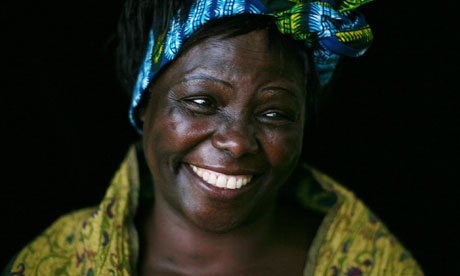
On the Death of Wangari Maathai


Wangari Maathai, the first African woman to win the Nobel peace prize, died on Sunday night of cancer. She was 71.

A towering figure in Kenya, Maathai was renowned as a fearless social activist and an environmental crusader. Her Green Belt Movement, which she founded in 1977, planted tens of millions of trees.

Maathai's death was confirmed in a statement on the movement's website.

"It is with great sadness that the family of Professor Wangari Maathai announces her passing away on 25 September 2011, at the Nairobi hospital, after a prolonged and bravely borne struggle with cancer. Her loved ones were with her at the time."


I first read about this amazing woman's work maybe 10-12 years ago. She was not only a heroic figure in her native Kenya, but an inspiration to millions around the world. She was one of those unique people who was able to truly blend human rights efforts with environmental justice, to see the interconnectedness of it all.

Furthermore, she minced no words when it came to critiquing globalized capitalism, the great disparities between the "global north" and "global south," and also the ways in which those disparities lead to increased damage of the planet.

“We are very fond of blaming the poor for destroying the environment. But often it is the powerful, including governments, that are responsible.”

"The people at the top of the pyramid do not understand the limits to growth and they do not appreciate that they jeopardise the capacity of future generations to meet their own needs."

Personally, though, I found most attractive her ability to blend the social/political with the spiritual in a way that wasn't oppressive and demanding. Simple statements, like the following one, appear frequently in interviews with her, and her writings. And although the language is different from what I might use, I feel a resonance with what she says.

“All of us have a God in us, and that God is the spirit that unites all life, everything that is on this planet.”

Blessings to Wangari for being who she was. May she continue to inspire for generations to come.

Friday, November 5, 2010

The Money was Nothing


Here's a news story that is really hard not to like, especially amongst all the rottenness and conflict we usually are served by the media.

A retired Canadian couple who won $11.3 million in the lottery in July have already given it (almost) all away.

"What you've never had, you never miss," 78-year-old Violet Large explained to a local reporter.

She was undergoing chemotherapy treatment for cancer when the couple realized they'd won the jackpot in July.

"That money that we won was nothing," her tearful husband, Allen, told Patricia Brooks Arenburg of the Nova Scotia Chronicle Herald. "We have each other."

The money was a "headache," they told the paper--mainly, it brought anxiety over the prospect that "crooked people" might take advantage of them. Several people called them out of the blue to ask for money when the news first broke that they'd won the jackpot. So they began an $11 million donation spree to get rid of it and help others, the Chronicle Herald reports:

They took care of family first and then began delivering donations to the two pages' worth of groups they had decided on, including the local fire department, churches, cemeteries, the Red Cross, the Salvation Army, hospitals in Truro and Halifax, where Violet underwent her cancer treatment, and organizations that fight cancer, Alzheimer's and diabetes. The list goes on and on.

Violet told the Canadian Press that they retained about 2 percent of the money for a rainy day.

"It made us feel good," Violet told the Chronicle Herald. "And there's so much good being done with that money."


There are so many interesting threads to consider in this story. First off, this couple given everyone the simple, but profound message that love and companionship are much more important than material wealth. I also have to say it's kind of wonderful that they chose to distribute the money all over, pointing to a sense of how their lives are interconnected with the community they live in, and the institutions that have benefited them in the past.

On a more macro-level, it's hard not to contrast the care Violet has received for cancer, with the ways in which such care is either out of reach, or financially devastating for many here in the United States. While our government will probably spend the next two years bickering over the details of the decidedly tepid, pro-private health care industry bill that was passed last year, everyday Canadians continue to have a hell of a lot more options, even if there are some problems with their system.

And finally, back to the couple, there's this statement "We're not travelers anyway. We live in the country and we're proud of it. Money can't buy you health or happiness." I think it's just fine to travel when you're older, and I hope to be able to do so myself. But it's also refreshing to hear someone say they are happy right where they are. Even if they decide to go on vacation with the little bit of money they saved, it's clear they are at peace with the place they live in. Such a different attitude from all the "snowbirds" who run south the moment there's a chill in the autumn air every year.