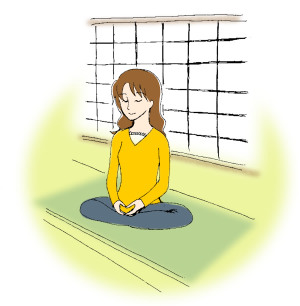
There was a time when I did 1 1/2 to 2 hours of sitting meditation everyday. When I was a fairly regular retreat practitioner, and when I would look around at the people who only attended Sunday services at our zen center and thought to myself "these folks aren't very dedicated." Those thoughts were certainly smug, and that level of devotion wasn't, at least for me at that time of my life, sustainable. I can point to many reasons why "my practice" changed over time, but what I'm more interested in these days is the sometimes huge tension between predominantly lay people trying to practice in Zen communities (or even on their own) from teachings that are predominantly monastic in flavor.
You may notice that my dharma name, Tokugo, is translated as "Devoted to enlightenment." It's a pandora's box once you start paying attention to it. I have a regular zazen practice, chanting practice, study practice. I'm pretty deeply involved in my sangha, as you have seen from previous blogs. And yet unlike in the past - I do almost no retreat practice. It has almost no draw for me right now. At the same time, I have spent the last month unemployed, not rushing, watching myself be a person in the world with no job, no partner, a shifting group of friends - in other words, being a person who is doing his best to stand in the middle of the flow of life as it is.
What does "devotion to enlightenment" mean for a lay practitioner? What are some necessary ingredients and what is simply form that might be helpful and might not, depending upon the circumstances?
When I plunged head first into what I believed was THE correct way of practice several years ago, what I saw was an interesting mix of wise renunciation and madness. Even though I seem to have a lot of tension these days around what "devoted" looks like, one thing I'm confident in is that it involves renunciation. If you want to see into the nature of this life, you have to give up a lot of the "entertainments" in your life. This is not only about ending the video game addiction you have or forging the weekly music concert binge - it's also about renouncing the stories you have about your life and the world, and giving up ownership of the various certainties you have collected over the years.
At the same time, I remember once having to decide if I were going to use the only paid vacation time I had to attend a meditation retreat. And feeling like if I chose to do something else, I was a "lesser" practitioner for it, but also sensing that if I didn't take some time to rest, I was going to burn out sooner rather than later. Although I don't attach as much to this notion of being a better or worse practitioner these days,I still find these quandaries coming up because the line between being lazy and self-care isn't always too clear to me. And when I read the great monks of old, or even many teachers of new, steeped in the tradition of those monks, I find myself thinking Yeah, that makes a hell of a lot of sense when you're in a monastery. What about the rest of us?
To be quite frank, when I hear some Zen teachers say things like "Well, this is why our tradition has always been small, and not for the faint of heart," I'm not terribly impressed. It sounds true, and points to the intelligent rigorousness that I have always been inspired by in Zen. But it's also a cop out, a way to skirt around the real life tensions between what's been handed down to us, and how our lives are in the world today, 2010, as lay practitioners.
Simply put, I don't buy it that the only way to practice Zen in a completely devoted way is to increasingly immerse yourselves in meditation practice, retreat practice, even monastic practice. And when I hear people saying things like "Oh, I'm not much of a Zen student. I don't do such and such. Just look at so and so..." I think - what good is that? How does all this comparing helping you, me, or anyone?
There are plenty of warnings about the trap of "comparing mind," and yet I also think the lack of honest reflection around the tensions between studying and implementing Dogen's teachings and being a lay practitioner set up a lot of ready made comparisons. Those who immerse themselves in zazen - good. Those who take up the various monastic roles in the sangha - good. Those who don't - slackers. I'm saying this as someone who has done some of those roles, been immersed in zazen, and also who has had times where I was definitely slacking and letting myself off the hook too easily.
Now, the black and white dichotomy above isn't what actually happens most of the time. It's more of a subtle undercurrent within Zen communities. Like what's upheld as "good practice" or who is considered a community "leader" and why.
I know I'm not alone in feeling these tensions, and having the kinds of questions that I do. But what I find frustrating is how often conversations about the various issues around the lay/monastic tension either slide into privileging monasticism (and it's forms), or platitudes about how "it's all good." The former is just a fast path to an inferiority complex, and the latter is a niceness that just makes everyone feel good, but doesn't really aid us in living our lives more in a more awakened way.
When I see discussions, for example, about how all Zen teachers should have X number of months of retreat practice under their belts before they are considered legitimate, I think "Is that the only way to wisdom?" It's hard not to view such requirements as akin to standardized tests - these tools we have determined to be the magic bullets that someone prove our children or college students are smart, capable, and ready to succeed in life. The thing is, wisdom isn't uniform. Awakening doesn't follow a single track, nor does it manifest the same for even two people, let alone everyone.
There are times when I think "maybe Zen just isn't your thing," whatever that means. I have seen others facing some of this stuff who have decided to move on, and find something else. But that just feels like going shopping to me. And to be honest, I find this tension pretty fascinating, even if it grates at me at times. And I love those old Zen dudes, and their monastic or wandering Zen ways.
So, in some ways I'm like the famous Catholic monastic Thomas Merton, who spent much of his life questioning and bucking the very tradition he also loved. How odd, but there it is.
