Showing posts with label threat narratives. Show all posts

Tuesday, January 11, 2011

"Violent White Men are Crazy!" - Considering Ways Violence is Spun


It's been interesting to watch the appearance, rising, falling, and disappearance of thoughts and feelings within myself in connection with the shooting in Arizona. Being someone who naturally starts looking beyond a given event, seeking to see it embedded within it's larger context, my mind has been all over the place over the past few days.

I'm finding that the myriad of culpability denials, political spinnings, angry tirades, and accusations that have been occurring are hard to swallow. Accepting the collective reality we are creating, not just around this issue, but so many others, feels like fatalism. It's astounding to me, for example, that Buddhists who, in one breath, speak of the importance of the precepts and then, in another breath, say that the angry, violent political rhetoric that has engulfed U.S. politics had no impact on the man who shot up a political meet and greet. But then I remember that I fail to see the depth of the teachings in my own life plenty, so why should it surprise me so much.

People wanna pin the crazy label on Mr. Loughner, but I'd say it's the mass dissociation from responsibility for public speech that's pretty damned insane. Freedom of speech never, ever meant freedom from responsibility, but try telling that to members of a nation swamped in a consumerist mentality that equates liberation with being able to do say anything you want without consequence. Where everything from education to romantic relationships to spiritual practices have become subjects of a multiple choice brand of thinking that places more value in ones ability to dispose of people and practices deemed not "the biggest and the best," than it does on commitment and faith in life's process.

When the Fort Hood shooting occurred, it was hard to locate voices calling for patience from any part of the political spectrum calling for suspension of judgments around motives. President Obama tried, to his credit, but was mostly lambasted for it. No, what happened in that case was the swift and mostly united determination that Major Hassan was both crazy and a terrorist. Everything he read, the lectures he gave, and all of his e-mail correspondences were combed for connections with militant Muslim groups from the beginning, with the news media reporting anything and everything that showed a potential link. In fact, when new sources of information dried up, media outlets and pundits resorted to repeating old story lines to keep the general public primed with a view that this guy was probably a terrorist.

I write this not to defend Major Hassan's actions. He is still responsible for those murders. And clearly the violent rhetoric he read and the correspondences he had with a prominent anti-American, radical Muslim cleric had an impact on his thought and decision making processes.

So, why is it that when white men in America commit heinous crimes it's all about them being isolated, crazy individuals? Could it be institutional racism? I say "Damn right it's institutional racism!"

Anyone remember Joe Stack? If not, he's the guy who crashed his plane into a IRS building in Texas. Some deemed him crazy. Others, like his daughter and members of anti-tax groups, continue to consider him a hero and a patriot. And like the current case in Arizona, Stack's writings on various subjects were quickly deemed the ramblings of an incoherent, angry man, and not tied to any larger context.

Let's broadening out a little more. Around the world, members of racial, ethnic, and religious minorities who commit violent acts are often treated completely differently from members of the majority group who commit similar acts. Consider the way violence by Palestinians is treated in Israel, a tiny nation with quite a power military backed by billions of dollars and logistical support from the U.S. Or consider the way members of the ethnic Karen National Liberation Army are treated by the Myanmar government and Burmese elites. Christian missionaries in Pakistan, Iran, and a few other middle east nations have been murdered or put in jail, often not for committing physically violent acts, but for speaking against Islam, or attempting to convert people. These are just a few of the myriad of examples. They all look different due to the social and cultural contexts of their given places. However, what's similar is how the actions of either single members of, or a small group of, a religious or racial/ethnic minority is considered indicative of the entire group.

Thus, a single Muslim's man's act on a military base was considered by many Americans to be a sign that all Muslims are out to "destroy America." A ragtag group of Palestinians set off some bombs, and it's a sign that all Palestinians are out to "destroy Israel." A few small groups of Christian missionaries try to convert people in Iran, and Christians are suddenly considered so much of a threat that the government begins arresting them.

Yet, if you flip over the equation in all three situations, it's treated completely differently. The violence of white men in the U.S. is almost always treated as a form of individual, pathological deficiency. The violence of Jewish Israelis is almost always couched in a rhetoric of defense, often heroic defense. The violence of Muslims in Middle Eastern nations, especially when that violence is aimed at religious and ethnic minorities, is often either spun off as fringe lunacy or is elevated to heroicism as well.

And this trend is not just linked to oppression of religious minorities. Last night, I watched a film about a small group of young radical German socialists who committed acts of terrorism in the 1970s, and who were then protected by operatives from the East German government throughout the 1980's. Based on research done by the director,the film attempted to show how those who committed violence that supported the aims of the East German socialist government were sometimes considered "sympathetic characters" by the authorities, and worthy of state aid. It was quite telling however that as soon as the Berlin wall fell, and the government began to collapse, the same government officials publicly outed the radicals as terrorists, and destroyed any evidence of past connections with them. This is a great example of the ways in which violence done by members of the majority group in a nation can be spun in different ways, depending upon whether it benefits those in power or not.

Had Jared Lee Loughner flipped out as an American in Iraq, Afghanistan, or Pakistan, you can bet the narratives being spun about his actions would be different. Had Joe Stack chosen to crash his plane into the White House or the Pentagon, you can bet the narratives around him would also be different. But in neither case would you find serious questioning of the man's religious or racial background, regardless of the circumstances.

I've long felt that one of the weaknesses of Buddhism in "the West" (I really want to figure out a better term for this, but that's for another day.) - is that too many practitioners have a "privatized" approach to the teachings. What do I mean by that? Well, take a teaching like Right Speech. The average convert practitioner understands that attempting to speak from a kind, compassionate place with those within their immediate lives is an important part of practice. However, I can't tell you how often I have heard and seen discussions around large scale social and political issues where Right Speech gets thrown under the bus because people want to either avoid entrance in politics (an impossible task folks!) or because the words in question came from members of the political group a person most affiliates with. I doubt many liberal Buddhists had much to say about right speech in 2006, when former Presidential candidate John Kerry joked about killing "the real bird with one stone" in reference to then President Bush.

Overall, I'd say the use of violent rhetoric is more prominent amongst Republicans and other conservatives right now, but it's certainly not exclusive to them. And while it's quite impossible, and pointless, to try and point out every act of dangerous political speech that occurs, I think it's vitally important that more people both speak out against the trends of violent social/political rhetoric, recognizing that it DOES negatively impact all of us. And perhaps more importantly, more of us need to make efforts to embody a more compassionate and principled way of talking and doing politics and social issues.

This includes beginning to reject electoral candidates that use personal attacks, hate speech, and violent metaphors as central features of campaigns. It also includes learning about nonviolent social movements of the past and present to come to a better understanding about how people have worked with major social issues across political, racial, religious, and other lines. And finally, it includes working with social change groups to promote more non-violent approaches to framing the issues being worked with. For example, I remember walking away from Anti-War protests and a few groups working on those issues because so much of it was about hating Bush, Rumsfeld, and the rest. If I became involved with another group working on "Peace Issues," I'd make efforts to both embody non-violence myself, and also help shift the tide away from wanting to destroy or demonize another group of people.

Saturday, July 31, 2010

Privileging Suffering - Anti-Mosque Sentiment in New York


Hatred and ignorance, two of the three poisons, are flying all around the United States these days. In fact, I'd say the third poison is also present in the form of a "greed for ease and comfort" attached to the other two. If you have heard about what's been going on in Arizona when it comes to immigration laws, you've probably been off the grid lately. In addition, there has been an uproar over a proposal to build a mosque near the site of the former World Trade Center. The usually right wing suspects - Sarah Palin, Newt Gingrich, Fox News commentators - have been stoking the barely latent, commonplace bigotry towards Muslims for weeks now. However, the most ridiculous statement I have heard yet came yesterday from the leader of the Anti-Defamation League.

“It’s the wrong place,” Mr. Foxman said. “Find another place.”

Asked why the opposition of the families was so pivotal in the decision, Mr. Foxman, a Holocaust survivor, said they were entitled to their emotions.

“Survivors of the Holocaust are entitled to feelings that are irrational,” he said. Referring to the loved ones of Sept. 11 victims, he said, “Their anguish entitles them to positions that others would categorize as irrational or bigoted.”


Wow! This is rich. I am going to say something that might upset some people. The Jewish holocaust is not the only act of genocide that has occurred in this world, and anyone who has been to a major city in the United States knows that there are a plethora of peoples who have lost family and friends in genocides all over the world. There are a certain segment of the American Jewish population that privileges their suffering over everyone elses', and this statement is a perfect example of that.

The sad thing is just as the percentage of violent, hateful Muslims is pretty small, so too is the percentage of Jews who think nothing of oppressing other people so that they can live comfortable. And yet, both of these groups have gained a lot of power, precisely because they cater to the unexamined fears and prejudices within each of us.

Obviously, the backlash against the mosque in question is more than just a small group of Jewish folks. It includes Christians, atheists, agnostics, and probably a fair number of Buddhists as well. Ah, maybe you're thinking "No, not Buddhists - aren't they supposed to be 'liberal'?" Yeah, well, I've met a lot of self proclaimed liberals who have no problem hating brown and black skinned Others.

What I find so interesting about Mr. Foxman's comments is that he moves from the messy feelings that people have, to using the feelings of a particular group as the justification for determining the building policies of an entire city.

Even the conservative Mayor of New York, Michael Bloomberg, who is Jewish himself, rejects this leaping from the feelings of one group to city policy.

“What is great about America, and particularly New York, is we welcome everybody, and if we are so afraid of something like this, what does that say about us?” Mr. Bloomberg asked recently.


One of the ironies about hate campaigns like this is that most of the very same people harbor fears of a dictatorship of the likes of Iran, or Saudi Arabia - where only one group of people have any real freedom or power, and everyone else is second class at best.

I expect knee jerk reactions to a post like this. Things like "You have to protect people from terrorists" or "Get back to your fucking practice!" Things like that. I've heard plenty of it. It's old hat.

Practice life includes the sufferings in your community, nation, and world - end of story. This particular story impacts me because some of my students are Muslim; I've witnessed hatred expressed towards them. If I fail to examine, speak out, and aid in uprooting these kinds of hatreds, fears, and ignorance, then what's the point of my practice?

I have to say that I, too, have been Mr. Foxman on a small scale. Feeling entitled to my misery-driven views, I, too, have tried to twist collective actions in favor of that which would be most comfortable for me. This is where the practice must begin - by examining how something on a macro-level also plays out in your own life. However, too many of us Buddhists stop there, thinking that this is enough.

I, for one, want to move beyond this privatized view of practice. I want to be committed to life as it while I'm on the meditation cushion, doing walking meditation, chanting or bowing. And I also want to be fully engaged in the work of liberation, in the myriad of forms that it might take.

Friday, July 9, 2010

Responsibilty, Leadership, and their Narratives


Feeling a bit in a funk the past few days. At work, we now have a new director. I met him this morning. He probably will be successful, and elevate the organization. He seems to be a person who knows what is necessary to get things done. And at the same time ... I think it's still time for me to go. But to what and how?

Barry over at Ox Herding recently had some posts about making a one percent shift in your life, our communities, even in our nations' current trajectories. He points out that such a shift will lead to others, and that it's often the first action step that is the hardest (in our minds.)

This is me, stuck on that first shift, not only in my job, but really in much of my life. I have plenty of ideas. Yoga teacher training. Studying herbal medicine. Going back for a PhD in Education. Getting a driver's license for the first time in my life. Starting another non-profit. Lots of ideas, but that's where it all is at right now.

I have a great fear to be honest that I will end up being over-committed and responsible for even more than I already am. This has been my life's storyline. Being the "responsible one," the one that is fairly self-sufficient, doesn't need a lot of help, volunteers in multiple capacities, and generally lands in positions of responsibility. It's a story, certainly. But also one with enough truth to it that it's hard to simply let go.

Before I was 10 years old, I had already become part parent to my sister, was responsible for a lot of the house cleaning, and had collected an internal narrative that I also was "responsible for maintaining the peace" between my then often fighting parents. Into my early teens, I began volunteering at my local rec center, and also "acquired" my mother's overbearing boyfriend's list of non-negotiable helping demands. I've rarely felt deep hatred towards another - I very much hated this man even long after he had exited my life.

Moving on, into college, I began acquiring extracurricular positions, eventually landing on the University's Student Senate, where I chaired multiple committees in addition to averaging 16 credits a semester. The end of college was, for this reason, both a time of loss and a relief. However, it wasn't six month and I found a new way to get involved, this time as a volunteer ESL teacher. That was 12 years ago. In the meantime, I have finished grad school, helped start a non-profit adult education organization and a literary journal, been an ESL teacher in three different organizations, and have risen to board chair of my Zen center.

And I have made so little money over the years that it's taken every last bit of frugalness, and probably a pound of stinginess to boot, in order to make it this far. No car. No health insurance. Living at home until three years ago. Lots in unusual decisions in the eyes of the average American. Honestly, I think I've done alright though, and there is little or nothing I'd change in my past even if I could.

Maybe this gives you all an idea about why taking the next step, making that one percent change, isn't so easy. Because I can feel the trajectory of my life being ready to reflected differently in some way, and yet can also feel all the fears and doubts attached to what might come.

Really, I'm afraid to fail - kind of silly when I view it from a teachings perspective - but there it is.

I've been told before by people who don't know me well, and could care less, to shut the hell up, suck it up, and move on.

Uh huh. That's a nice blunt offering. Sometimes very true too. Then again, the same person could just give me the bird and call it a day.

From a practice perspective, I think I've always had a major rub between the silent, contemplative, meditative aspects and action in the world. Anyone reading this blog for more than a few weeks would know that one though, so it's barely news. I find myself sitting in zazen, or walking around my neighborhood, listening. Maybe expecting answers to come and/or a direction to take as well, which I can see is probably a hindrance. Thing is, in the past, that direction, and the actions required have come to me - as you can see by how much I've done in my life.

So, I'm feeling impatient. Thinking maybe I just have to leap in some direction, and letting what comes come. Wondering if the whole leaping off the hundred foot pole teaching is foolish if done in haste. And what is "in haste" anyway?

I like to be a confident person. I like to have some sense of what I'm doing, and to be able to support others in finding that sense for themselves. It's part of the reason why I love teaching. But being in a lead role too often makes it that much harder to feel confusion, directionlessness, and incompetence because not only do you expect the opposite of yourself, but others come to expect you'll have your shit together as well.

Over the past week, I have felt less resistance to these decidedly "non-leaderly" qualities I am experiencing. In fact, I can even say I am curiously attending to them a little more. But it's still a challenge, one I can handle, but which seems to leading me slowly away from familiar territory.

Friday, June 18, 2010

Tornado Dharma


Extreme weather is always a good reminder of our rightful place in the world as one of many kinds of living beings, and not in charge domination experts we humans like to think we are. Yesterday afternoon and evening, a series of powerful storms ripped through my home state of Minnesota, killing three, injuring dozens, and destroying parts of several towns.

As I sat inside my basement apartment, listening to reports coming in, I couldn't remember a time in the past when there had been so many actual tornado touchdowns in a single day. It was heading right towards us in St. Paul/Minneapolis, and even though a lot of storms seem to weaken as they enter the cities, this one wasn't getting any weaker, so I found myself popping in and out of the apartment building, watching the sky. Around 8:30, I noticed a fierce yellow/orange tinge to the dark clouds that we're rushing overhead. Soon, the color had shifted to red, an odd bright, but also dark red with gray-black clouds intermingled. A few drops of rain began to fall, and I went back in to check the reports.

Nothing. Regular programming had returned to the radio. Another twenty minutes went by without anything else happening. I looked out again, wondering at the beauty of the sky, but also surprised that the rain had stopped and only a fairly strong wind remained. Another twenty minutes went by, and the colors faded into darkness as the sun went down for the day. Not another drop of rain fell in St. Paul, nor did the winds pick up beyond a strong, but not really dangerous gust. The thrust of the storms had missed us.

Recently, I wrote a post about threat narratives, and for those of us living in the Twin Cities, these storms are an interesting parallel to the way those stories play out in our lives. You take something dangerous that might possibly happen, blow up into something that absolutely will happen if you don't do or say certain things, and then even if it doesn't happen, what you experience is still ramped up. Indeed, even though the "storm" misses you, the threat narrative continues to live on because it could have been bad, really bad - you just barely escaped, right?

However, unlike a line of severe storms producing tornadoes, which can and often does cause real damage, many of the threat narratives people have are completely devoid of connections to reality. And yet, think of all the internal tornadoes you've had in your lives because you thought something was going to happen which ended up not happening, and probably had little or no chance of happening in the first place. My city could have been hit by a tornado last night like the others that did get hit in Minnesota; there was little chance that the arguments I was having with one of the directors at work was leading to me getting fired, even though I feared this for several weeks. Not that it couldn't have happened, but it was a long shot really because even if she wanted me gone, she had to convince the other two directors, as well as establish a new precedent - no one's ever been fired from our workplace, at least in the six years I've been there.

After an oppressively warm day yesterday, and those storms, the weather today is calmer, less humid, and almost windless. Pretty interesting how this all happens, isn't it?

Tuesday, June 15, 2010

Threat Narratives, Personal and Collective


Fear and ignorance have a way of creating massive story lines about reality. Anyone who has watched the news lately, or read a mainstream newspaper, has seen articles about drug related violence in Mexican border towns that is supposedly sliding into the United States. Indeed, if you listen to nearly every politician these days, you would think the United States is close to being under attack by roving Latin American drug gangs. The Obama Administration which, when it took office was claiming a new, more humane approach to immigration in general, and the U.S./Mexican border "issue" in particular, has rolled out more of the same in dramatic increases in militarization and undocumented immigration detention monies. Others, like Republican Senator John McCain or his counterpart in the Arizona Governor's office, Jan Brewer, are drumming up hysteria with draconian legislative efforts and talk of a nation under siege.

I found this interesting article this morning, which looks at the actual murder rates in U.S. border towns, and considers them in relation to national perceptions about the border. The following lines I found particularly compelling:

The same week Obama announced his troop increase, Texas Sen. John Cornyn—who wants to redirect $2.2 billion from the stimulus for border security—wrote in an op-ed: “Our porous border endangers every American, yet Washington refuses to make border security a priority.” When reporters pressed Cornyn in a phone conference about the violence he so feared, the senator got stuck. “As far as the Texas border is concerned, to my knowledge, we have not had spillover violence, per se,” he told reporters. It was actually “the threat of potential spill over violence,” he later clarified.

More accurately, it’s the perception of that violence. Because the realities simply do not support the rhetoric about public safety in border states.


Perceptions. Ah, anyone who has spent some time in a Buddhist community or even in a psychology classroom should some familiarity with how faulty are perceptions can be.

Now, I'm not going to say that things along the border are peaceful; that would be another lie. There is some trouble and it's coming from many directions. Latin Drug gang members. Rogue U.S. Border Security members. White Supremacists who think they are border guards. Starvation and dehydration amongst undocumented people attempting to cross into the U.S. There are many locales of violence one can point to, but it's not flowing in the single direction the mainstream media and our political leaders are claiming. And yet, poll after poll, including one by CNN after the passage of the controversial Arizona immigration law, suggest that many Americans believe our nation is in some kind of grave danger:

The poll, which questioned American adults rather than registered or likely voters, revealed the following changes:

* Those who want the number of illegal immigrants decreased went up three points in seven months to 76%
* Those who want all illegal immigrants expelled increased four points to 41%
* The split on whether immigration reform should focus on normalization or enforcement increased from 41/56 in December 2005 to 38/60 today
* Support for border fence went from a steady 45% over the last 4 years to 54%
* Support for stiff employer fines rose from 58% in 2006 to 71%
* Increasing federal agents at the border now supported by 88%, up from 74%


The reporting source of this information itself, Numbers USA, is one of the many anti-immigrant think tanks spreading lies and distorted information into the U.S. media, government, and corporate worlds. In fact, if you take any time to examine such things as polling questions about immigration, you'll quickly discover that they are frequently leading questions littered with loaded words. In other words, it's really easy to lose track of the realities when it comes to issues like immigration and violence.

Here are a few statistics to contrast with the attitudes expressed above:

The murder rate in San Diego, Calif., dropped by 25 percent last year. Phoenix’s decreased by 27 percent. El Paso saw a 29 percent drop in murders, bested by Tucson, Ariz., which saw a 46 percent decline in murders. The national murder rate went down just 10 percent from 2008 to 2009.

When it comes to violent crime more generally, all four of these border cities hover around four to six violent crimes per capita, just under the national average of 6.6.


Here's the thing about all this: it's pretty easy to go back and forth about statistics in an effort to defend your position. I expect someone will probably try this tactic with this post because every immigration-related post I have done, especially those where I have explicitly called out the racism behind a lot the "security measures," has had such responses. That's easy. I've heard every argument under the sun in support of border security, stopping undocumented immigrants, and lowering immigration numbers in general - and I can argue U.S. immigration policy and history with the best of them. But you know what, who cares?

I'm more interested these days in how people, including myself, get tripped up in faulty perceptions. And how belief in those perceptions leads us to do things which increase our suffering in sometimes dramatic ways.

White people living in border states like Arizona, who believe their state and country are under attack, live with a hell of a lot of stress, don't you think? And how much of that stress is linked to realities, and how much to perceived threats?

Americans of any racial background who feel our nation is gravely threatened by "invading Latin American drug cartels," and who support the funneling of billions of our tax dollars to border security related measures, are often also the same people who are struggling to make ends meet financially and are seeing the few government safety nets, however flawed they are, being destroyed because the money is going to security and war efforts. The "freedom isn't free" crowd is slitting their own throats in my opinion, and taking the rest of us with them for the ride.

I won't apologize for the blunt, direct, and yes, opinionated language of this post. As a Buddhist, and as an person active in my community, I feel that the ramped up perception of threat narratives we are manifesting daily are probably some of the most damaging around. they eat away at community connections, drive nationalistic xenophobia, feed war machines, and compel our leaders to drain collective financial resources and misuse defense forces so terribly that we can't access them in times of need.

Think of how many natural disasters have happened in the U.S. over the past decade, and how often there was a lack of National Guard troops or others available to intervene quickly and minimize the damage that occurred. Or look at the Gulf Coast oil spill. Even though President Obama authorized 17,500 National Guard troops to be
used to help with the disaster, only about 1,400 are currently in action. Now, there are probably various reasons for this, including interference from BP officials, but it's hard to imagine that the high numbers of National Guard members out patrolling mostly quiet border lands, or who are deployed in Afghanistan or Iraq, are not impacting the numbers being used in the Gulf.

So, this is one example of a collective threat narrative which is causing suffering for everyone involved. However, even if you don't believe the myths about the border, if you are like me, you still have threat narratives that rule parts of your life. I've had plenty of threat narratives tied to my current job over the past few years. A few of them turned out to be true, and the rest were either somewhat misguided or totally false. I've had similar experiences when it comes to romantic relationships, friendships, and even about family members. The fear, grief, and lack of trust behind these narratives can't emerge from the depths if we don't first pay attention to the stories, and see them for what they are.

What about you? What "threat narratives" have gripped you and how have you worked with them?

In the end, we can agree or disagree about immigration policy and whatnot, but it's what we do with the various threat narratives in our lives that is most important. In fact, I'd argue that the well being of our practice, relationships, and communities depend upon us facing these narratives head on, and not giving into their drama and seductiveness.

Tuesday, May 25, 2010

What Are You Afraid of?


Yesterday, our class had a short discussion about snakes. A few of my students had the idea that there aren't any snakes in Minnesota because they hadn't seen any. Living in the city can do that to you. But mostly, what was interesting about the conversation is how we ended up talking about some very large snake from Burma that seemed to scare a fair number of people. Things got detailed when discussing this snake - hand gestures to show size, comments about how it can swallow a buffalo - which got me to thinking about how we humans get about the things we fear.

Now, I'm not so afraid of snakes, but that storytelling I experienced yesterday certainly reminds me of favorite approach to fears. Namely, to get lost in exaggerated stories.

What am I afraid of? Well, I still haven't been liberated from good old fear of death yet. And I still have a fear of failure more often than I'd like. And there are days when I get the feeling that I'm completely afraid to fully step into my life as it is.

Life as it is. I've been contemplating the fact that when things aren't going well, I believe stepping fully into them will somehow prolong the misery. This is a curious negation of all I have learned on the path, and yet I can see myself doing it daily when it comes to my current job, and what I need to do to get to the next one. I find myself saying things like "If I just accept everything here," I'll never leave here. Or I'll only leave here if someone pushes me out."

It's a story. I don't know what would happen if I completely accepted things as they are at work because I haven't done it yet. What's interesting is that I've tried everything else I can think of. I've stopped arguing about every last thing I disagree with. I've done zazen on breaks. I've done metta meditations for everyone I work with, even the few people who I really clash with. The list goes on and on. But I have never truly, fully accepted where things are at.

When it comes down to it, I think all fear is tied in some way or another to death. Not just death of the body, but also of parts of our life that have become familiar, comfortable, loved, or even hated. And I've found that when you get to stage where something, or someone is on life support, all sorts of stories arise that can get in the way of letting death come. The roller coaster rides of the end for both of my grandfather's certainly taught me this, if nothing else has.

So, can you let the stories just be stories? Can you accept them too? I say this to myself, but also can imagine you all who are reading this have your own stories to work with.

What are you afraid of anyway?

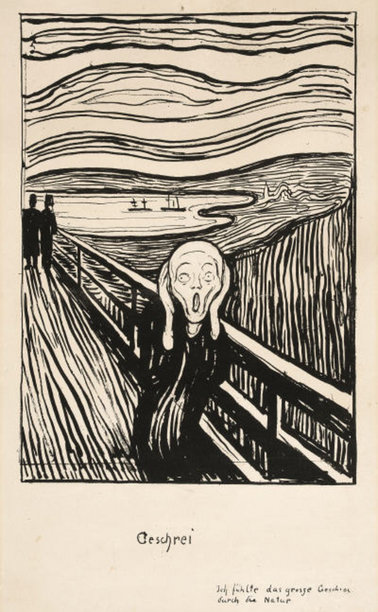
*Litho of Edvard Munch's "The Scream"