Tuesday, March 2, 2010

Indra's Net and Gardening


I've been enjoying the eclectic writing over at the new webzine Life as a Human. You never know what's going to appear, given the wide approach the journal is taking, which is part of the fun. I've contributed about half a dozen articles to the journal, with more coming soon. In fact, I have a new post up right now about abortion and the first precept. Dicey stuff, but definitely important to dig into.

Karen York, in her current Life as a Human post, says the following:

Our health is inextricably bound to the Earth’s health that we have jeopardized. The good news is that, in restoring the earth, we restore ourselves.

The garden, as Peter Harper so eloquently puts it, “provides a unique opportunity to explore the mutual healing between you and the Earth. It is a model of the universe, a microcosm of the biosphere and a metaphor for yourself.”1

I have wrestled somewhat with that word, healing, because for many people — and according to the first dictionary definition — it is synonymous with cure. I prefer the second definition: “to set right,” as in “to heal the rift between us.”

If we grow in understanding and set things right with nature in our gardens, then we too can be “set right,” and the rifts in our lives, whether with our family, our work, or within ourselves, will be healed. There is a third, equally essential definition of healing: “to restore a person to spiritual wholeness.” That is something we can all strive for—and can achieve, despite disease or disability.


As a gardener, and lover of plants and the earth, this resonates with me deeply. As does her struggle with the word "healing," which has become a toss about word found everywhere from doctor's offices to New Age magazines.

Every time I put my hands into the soil, tending to a plant or simply moving the earth about, it's a unique, one time act. In a way, it's beyond any notions about being cured, being set right, or even being restored to spiritual wholeness. Although I have read a lot about the benefits of gardening and touching the earth, when I'm doing so, all that stuff usually falls away and I'm just there. Is this enlightenment? I don't know. I'm not even sure that's worth considering.

Obviously, if you around, the planet is in a lot of trouble. Even for those of you who question global warming, there's really no doubt that ecosystems have been vastly changed by human intervention and exploitation, and I don't think for the better in many cases. It's easy to feel tiny and insignificant within the midst of it all, so much so that planting a tree, growing your own food, or re-seeding a field with native grasses can feel pointless.

I'm trying to recall Indra's Net at such times, to remember that each jewel in the world and it's activity (or non-activity) reflect in all of the others. That my tiny drop added to the ocean of life is the ocean itself, nothing more or less.

Not easy to remember this during difficult times, but when in the garden, when touching the earth as the Buddha did all those years ago, I don't even need to remember - it just is.

*The photo is of Prairie Sage from my garden last summer.

Monday, March 1, 2010

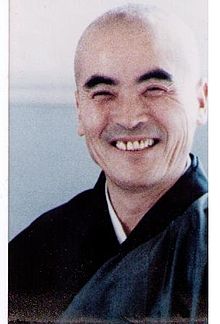
20th Anniversary of Dainin Katagiri Roshi's Death


Twenty years ago today, Katagiri Roshi, a root teacher for so many of us here in Minnesota, died at the age of 62. Even though I was a mere bumbling teenager at the time of his death, and never met the man, I feel his presence deeply in my practice. His teachings pour out of his students, who are now my teachers, and his sincere dedication to Zen shines brightly through both the books and lectures he left us, as well as the attention to details and rituals manifested in my own sangha and others here in the Twin Cities, and greater Minnesota.

I was fortunate to work with Tomoe Katagiri, Roshi's wife and a deep practitioner in her own right, during jukai a year and a half ago. Tomoe's devotion to Zen sewing practice as an expression of the dharma is probably unmatched, at least here in North America, and I credit her repeated firm, but gentle efforts to turn us back to the present moment, just this stitch, for helping me not only enjoy sewing, but also really taking the precepts into my life in a bodily way. I can only imagine what it was like when both her and Roshi were alive together, how they impacted those they worked with, practiced with, in small and great ways.

Dainin Katagiri didn't live a very long life, and cancer made the last period of his life a difficult one. However, his beneficial impact continues through his many students, who are now leaders of their sanghas. Many bows to Dainin for crossing the ocean, leaving your home country behind, and helping us set up Zen practice here in the land of 10,000 lakes.

Sunday, February 28, 2010

Radical Trust and Radical Patience


Subhuti said to the Buddha, "World Honored One, in the future will there be living beings, who, when they hear such phrases spoken will truly believe?"

The Buddha told Subhuti, "Do not speak in such a way! After the Tathagata's extinction, in the last five hundred years, there will be those who hold the precepts and cultivate blessings who will believe such phrases and accept them as true.

"You should know that such people will have planted good roots with not just one Buddha, two Buddhas, three, four or five Buddhas, but will have planted good roots with measureless millions of Buddhas. All who hear such phrases and produce even one thought of pure faith are completely known and completely seen by the Tathagata. Such living beings thus obtain measureless blessings and virtue.


From Chapter 6 of the Diamond Sutra

I read these lines this morning to open a seven hour board retreat for our zen center. In terms of working with issues of institutional sustainability, these words spoke deeply to me. However, looking at them now, what stands out is the emphasis on having faith.

Faith doesn't seem, on the surface, to be a heavy teaching in Buddhism. Partly, it's the word, faith, which is probably associated (in many North American minds anyway) with monotheistic traditions. However, I think if you replace "faith" with languaging like "radical trust," then you can certainly find the Buddha lurking about.

I think it's really hard, in this high paced, violent, heavily materialistic world of ours to develop radical trust. All that talk we do about everything having Buddha-nature and how everything is dynamically functioning together sounds great, but often feels like just nice talk when you spend any time reflecting on the relative world of our everyday lives.

The selection above from the Diamond Sutra above points to, among other things, a quality of time beyond the regular notions of time we have. In others words, it's calling for us to develop a radical patience along with that radical trust, while at the same time doing the work to "plant good roots."

At our retreat today, I felt we did a bit of root planting. And I feel like our sangha is at a point now where we can place some sustained work into enhancing and refining our organization for the long term (instead of simply the year to year way we've functioned for the past several years). A wonderful place, filled with potential.

At the same time, the largeness of some of the topics, and the level of effort required to bring about fruition of some of the projects discussed, is calling for us (I believe) to develop both a radical trust and radical patience. Radical trust that we will find the ways we need to go and be able to come together to do what needs to be done. And radical patience in that we need to renounce completely any attachments to outcome.

I must admit that towards the end of the meeting, taking in the whole of what had been proposed, I, as board chair, felt a deep panic. Just an hour earlier, our guiding teacher experienced something similar, and we both had a little laugh about our shared experience there. Together, we resolved to let it go for the evening - to not fixate on what needed to be done next. I didn't completely drop it, as this post probably shows, but I don't feel panic or anxiety at all right now - only interest (curiousness) in the process unfolding as a whole.

Saturday, February 27, 2010

Backwards Buddhist Mantra


Have noticed more than a few comments on a comedy routine Bill Maher recently did about Tiger Woods and Buddhism. Rod, over at The Worst Horse blog dug into the content more than most, but others have had various things to say as well. I honestly didn't plan to wade in on the whole thing because keeping up with the viral mainstream media is like trying to dig a well with a spoon. However, the following line from Maher caught my attention, and made me pause.

Craving for things outside ourselves is what makes life life — I don’t want to learn to not want, that’s what people in prison have to do.


Isn't this what we think most of the time, even us Buddhists? There were plenty of boneheaded jokes in Maher's routine, but this particular line points to one of the major fallacies that humans struggle with in life. Even the prison comment is an accurate view of the way most of us think of renunciation and letting go of all the things we want. Giving up whatever it is that needs to be given up feels like our freedom is being taken away, doesn't it? Don't lie - you know you've felt this before, maybe often. So, I think Maher is doing us a service by summing up in a single line a false view that many of us have a ton of trouble with.

There's great value, in my opinion, in having something clearly pointed out for you that you want to cease believing in. Too often, I think we walk around talking about compassion, helping others, and not being driven by the three poisons of greed, hatred, and ignorance. But how much of the time does this occur in a kind of sweet, hazy daze?

Maher's conclusion, if this indeed is his conclusion and not just another joke, is completely wrong. But it's dead on clear, and as such, a way to mark the craving that occurs on the path.

When you feel like you need something outside yourself to "be alive," or that giving up something is like being in prison, just remember Maher's line, a backwards Buddhist mantra of sorts.

Chile Earthquake


I've been offline for the last 24 hours, and have no TV, so I didn't hear until now about the earthquake in Chile. A few hundred have died - nothing like what happened in Haiti - but still plenty of damage and suffering to go around. John over at Sweep the Dirt, Push the dust has some links, as does Richard over at My Buddha is Pink. And now there are also tsunami warnings out for Hawaii. Metta and peace to everyone in Chile and in Hawaii.

Friday, February 26, 2010

How are You?


Thanks to Paul Lynch over at his blog Zen Mirror for this little commentary from a book introduction Robert Aitken wrote for Zen Master Seung Sahn.

How are you?

Sŏnsa-nim begins his letters by asking “How are you?”, and his students take up the question too. “How are you?” they ask in turn in their letters to their teacher. We begin to notice this most routine of American greetings as though for the first time.
Does Sŏnsa-nim’s “How are you?” differ from his students’ “How are you?” Is their “How are you?” just an echo? Are they being imitation Sŏnsa-nims? If so, that won’t do. Sŏnsa-nim stands on his own feet, you stand on yours, I stand on mine.
If you stand on your own feet, then what do you say? “Fine!” might be all right, or maybe you are just temporizing. “Temporizing” there’s an interesting word. It means you are gaining time, but gaining time for what? The next question and the next temporizing? When will you come to terms?

“How are you?” “Fine!” That’s more like it. There are other questions like this in this book. Please pay attention.


I don't know about you, but the "How are you?" often feels like a throw away question. Polite. Trite. Slightly curious. Filler. These are a few of the ways I see it, even when I'm saying it often. Not always, but often.

And answering it, especially when I'm either in a lousy mood or feeling like I have nothing new to say, is equally throw away. "Fine" is often a lie, even if in the ultimate sense, it is exactly true. "Good" is a wildly inaccurate judgment, as is "Bad." And beyond those three words, most responses seem to be an effort to fixate on something that might draw some interest, or at least offer some satisfaction. "Oh, I'm happy because the weather is warmer." "Oh, I'm not so good because work is stressful." "Oh, my writing is doing well. How about you?"

Yesterday, during my ESL class, we studied using "How about you?" An interesting phrase. I can show care for another, or can simply be a way to pass the buck to another. I really don't want to talk about the intense suffering I'm feeling about X or Y, so lets just stick to pleasantries. Or, I really don't think you will understand the joy I'm experiencing about learning something new about the medicinal properties of Rosemary plants, so let's just stick to pleasantries. That kind of passing the buck.

I often don't really know how to become intimate with another, and I can imagine neither do you. Lots of fumbling about, judgments, defensiveness, and confusion - not as much actual liberated interaction. Even though people say a lot of things when it comes to why they started practicing meditation, the precepts, and the Eight Fold Path, I'm starting to think that the misery of failed relationships - all relationships, from the slightly off stranger on the street to your parents - is one of the main reasons people start all this.

Yesterday, there was a televised forum on health care reform here in the U.S. Lots to yawn at in my opinion, but one thing that came out very clearly was that these people - representing people like me and some of you - aren't very good at relationships. Listening without snap judgment is at a minimum. Curiousity is almost out the door, as is openness to new ideas. These supposed leaders are like many of us, stuck in auto pilot, firmly convinced we have everything under control, when in fact we haven't a clue what's really going on.

"How are you? Can you ask it, and/or answer it with heart? To hell with knowing for sure, can you answer it from your heart? Far from being some soft request, this, to me, is becoming the gateway question for liberation.

How about you?

Thursday, February 25, 2010

"It Sucks Everywhere!" Speaking in Accord with Reality


Subhuti, the Tathagata is one who speaks of things as they are, speaks what is true, and speaks in accord with reality. He/she does not speak deceptively or to please people. Subhuti, if we say that the Tathagata has realized a teaching, that teaching is neither graspable nor deceptive.

Diamond Sutra, Chapter 14

Being a wisdom teaching heavy on lessons about the emptiness, or no independent existence of all things, The Diamond Sutra is filled with passages designed to wear down human conceptualizing and clinging to ideas and views. It's a challenging teaching, filled with little sword-bearers waiting to slice apart any sense of "I've got it!" that might crop up.

Yesterday, I felt slightly sick and fairly cranky. It's spilled into today, which led me to start reflecting on crankiness itself. There were two or three exchanges I had with others about my job yesterday that quickly slide into sourness. At one point, I told a former co-worker who now just volunteers once a week: "You got out at the right time." She said something back, and then I responded "Yeah, well, around here, it's more work, and less pay." Later, I wanted to add "And no respect."
She responded, "That's seems to be happening all over the place." Which is true, but I didn't want to hear it.

And why not? Because I wanted to be heard as unique, that the issues I and the other teachers at my workplace were experiencing shouldn't just be lumped in with everyone else in this recession-era economy.

Truth telling is an interesting activity. I wonder how many business leaders, non-profit leaders, government leaders, etc. around the country are walking into meetings and telling their employees: "It sucks everywhere. That's a bummer. You'll just have to suck it up." Certainly, there's a lot of truth to that statement, and yet is it also deceptive?

Somewhere recently, I read the statement that objects and experiences are just triggers for your responses - they don't actually produce those responses. This is something I have long seen as valid, and yet it's so easy to forget. Nearly every time I hear someone in a position of power say something like it sucks everywhere economically right now, there's a bristling inside that arises. And sometimes, this even leads to acting out.

After work, I was asked by an acquaintance how work was going. I said "I haven't killed anyone yet." Not the most skillful statement, and the "yet" implies a rage that just isn't present, so it wasn't a very accurate statement either.

Later on, I got to thinking how often we rely on dramatic language that isn't a clear reflection of reality. Partly, it seems that in this media saturated, multi-tasking, overworked society of ours, just saying "Oh, I'm irritated about work today" isn't interesting enough to keep many people's attention. However, the dramatic statements like the one I made above either slide into terrible, life sucking gossip or they shut down things all together. In my case, the woman I was speaking to quickly saw her way out of the conversation.

If you take a look at crankiness, it's pretty easy to see that it's made up of non-cranky elements. In my case, there is sadness, disappointment, and a tinge of outrage at the very least. And the triggers of today, like that overly equalizing statement about the economy, are simply tapping into older wounds, including a fixation on injustice that, when it gets like this, doesn't benefit anyone.

But this isn't all about me and my reactions. That's too simple, too easy. Failing to see how Buddhist teachings like the Diamond Sutra are all about relationships is a pretty common mistake I think. How does one speak in accord with reality anyway?