Showing posts with label "Western Buddhism". Show all posts

Tuesday, March 13, 2012

Social Dukkha - Moving Beyond Individual Buddhist Practice

In honor of three years of writing here at Dangerous Harvests - where did the time go?! - here is a re-post from the early days. Originally published on Friday, May 22, 2009. Comments welcome as always.


Working with people from all over the world, whose ideas and ways of living are often very different from my own, has definitely helped to jar the sense of self I have. In addition, the discussions I have had with these same learners in my classes have shown me as much as anything how constructed our views of the "good life" or "proper life" are. Here's a simple example of that from a recent class.

A woman originally from Somalia is pregnant, which sparked a discussion about family size and also happiness. She was asked by another learner how many children she would like to have. I believe she said "maybe four," although I may be misremembering that number. Another woman, a very joyful Ethiopian woman in her fifties, said "why not more?" She went on to talk about her eight children, and how she loves big families, and would have more children if she could. Recently, her son graduated from college, the first degree in her family I believe, and she's been walking around beaming about his accomplishment, telling anyone who will listen about it.

A few other learners, ethnic Karen from Burma, gasped upon hearing the desire for very large families. One said something to the effect of "three is enough, thank you very much." And there were other expressions from this group about the hard work and difficulties large families create for mothers. Which brought us to economic issues in the U.S. and a short conversation about how expensive it is in the U.S. to have a lot of children. But the woman from Ethiopia didn't stand down - she still felt that there was more joy in a bigger family. I have had other learners in the past, from other nations, express very similar views. Yet, even within groups, as should be expected, there is a fair amount of difference of opinion about this question.

However, despite wide differences of opinion within any group, it can be said that culture and social structures of a given society have an influence on how people think and act in the world. And because of this, I believe there has been a failure on the part of many in the convert western Buddhist world to see beyond individual practice, and individual "enlightenment," as a way to address the suffering of the world.

Dukkha is the Pali term which is usually translated as suffering. It is often viewed as the sense of dissatisfaction or disease a person feels with the world as it is presenting itself in one's life now. Of dukkha, Buddha said that all of us experience it in our lives - many of us so much so that we are consumed by it. And yet, as Buddha himself experienced, there are ways to be liberated from it. In terms of Buddhism, these ways are expressed as The Eightfold Path. (Other spiritual traditions have other methods which I would argue also can be gateways to liberation, but discussing those would lead us off track today.)

Returning to the classroom discussion above, the Ethiopian woman in my class seems have pinned at least some of her happiness in life on having a large family. Although I don't know for certain, it seems that larger families are more common in Ethiopia than they are here in the U.S. When you think of the droughts, famines, wars, and other difficulties that have plagued Ethiopia over at least the past century, it's very understandable that an emphasis on procreation might be promoted not only in individual families, but much more broadly, as a social or cultural value. So, then, since she has a larger family, the woman in my class might be viewed in a positive way by others in her cultural group, and she might internally view herself more positively because she has manifested what has value within the larger group.

Of course, there are also many individual factors that play into this as well. Her family seems to work together well. The children are doing well academically, and unlike other learners I have had in the past, she doesn't come to class with a heavy burden of problems her children are having at home, or at school, or elsewhere. So, it's very much possible that her emphasis on "big families" is as much, if not more, tied to her personal experience than to cultural or social values or constructs.

Yet, I think it's foolish of us, especially if we believe in the view that there is no solid, fixed self or "I," to place all our eggs in the individual basket. Any one person's suffering or joy is a product of a complex uprising of causes and conditions, some of which one might be personally responsible for, but also which include others that are much bigger than any one person.

No one person, no matter how powerful, is responsible for bringing about war for example. Or environmental destruction, or patterns of patriarchy, or racism, or sexism, or heterosexism, or any other number of social ills that infiltrate and effect our lives on a daily basis.

In his excellent book The Great Awakening: A Buddhist Social Theory David Loy spends a lot of time examining these kind of larger patterns. Using the term "social dukkha," he argue that Buddhist teachings: the precepts, emptiness, compassion, and others can be applied to broader social issues as a means to potentially reducing suffering on a larger scale.

Now, he certainly isn't the first to say any of this, nor is he a lone wolf crying in the wilderness, but it strikes me that until there is a critical mass of us speaking and acting in ways that might address these larger scale issues, no amount of individual effort on spiritual practice will be enough to greatly reduce suffering in the world. Maybe if we all took up meditation practices, and stuck with it diligently, there would be some massive change. But I still wonder even then if oppressive social structures would simply fall away, or if, in spite of our efforts, we'd still be facing the problems these structures create. I have a hard time believing that racism, sexism, and heterosexism, would simply vanish as a result of all of us individually, or even as collects of individuals, doing meditation practices. This is not at all to denigrate meditation - I love it - but to suggest that given where we are at on a global scale today, it seems additional, more collective approaches to the dharma are being called for.

Tuesday, August 9, 2011

Working Class Buddhisms


Thanks to Katie over at Kloncke, who just celebrated her birthday, I got to read this cool article on Buddhism and working class folks by Joshua Eaton. He brings up many excellent points in his writing, but what struck me most was a comment left by "amayfaire":

I came to Buddhism as a working class kid, seeking some sort of spiritual home that didn’t require me to rely on fancy clothes, or tithes, or praying to deities that seemed to have little connection to my daily life. I found Buddhism as a spiritual home that argued against all those systems that held me in. Nobody brought me Buddhism, I found it.

Is the problem that the working class needs help finding Buddhism? I don’t think so. I think Buddhism needs help finding the working classes. We in the working classes know all about sangha, because our networks of community are integral to our survival and the survival of our families. We know all about death, and disease, and living in poverty, because we live with it each day. I think that, too often, there is an assumption that a lower income somehow correlates to a lack of intellect or spiritual engagement, as though being working class means someone has to bring “enlightenment” to “the masses" or working class folks are too attached to understand non-attachment. The working classes, however, have much to offer mainstream American Buddhism about what it means to be enlightened, about what it means to be Buddhist. For us in the working class, a spiritual life cannot depend on income, so it does not. We don’t need a sliding scale, nor do we seek a teacher other than the ones we carry within ourselves and our communities. We are a sangha surrounded by struggle, by disease and death, by the realities of a life that requires hard work and social invisibility. And from my sangha I have learned more about being Buddhist than any experience in my life.


As long time readers of this blog know, I have always felt like a "tweener." I have a decidedly middle class education, but have spent much of my life living fairly close to the bone in material terms. So, this comment really resonated with me, and I think that it's various messages have something really important to teach Western Buddhists.

I recall having a discussion with a few members of our sangha recently about personal finances and the larger, slowly tanking global economy. One person was, in particular, struggling with fears of losing her job, and suddenly finding herself homeless or in some other really difficult pickle due to lost income. And she turned to me and another dharma friend who lives close to the bone and said "I worry about you guys."

Now, in one sense, it was heartening to hear such a statement. After all these years of practicing together, I do feel the caring and compassion of the folks who have been there - kept going at the practice, even when it felt like the last thing they wanted to be doing.

I another sense, though, I noticed a difference in view that in some ways is built upon differing levels of material wealth. Simply put, while I do have a bit of fear around going completely broke and having nothing, it's also the case that I don't have a whole lot to lose anyway. Furthermore, like the commenter above, I have developed a network and understand that not only survival, but thriving depends upon deeply interwoven, and sometimes really diverse relationships.

What that conversation got me thinking was this: how would our sangha handle a situation where one or more of it's members faced "financial ruin"? Do we understand "sangha" deeply enough to move past the privatized, post World War Two middle class notions that often divide us, even as we sit next to each other on the cushion?

What do I mean by that last question exactly? Well, to my sangha's credit, we have had an ongoing, informal group called "Hearts and Hands" which was set up to help support members facing some kind of crisis. People have cooked meals and brought them to sick members. Or driven people to appointments. Or taken care of children. As I have seen it, this group - when it's been active - has been a step across the line into a deeper understanding of sangha.

But is that the culture of our sangha? I'd say not really. It's the culture of a subsection of our sangha - something that some of us probably hope would spread throughout the sangha, but which hasn't done so as of yet.

Why? For various reasons. However, I'm quite certain that one of the reasons is class-based. Because middle class folks don't tend to see whatever networks they have as integral to their survival. When the chips are down financially, they usually seek individual or nuclear family-based solutions first, believing - even if they deny it - that personal responsibility trumps everything else. That "I" or "my family" must figure it out, and that "I" or "we" are not going to be "dependent on handouts," thank you very much.

Now, there is some of this attitude amongst working class and poor folks, but not nearly as much. And while some in this wide ranging and diverse group have given in to lives of "gaming the system" and not making much effort, I'd argue that the large majority are living with an understanding of sangha - of community - that is sorely lacking amongst middle and upper class folks.

As the global economy wobbles on the edge of total collapse these days, my mind has shifted towards how to be creative when it comes to meeting material needs. If things really fall apart, I'm convinced that one of our greatest hindrances collectively will be these middle class notions that "I" and/or "my immediate family" must take care of ourselves first, and foremost. We talk so much about breaking down attachments to that "I" on a psychological/spiritual level - but what about on a material/economic level? When will I/we finally see that interdependence actually is our birthright, and is actually calling us to reclaim a much deeper sense of living in community(s)?

There are signs in my home sangha that, if financial crisis hit a number of members, we might be able to break through the shell and support each other. Maybe even find a new sense of what it means to be a sangha. Our collective commitment to working with children, and seeing them as dharma practitioners in their own right, is a great positive. The Hearts and Hands group is another. And our head teacher's desire to diversify the sangha is yet another. At the same time, the privatized, middle class narratives are pretty damned strong, and there is plenty in the broader national landscape working against truly embodying interdependence.

I even wonder about myself, feeling some of that privatized, pull yourself up by the bootstraps narrative floating within my body and mind. I'd like to think that I'm capable of stepping beyond the pride, guilt, middle class "success" narratives and whatnot that help to maintain separation amongst people in community, but I just don't know. So, writing this is part of that process of opening, and/or remembering.

What are your thoughts on all this?


Tuesday, June 28, 2011

The Appearance of White American Buddhists


I have to say that the explosion over the post by Tassja over at Womanist Musings has jolted me. You'll have to forgive me for not moving on yet. Because I'm not moving on yet.

Given my life experience, race and racism are never far from my awareness. However, the genuine nastiness, callousness, and defensiveness that have come in response to this single article has been a reminder of just how screwed up people still are when it comes to race.

This morning, I read the following, a post by another young woman of color offering her own take, and standing with Tassja in the process.

I would like to tell you how Buddhism influences my father’s treatment of his patients, every one of whom are criminally insane. I would like to tell you how Buddhism plays a role in the way my mother lends the money she doesn’t have to spare. I would like to tell you of how Buddhism sustained my aunt through the famine and my uncle through the war—I would like to tell you how it gave some measure of peace to those who did not survive.

Because this is what we mean when we say that Buddhism flows in our blood.

I would like to tell you, but I am afraid. I am afraid of you Barbara O’Brien, Kyle Lovett, and Anonymous Commenter. I have a bone-deep fear of the things you will say about my father, my mother, my aunts and uncles, my cousins, my grandparents, and my three-year-old brother. I am terrified because I can see my future in what you are presently doing to Tassja.

You might tell me that Buddhism belongs in the meditation center and not the hospital. You might tell me that the war is over so what does it matter. You might tell me famine is a state of mind or any number of other things equally indicative of never having helplessly watched a child starve to death. You could discount all my family’s blood, sweat, and tears and the way they flow into and out of the Buddhism I live everyday.


I don't personally know either of these women. Just as I am a disembodied person to them who writes a blog about Buddhism, they are disembodied Buddhist writers to me. We are, even with the most heartfelt, passionate of words, abstracted from each other. Which makes it that much easier to toss labels about, make casual dismissals, and generally ignore the living, breathing being behind the words trying to break through their suffering.

It's quite easy to note the demonstrated lack of compassion amongst some of the white Buddhist commentariat. One man, who claimed to have written two books on the Pali Canon and to have practiced 23 years, repeatedly referred to Tassja as a "silly cow." Another commenter suggested that she needs to find a teacher, so she can deal with her anger.

I won't go on with more examples. Some of you will, no doubt, be saying to yourself "Stop pointing fingers at others and look at yourself." And that's fine. I don't care. I have spent years facing the legacy of race, racism, whiteness, and oppression that I have inherited. And I imagine I will continue to have to face it until the day I die.

Actually, though, what's even more apparent to me, when surveying all of the responses to Tassja's post, is the deeply fragile appearance of white Buddhist practice. Notice I said "appearance" because this isn't to speak of all white convert practitioners, but to speak of how we might collectively appear to people looking in from the outside.

How we, for example, appear to fail at the most basic teachings of compassion and generosity of spirit. How we appear to be fighting a turf war, and demanding to be acknowledged as "legitimate dharma students." How we appear to spin around and around in old patterns of guilt, denial, and blame the moment someone speaks a few critical words about "our race." How we appear to be smug in our book knowledge of Buddhism. How we regularly appear to make appeals to diversity, but then flip out the moment that diversity threatens the vision we have of "Buddhist practice."

All intentions aside, this is how "we" - white American Buddhist converts - collectively appear in this conversation. And it's how "we" have collectively appeared in discussions about race, privilege, and oppression for decades. Twenty years ago, then Tricycle magazine editor Helen Tworkov made the following ludicrous statement, "so far…not figured prominently in the development of something called American Buddhism," which set off a firestorm that looks terribly similar to the smaller online version I am writing about today.

It's important to me to bear witness to the fear, sadness, anger, and suffering reflected in the voices of the Buddhists of color who either wrote blog posts like Tassja and Prajna (the author of the piece I quote above), or who left comments on these posts. Even if we have divergent views at times, we are all practicing under the umbrella of Buddha's teachings.

I offer this post as a tiny seed in the vast, seeded field of race in America. It is so much bigger than us Buddhists, but we are, like everyone else, embedded within it. It is our collective karma, to be faced or not.

May we choose to leap, again and again, into the dragon's mouth.

Sunday, June 26, 2011

Responding to Criticism of Buddhist Practice by Practicing


I almost never delete a post once I put it up, but after reading and responding to a comment by Robyn, a regular reader here, I realized that most of this post needs to go. It's excess talking. So, I'm taking down the original post, and offering a few pithy statements from it that get at what I wanted to say without the confusing attempts to continue the discussion from yesterday's post.

1. Respond to criticism or perceived criticism of your spiritual practice by practicing.

2. Many of us "overdo" race talk. Few of us are willing to sit with race like a koan, listen for whatever wisdom is there "behind the curtain," and then speak from that.

3. Minimizing, denying, blaming, trying to "fix," and/or judging are the standard forms of acting out in response to something we don't like, or don't want to hear. Knowing that, now what?

4. If I choose to not listen to the pain and suffering beneath someone's words today, they’ll be someone else expressing something similar tomorrow.

5. Forget trying to get all your ducks in a row. You have to act, or not act, as it is, moment after moment.

Saturday, March 19, 2011

Buddhism and Wealth


I have long struggled with how to consider material wealth within the context of Buddhist teachings. One reason is that unlike many of my fellow American converts, I have experienced some "poorness," have always lived on the financial edge, and have worked with, and heard the stories of poor people much of my life. I frequently see the unexamined classism in the larger convert Buddhism community, and wonder how much of that impacts the way we interpret Buddhist teachings on money and material wealth.

There is a small discussion over at the Tricycle blog about all of this. It takes off from a recent column by Lewis Richmond in the Huffington Post. Lewis wrote:

In my 1999 book, Work as a Spiritual Practice, I introduced the idea of right livelihood as conscious livelihood. In other words, regardless of our job (or lack of a job) we should be aware of the implications and consequences of what we do. Though Work as a Spiritual Practice, by intention, emphasized the choices and changes an individual could make in his/her workplace, I also feel that conscious livelihood should not be limited to individual awareness and action. Society at large also has a responsibility to be conscious of the consequences of its economic and employment policies, even more today than in 1999 when when the economy was booming. It is not clear whether the Buddha thought of right livelihood in this way, but it behooves us to do so now.


I read his book perhaps three years ago. It's pretty decent, and asks some important questions about what work is, how we do it, and what Buddhism might have to say about it.

However, the larger questions around accumulation of wealth, what constitutes "need," how teachings about Right Livelihood fuction (or don't function) in a globalized capitalist environment aren't addressed as head on as I would have liked.

Nor are they in this current article.

Clearly, the Buddha saw prosperity and financial security as a good and appropriate activity for laypeople; "rightful means" meant any occupation that did not cause unnecessary harm to other living things. In the simple economy of 500 B.C. this meant avoiding occupations such as butcher, tanner, or soldier -- if possible. It also meant to be honest and ethical in business dealings -- not to cheat, steal or lie, and in general make one's living in an upstanding way. I daresay that all religions have ethical principles of this sort regarding making one's living -- certainly the Judeo-Christian tradition does.


I'm not sure what he means by "prosperity and financial security" here, but I'm not sure the Buddha was all that concerned about "security" of any kind. Why? It doesn't really exist. Beyond this, though, the word "prosperity" in the average American mind, even amongst Buddhists, means having a lot of stuff, a good job, retirement funds, and the rest. And when all of that is "yours" - in the relative sense - it's pretty easy to have a lot of attachment, which certainly isn't too helpful in term of liberation.

A commenter called Wtompepper on the Tricycle blog post who earlier had questioned the accumulation of wealth we tend to support in the U.S. - even amongst middle class types - wrote the following interesting response:

I don't think I've ever heard Buddha referred to as a pragmatist, or the "middle way" compared to pragmatism. I cannot imagine you mean that in the true sense of pragmatism. However, there is no need to "tie oneself in knots" avoiding anything--instead, just DO something that makes such knot tying less necessary. I hear the "tying in knots" argument all the time; it is too hard to figure out how to make the world better, so we all want to think that Buddha would have thought everything we are doing is just fine, and that all we need to do is avoid things we already wouldn't do (slavery, weapons trading); but we can't just feel better about ourselves through ignorance. Well, we maybe can, but that's not awakening. Didn't Buddha also say "Strive with diligence"?

And I really think it is important to remember the difference in historical period. Buddha recommends that lay people produce wealth, but he could not possibly have meant investing in the stock market. Remember that money was a very recent invention, and it is the coining of money Buddha is referring to with the term "gold and silver." The accumulation of wealth in a pre-monetary economy meant producing more useful goods and storing food, not having a 401k. Buddha does encourage such production, but warns against the delusion of money, for anyone hoping to become enlightened.


It's interesting to think about the abstractions that have come into the wealth equation in modern society. Paper and coin money. Stocks. Bonds. Credit Cards. Derivatives. I think it's true that the historical Buddha wasn't talking about these things, but the fact is they are here, part of a lay life - so now what? How do you work with them in a way that exemplifies Right Livelihood?

I have often thought that after a certain point, we should figure out ways to pool our surplus wealth to use for developing/supporting our communities. That what is already happening with skill swaps, free exchanges like Freecycle, and grassroots money pooling should become the norm.

This is where things get really sticky I think. "Buddha does encourage such production, but warns against the delusion of money, for anyone hoping to become enlightened." And I'd argue, he warned against the "delusion of money," not necessarily against having money for lay folks. But that same argument I have heard taken as a license for millionaires to keep squirreling money away, or for huge corporations to rake in billions and justify that by offering millions in charity.

And one of the problems I have always had with this is that you end up with a small number of wealthy folks determining a large part of what is "socially good." A single couple, Bill and Melinda Gates, have the power and financial resources to decide what's worth spending money on, and what isn't. There is something greatly screwed up about this in my view. Some might say they are bodhisattvas in the world, but it often seems more like paternalism to me.

What do you think about all of this? How do material wealth, especially accumulating wealth as individuals, fit into Buddhist teachings? Is the pursuit of relative financial "security" always a hindrance, or is that a new "necessity?" What is Right Livelihood to you?

Tuesday, September 28, 2010

"Western Buddhists Don't Know Anything"


So basically says our old friend The Zennist, doing his best to ruffle the feathers of "Western" Buddhists again.

There are times when you have to face the facts. Something isn't right in Buddhism. Many Buddhist writers I am familiar with, not to mention the bulk of the Buddhist public, don’t read much of the Pali canon or the Mahayana canon, enough to know what it actually contains (this includes Asians). This is guessing, but I think their Buddhist reading list may only contain two discourses they’ve actually read such as the the Kalama Sutta and the Heart Sutra. Of course there are others. But these two seem to be the main ones.


First off, I wish I or someone could come up with a better term than "Western Buddhists." The whole west-east thing is tired.

Anyway, The Zennist's post is an interesting set of observations. I think he's onto something as well. The Kalama Sutta seems wildly over represented in the blog posts I have read online over the past two years. And at that, it's mostly reduced to a paraphrasing of section 10, which reads:

The criterion for acceptance

10. "Come, Kalamas. Do not go upon what has been acquired by repeated hearing; nor upon tradition; nor upon rumor; nor upon what is in a scripture; nor upon surmise; nor upon an axiom; nor upon specious reasoning; nor upon a bias towards a notion that has been pondered over; nor upon another's seeming ability; nor upon the consideration, 'The monk is our teacher.' Kalamas, when you yourselves know: 'These things are good; these things are not blamable; these things are praised by the wise; undertaken and observed, these things lead to benefit and happiness,' enter on and abide in them.


I think it's probably fair to say that not a lot of Buddhists in general are very well versed in the original teachings. We are currently studying the Anapanasati Sutta at our zen center, and before this did a class on the Diamond Sutra and also one on the Third Chinese Zen Patriarch's poem Hsin Hsin Ming. I know other sanghas in the U.S. also have rigorous study of some of the ancient texts, but it's probably also true that other sanghas don't. The "Just Sitting" mindset amongst some Dogen-centric communities seems to lead to not much studying of anything besides Dogen. The same might be said of communities that only study Nichiren's writings. I'm just throwing out some examples here of groups that study a single teacher, sometimes to the exclusion of all others.

The Zennist continues:

The popularity of these two Buddhist discourses [the Kalama and Heart Sutras] tells us more about the modern ethos than Buddhism. In fact, if this is all of the Buddhism someone has read, they don’t know much about Buddhism, especially about its mystical side, for lack of a better term. In fact, the mystical side is really what Buddhism is all about or in the words of Bodhidharma, “The most essential method, which include all other methods, is beholding the mind” which is not our ordinary mind but is the very spiritual stuff of the universe.


I'm interested in this. There are times when I do think modern Buddhist writers and teachers focus too much on things like mindfulness while washing the dishes, or how to work with difficult emotions. These are very important, but they aren't the whole works.

There's been some interesting posts recently on the blog On the Precipice about the value of monastic practice, and the need to give it more support in "Western" nations. I left the following comment on today's post:

One thing I think is important to consider is the lack of records on lay practitioners historically. Most of what we have been handed down has been recorded by monastics about monastics. Occasionally a figure like Layman P’ang shows up, but it’s a rarity. And I think this is especially important to women in our practice today because we really don’t know a lot about the Buddhist women of our past, monastic or lay. I have three or four books on my shelf written about historical Buddhist women, and the authors’ research was often years in the making, and yet they only have stories about maybe 20 or 30 wise Buddhist women. So, I’m kind of convinced that we don’t have a really well rounded view of the different ways people have practiced and potentially awakened throughout Buddhist history.


Why is this relevant to the rest of this post? Well, I think there are a few overlapping issues going on that tie together. First off, The Zennist's general point about practitioners having little knowledge of what the ancient teachings actually say. And second, the fact that many of those ancient teachings are coming from monastics writing about monastic experience. One of the benefits of going through the Pali Canon is that there are lay practitioners found in it, and the Buddha directly addresses them, tailoring teachings towards lay life. However, once you move past the Pali Canon, at least amongst Zen records, it's mostly monastics and wandering loner types whose stories and teachings are available. All this to say that I'm not terribly convinced we have a good sense of what's it's been like for lay Buddhists throughout history. And along with that, since we don't have, for example, lots of enlightenment stories about lay practitioners, it's been generally assumed that lay people almost never experience enlightenment.

One thing I have to say about The Zennist's criticism of modern, "Western" Buddhists, which gets nastier at the end of his post, is that it's probably more the case that the majority of people in every religious/spiritual tradition are, and have always been, lacking in depth of knowledge about the actual recorded teachings of said tradition. How many Christians do you know that can rattle off entire sections of the Bible, and easily cite a wide diversity of quotations from early Christian scholars and theologians? How many Muslims do you know who can do the same with the Qu'ran and early Muslim scholars?

Part of the problem those of us who do read in depth have is that we are reading material written by other people that were privileged enough (i.e. had the time and resources) to be able to present a more complete picture based on a variety of historical teachings. If we had a better sense of what lay practice was like historically, and how people grew wise or not through it, perhaps the monastic/scholarly approach might be seen as one path amongst many to awakening.


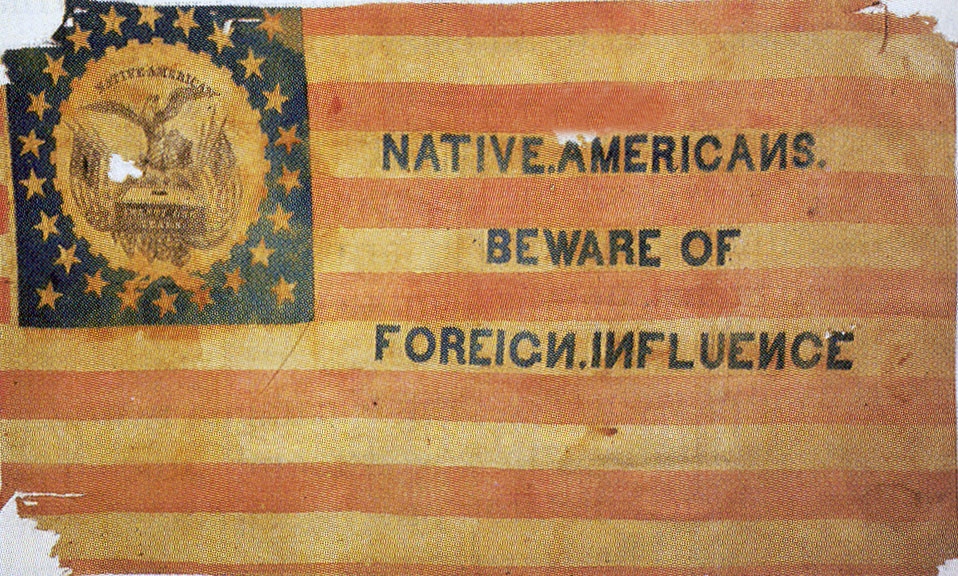
*Image is of a flag from the American "Know Nothing" movement - mid-19th century.

Wednesday, May 26, 2010

Fully Enlightened Dharma Heir Required for Establishment of "Western" Buddhism: Film at Eleven


I enjoyed writing that piece on clothing and naked buddhas this morning, but when I looked at it again this evening, it felt a bit too metaphoric. So, I took it down for now. Maybe it will reappear again, but in the meantime, here's a big bone for everyone to chew on, courtesy of today's Tricycle blog:

In Tricycle’s most recent issue there is a piece titled “It Takes a Saint.” In this piece, Tai Situpa Rinpoche shares his beliefs on what it will take for Buddhism to become truly established in the West. He writes,

“I’ll make it simple: One Western person must attain full enlightenment in the same way as Marpa, Milarepa, or Padmasambhava. If one Westerner—man or woman, doesn’t matter—attains that level of realization, then pure dharma will be established in Western culture, Western language, and environment, and so forth. Until that time, dharma can be taught in the West, which is already happening; it can be practiced in the West, which is already happening; and it can be recited in Western languages. But it’s not yet one hundred percent complete.”

Read the whole piece here.

For me, it was love at first sight with this article. I remember reading it for the first time and holding back the urge to cheer while reading certain passages (particularly when Tai Situpa speaks of what would happen if such a Mahasiddha rose above New York City while singing the perfect dharma song for New Yorkers). Yet before long I realized that what was striking me so deeply was not necessarily what he was saying, but where the piece was taking me in my mind—to a West where the Dharma was utterly thriving. THAT is what had me on the verge of joyful cheers. Once I noticed this, I began to question his main point and I realized that while I don’t necessarily disagree, I don’t necessarily agree either. I’m not sure what the answer to the question is.


The writer of the post goes on to interview a few people he knows, asking them what they thought. One said the dharma is established, but just young. Another felt we needed a strong monastic tradition before any claims of established dharma can be made. Neither answer does much for me, but this "established/not established" argument does bring up a question for me. What is behind these kinds of discussions anyway? Are people trying to measure up? Too focused on what has fruited, and not enough on all the seeds being planted? I guess I don't know for sure, but before long - maybe 50 or 100 years - this kind of talk will be history. And then what? Maybe there will be a different issue to deal with - like an "established" dinosaur that doesn't attract anyone's attention.

I personally rather enjoy this somewhat unsettled, often experimental, and sometimes confused thing called Buddhism here in North America. Where else could you have a 100 year old + Buddhist organization be considered both "youthful" and open to major changes? Among other things, said organization, the Buddhist Churches of America, has had an ongoing debate about adding practices like sitting meditation that appeal to non-Japanese practitioners. Now, similar debates and changes are being made in sanghas in places like Thailand, but the difference is that in the United States, the traditional practices aren't really that old. And if you look at the oldest groups, be it the BCA or a place like San Francisco Zen Center, major changes and shifts in emphasis have been more normal than long periods of consistency.

And although it can certainly be a source of confusion, conflict, and sloppy dharma, I have to say that living in the middle of such a flux is pretty damned interesting. Whether or not a viable practice called Buddhism has been established, I'll let the philosophers decide that issue. How about you?

*painting by Rene Magritte