So basically says our old friend The Zennist, doing
his best to ruffle the feathers of "Western" Buddhists again.
There are times when you have to face the facts. Something isn't right in Buddhism. Many Buddhist writers I am familiar with, not to mention the bulk of the Buddhist public, don’t read much of the Pali canon or the Mahayana canon, enough to know what it actually contains (this includes Asians). This is guessing, but I think their Buddhist reading list may only contain two discourses they’ve actually read such as the the Kalama Sutta and the Heart Sutra. Of course there are others. But these two seem to be the main ones.
First off, I wish I or someone could come up with a better term than "Western Buddhists." The whole west-east thing is tired.
Anyway, The Zennist's post is an interesting set of observations. I think he's onto something as well. The Kalama Sutta seems wildly over represented in the blog posts I have read online over the past two years. And at that, it's mostly reduced to a paraphrasing of section 10, which reads:
The criterion for acceptance
10. "Come, Kalamas. Do not go upon what has been acquired by repeated hearing; nor upon tradition; nor upon rumor; nor upon what is in a scripture; nor upon surmise; nor upon an axiom; nor upon specious reasoning; nor upon a bias towards a notion that has been pondered over; nor upon another's seeming ability; nor upon the consideration, 'The monk is our teacher.' Kalamas, when you yourselves know: 'These things are good; these things are not blamable; these things are praised by the wise; undertaken and observed, these things lead to benefit and happiness,' enter on and abide in them.
I think it's probably fair to say that not a lot of Buddhists in general are very well versed in the original teachings. We are currently studying the
Anapanasati Sutta at our zen center, and before this did a class on the
Diamond Sutra and also one on the Third Chinese Zen Patriarch's poem
Hsin Hsin Ming. I know other sanghas in the U.S. also have rigorous study of some of the ancient texts, but it's probably also true that other sanghas don't. The "Just Sitting" mindset amongst some Dogen-centric communities seems to lead to not much studying of anything besides Dogen. The same might be said of communities that only study Nichiren's writings. I'm just throwing out some examples here of groups that study a single teacher, sometimes to the exclusion of all others.
The Zennist continues:
The popularity of these two Buddhist discourses [the Kalama and Heart Sutras] tells us more about the modern ethos than Buddhism. In fact, if this is all of the Buddhism someone has read, they don’t know much about Buddhism, especially about its mystical side, for lack of a better term. In fact, the mystical side is really what Buddhism is all about or in the words of Bodhidharma, “The most essential method, which include all other methods, is beholding the mind” which is not our ordinary mind but is the very spiritual stuff of the universe.
I'm interested in this. There are times when I do think modern Buddhist writers and teachers focus too much on things like mindfulness while washing the dishes, or how to work with difficult emotions. These are very important, but they aren't the whole works.
There's been some interesting posts recently on the blog On the Precipice about the value of monastic practice, and the need to give it more support in "Western" nations. I left the following comment on
today's post:
One thing I think is important to consider is the lack of records on lay practitioners historically. Most of what we have been handed down has been recorded by monastics about monastics. Occasionally a figure like Layman P’ang shows up, but it’s a rarity. And I think this is especially important to women in our practice today because we really don’t know a lot about the Buddhist women of our past, monastic or lay. I have three or four books on my shelf written about historical Buddhist women, and the authors’ research was often years in the making, and yet they only have stories about maybe 20 or 30 wise Buddhist women. So, I’m kind of convinced that we don’t have a really well rounded view of the different ways people have practiced and potentially awakened throughout Buddhist history.
Why is this relevant to the rest of this post? Well, I think there are a few overlapping issues going on that tie together. First off, The Zennist's general point about practitioners having little knowledge of what the ancient teachings actually say. And second, the fact that many of those ancient teachings are coming from monastics writing about monastic experience. One of the benefits of going through the Pali Canon is that there are lay practitioners found in it, and the Buddha directly addresses them, tailoring teachings towards lay life. However, once you move past the Pali Canon, at least amongst Zen records, it's mostly monastics and wandering loner types whose stories and teachings are available. All this to say that I'm not terribly convinced we have a good sense of what's it's been like for lay Buddhists throughout history. And along with that, since we don't have, for example, lots of enlightenment stories about lay practitioners, it's been generally assumed that lay people almost never experience enlightenment.
One thing I have to say about The Zennist's criticism of modern, "Western" Buddhists, which gets nastier at the end of his post, is that it's probably more the case that the majority of people in every religious/spiritual tradition are, and have always been, lacking in depth of knowledge about the actual recorded teachings of said tradition. How many Christians do you know that can rattle off entire sections of the Bible, and easily cite a wide diversity of quotations from early Christian scholars and theologians? How many Muslims do you know who can do the same with the Qu'ran and early Muslim scholars?
Part of the problem those of us who do read in depth have is that we are reading material written by other people that were privileged enough (i.e. had the time and resources) to be able to present a more complete picture based on a variety of historical teachings. If we had a better sense of what lay practice was like historically, and how people grew wise or not through it, perhaps the monastic/scholarly approach might be seen as one path amongst many to awakening.
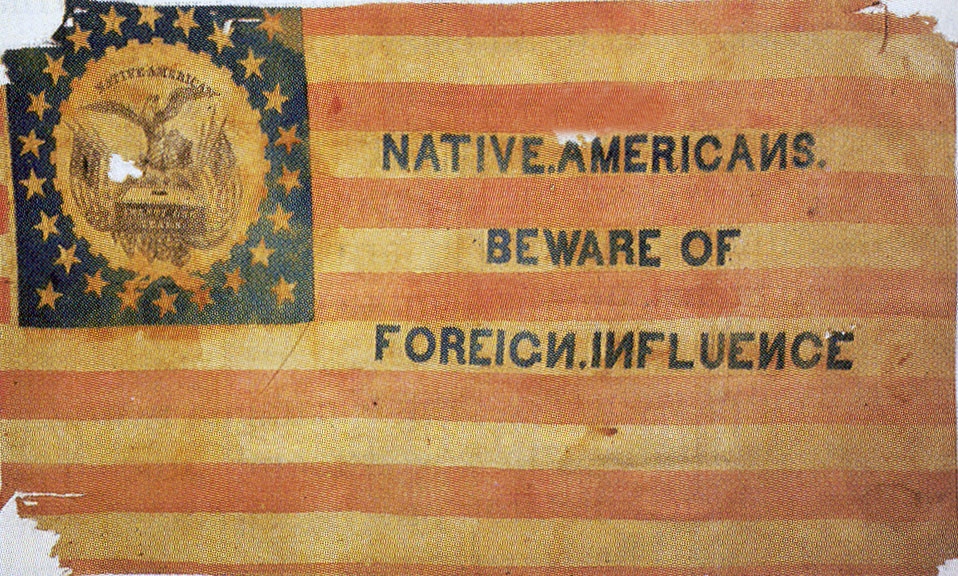
*Image is of a flag from the American "Know Nothing" movement - mid-19th century.