I was on the bus this morning and I saw a woman hurrying across the street in front of us. She was clearly anxious and as she passed the large, wide front bus window, I noticed a ball of tension rising within me. Looking at her struggling, I felt a resistance, a not wanting to "deal" with her appearance in my life.
And it hit me - this was the confused mix of compassion and control I often respond to the human-filled environment with. I felt whatever she was experiencing trying to enter me, and I both wanted to heal it, and banish it at the same time. While desiring to heal or help someone is a compassionate feeling, it often tied to a self centered desire to significantly reduce the amount of time you have to spend witnessing another person's suffering. Wanting to banish suffering can also be a noble impulse, but too often this impulse is tied to violence and/or hatred.
"Turn around the light to shine within, then just return.
The vast inconceivable source can't be faced or turned away from.
Meet the ancestral teachers, be familiar with their instruction,
Bind grasses to build a hut, and don't give up."
We are called to learn how to see ourselves, and others, completely - moment after moment. That turning "the light o shine within" allows us to act in the world, as opposed to react to it.
Shitou (author of the above) , lived a lot of his life in intimacy with the planet as it was. The ancestral trees, grasses, medicine plants, waters, mountains - these were as much his teachers as any human, if not more. At the same time, familial and cultural human ancestors probably played a large role in his life. Another reason perhaps why it took only two poems to cement his place amongst the great Buddhist teachers. He didn't need a lot of words because he had taken everything in, and wasn't controlled by it, but could engage with it fully.
Things are probably more complicated for a lot of us living now, but at the same time, there are these lines from the Sandokai:
"In the light there is darkness, but don't take it as darkness;
In the dark there is light, but don't see it as light."
Bumping up against human stress and suffering might be more concentrated now, but still is not all that different from twelve hundred years ago. The stress and suffering of the planet is probably much more in our faces now, but decay and death have always been with us.
At the same time, we don't have the luxury to just copy what the various ancestors did. Or we can, but it won't bring the liberation we say we're seeking.
In responding to changing weather conditions, soil conditions, sunlight and moonlight conditions, each generation of trees grows somewhat differently from the previous ones. And yet, through the seeds, their ancestral lineage remains fully intact.
The basis for the bodhisattva work of non-violent intervention is being able to see ourselves, and others, completely - moment after moment. And then acting from that clear seeing.
Showing posts with label Bodhisattva. Show all posts
Showing posts with label Bodhisattva. Show all posts
Thursday, October 9, 2014

Thursday, June 5, 2014
Buddhism in an Age of Manufactured Impermanence

Beautiful iris. Soon this photograph will be all that is left. Some might say the same of the Earth itself. That because nothing lasts, we shouldn't care that much if fracking has become a worldwide activity, or species extinction is happening at an alarmingly fast pace these days, or that the rainforests that many of these disappearing species live in are also disappearing, being shredded for profit. It's all inevitable, some say. I even here this kind of thing from some Buddhist practitioners, using the absolute side of the teachings to justify not attending to the care the relative side is calling us to do, especially when it comes to the non-human life on this planet.
Greed and utilitarianism seem to compete on a moment by moment basis with the recognition that the poisoned water is us. That the murdered pelicans are us. That the oil soaked land cannot possibly be separated from the marrow in our bones.

This majestic oak tree has thrived in a park near my house for longer than most of the residents in St. Paul, myself included, have been alive. Someday, like everything else, it too will die. Will it die of natural causes, or will humans take its life for some mundane or sinister purpose?
Modern civilization seems to be in the business of manufacturing impermanence. We create purposely defective products. We kill far, far more than we need to sustain ourselves. In the name of security, we blow up and poison everyone and everything in sight that is deemed a "threat." In this worldview, dandelions are terrorists. Children murdered in warzones are collateral damage. Endless hours and dollars are expended on creating technology whose sole purpose is to kill, eliminate, obliterate.
In the climate we live in, the impermanence teachings of the Buddha ancestors feel pretty impotent after a certain point. They might be of great help in creating a certain freedom of the mind. However, when applied too much to the social/world context, they become little more than reinforcement for the nihilism that's behind all the murder and destruction. It doesn't really matter that the teachings themselves are not at all nihilistic. The subtleties are too easily swamped, the raft too easily sunk.
Here's another thing. There's not enough love of the non-human world in much of modern Buddhism. Especially Empire Buddhism - that which thrives part in parcel with colonialism and the capitalist economies it spawned. Sure, we talk about love sometimes. But almost always with a healthy dose of non-attachment as a side dish, or even main dish. It's as if we do not trust the process of learning and awakening that comes with the maturation of love. Instead of living through the needed ferociousness of passionate attachment during love's formative years, too many of us opt either to be detached wallflowers or stunted puppies who endlessly miss the opportunities to grow out of infantile attachments that can't possibly help us to serve the world.
Ironically, I think it's time for some manufactured impermanence. Only instead of directing it at all the things that sustain life, let's direct it at all the things that destroy life.
For Empire Buddhism, this might mean burning down some of the cozy huts and being willing to step into an attachment to the well-being of the planet that we accept is desperately needed, even if it's a hindrance to "individual" enlightenment. It may also mean a need to tip the scales away from focusing on the impermanence teachings. Or to reconsider how to offer these teachings in a more targeted way, so that their profundity doesn't just become another cliche in service of destruction. One way to begin to address this is to stop seeking balance. Perhaps emphasizing impermanence when speaking about mind states, for example, but emphasizing protective love when speaking about social concerns and the planet.

What good are the bodhisattva teachings if we aren't willing to wildly apply them to the very Earth that gives each us our breath? Doesn't it strike you that without a planetary focus, all our efforts to help other humans won't amount to too much more than rearranging chairs on the Titanic?
Do not take that last question as minimizing human service and support of other humans. That, too, is always needed. And no doubt for many, it will be the main, if not sole focus of their efforts in life.
What I'm saying is that on a collective level, it's necessary, but not sufficient anymore. We no longer can be a self absorbed species, endlessly living out a collective adolescence. That is, we can't continue doing so without serious, most likely dire consequences as a result.
Sunday, July 1, 2012
Conventional Responsibilty and the Work of the Bodhisattva
The following is a slightly adapted e-mail I just sent to our head teacher at Clouds in Water Zen Center. She has a new post on Dongshan's five ranks that sparked some reflections I'd like to share.
Hi Byakuren,
Sorry I missed your talk this morning, because I'm guessing it was on the 5 ranks. I just read your blog post. Thank you!
Perhaps you know this already, but I was reminded of Dongshan's death story.
"According to one of the koan of his sect, Dongshan announced the end of his life several days ahead of time, and used the opportunity to teach his students one final time. In response to their grief over the news of his coming death, he told them to create a "delusion banquet". After a week of preparations he took one bite, and told them not to "make a great commotion over nothing", then went to his room and died."
What would it be like if we prepared delusion banquets regularly? Makes me think this could be a useful ritual for letting go anyone could do.
I wanted to comment on one section of your blog post.
4. Arrival at mutual integration
Two swords are crossed
The spirits of the warrior
Like a lotus flower shining in the fire
Soar high penetrating through Space.
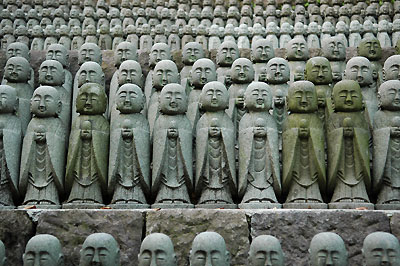
Many of us know this state. The state of being a Bodhisattva in the world, working to free all beings. It is a state of being inside of a fire. It has the intensity of sword fighters, not in their militancy, but in the heightened awareness. We feel the suffering of the world of samsara, and don’t turn back. This requires the courage of a warrior. As we return to the relative world, we burn in the suffering, going into greater and greater difficult situations to help. Jizo Bodhisattva jangling his staff to open the doors of hell and entering. The shining lotus flower needs the burning fire to exist and the practitioner has accepted being covered in the mud of the human realm. There is a true freedom in that and no need to have a duality of form and emptiness.
It strikes me that the many are thrust by circumstances into the work of the Bodhisattva. They may or may not know it at the time, but are simply responding as best as they can. It's not really a conscious choice on their part, and when the crisis is over, the many are happy to go back to something resembling the quiet, comfortable life they had. (Obviously, crises tend to change things forever, and maybe the "new life" is much different from the old.) However, I think there is as much retreat (if not more) from samsara as there are those who choose - following the initial life shaking crisis - to go into greater and greater difficult situations.
For all the engaged work I have done, I know that retreat. It's not the needed rest after a round of warrior action. It's the slide back into comfort and false ease, mostly out of fear of heading back into the fires. Part of me just wants to rest on what I have done. To say to others and the world: "I did my piece; it's someone else's work now." I think "true freedom" would be to be able to move between Bodhisattva action and stillness/non-action without such concerns about responsibility.
The more I contemplate responsibility as we understand it in the conventional sense, the more I see a stink of ownership that gets in the way. There's no fluidity in conventional responsibility. It's all about an "I" or set of "I's" who are supposed to "do" something, or not do something. And so often, it's not compassion and wisdom compelling conventional responsibility, but guilt, shame, and/or fear.
Perhaps the many thrust into circumstances have that conventional responsibility transformed by the heat of the particular situation. But I believe in order to sustain Bodhisattvahood, to act more regularly and naturally in such a way, one needs to both deliberately cultivate a mind liberated from conventional responsibility, and also must consciously choose to enter difficult situations when they can.
I have repeatedly had to overcome the fear of making mistakes, and not being "good enough," in order to step in the places I have. Had I waited until I was "ready" according to my mind, I wouldn't have gone much of anywhere.
It seems to me that those who know the "state of being a Bodhisattva" are those who are able to let themselves be burned straight through without getting burned. I get it, and I don't get it at the same time.
What an odd, wonderful world we live in.
I hope you are well. Talk to you soon.
Bows,
Nathan
Friday, December 3, 2010
Do You Have to "Do" Anything Specific to be a Buddhist?

Scott, over at the buddha is my dj, made a rare, but appreciated appearance in the form of a new post today. Having just listened to the Buddhist Geeks interview with Michael Trigilo about his new film "Bodhisattva, Superstar" two days ago, it was cool to discover Scott's reflection on the movie so quickly after.
Amongst his points, this one struck me:
Most of us know folks who are nominally Catholic — they’re the ones who only go to church on Easter or Christmas. Ask them about transubstantiation and they’ll likely tilt their heads and, at most, mutter something incoherent before changing the subject. Most of us probably know (or are at least familiar with the concept of) secular Jews — folks who are Jewish by birth and maybe they feel some strange familial pressure to have their sons circumcised but they have no qualms about eating bacon. Do they believe in God? Meh. It’s not really an issue. For some reason, these nominally religious folks are given a pass. We’re familiar with them and we don’t press them too much about their religious or spiritual lives.
But in many a Buddhist quarter, as soon as you announce to a crowded room that you are, in fact, “a Buddhist,” invariably the first question someone’s going to ask you is some form of the “do you practice?” question which almost always translates to “do you meditate?” And if, god forbid, you say no, you’re likely to suffer the stigma of not really being a Buddhist.
In the post, Scott writes about how he views his scholarly work on Buddhism as a form of practice, but that he also feels that it isn't sufficient to just do that. But he also questions the mindset that says you must meditate to be Buddhist, which he felt the movie implied is the case.
It might be helpful to note that Scott is a Shin Buddhist, a tradition that really hasn't emphasized sitting and walking forms of meditation.
As I have been bumping up against the question of "what is lay practice?," I find Scott's comments quite fascinating, in part because there are a lot of probably fruitless arguments going on in convert circles about what Buddhism is, and isn't. Everything from searching for an "essential core" of teachings to whether it's a religion or not.
But most of the converts, myself included, reside in traditions that emphasize meditation, and view doing it a lot as essential. I don't think that's a problem necessarily, and certainly I, myself, meditate a fair amount. However, it's not the only way. And my own experimenting, and the sometimes interesting reactions I get to it, show that it's kind of easy to get hung up on forms, forgetting that forms are skillful means that may or may not fit the situation at hand.
Subscribe to:
Posts (Atom)