Showing posts with label Buddhist practice. Show all posts

Monday, July 22, 2013

A Short Note to Any White American Buddhists, Yoga Practitioners, or Others Who Feel Threatened By "White Supremacy" Discussions

I wrote these points as a response to comments I received on an old post on American Buddhism and race. In light of the Trayvon Martin case, and the seemingly endless rounds of back and forth about all things race and racism, I'm offering them again.

1. Respond to criticism or perceived criticism of your spiritual practice by practicing.

2. Many of us white folks "overdo" race talk. Few of us are willing to sit with race like a koan, listen for whatever wisdom is there "behind the curtain," and then speak from that.

3. Minimizing, denying, blaming, trying to "fix," and/or judging are the standard forms of acting out in response to something we don't like, or don't want to hear. Knowing that, now what?

4. If I choose to not listen to the pain and suffering beneath someone's words today, they’ll be someone else expressing something similar tomorrow.

5. Forget trying to get all your ducks in a row. You have to act, or not act, as it is, moment after moment.

And I'll add a number six to this list.

6. Racism is ultimately a heart/mind issue. Both on the individual level, and also collective level. It's poisons can't be removed by rational debate and statistics.

Monday, October 17, 2011

Attachment to Meditation Practice


I really enjoyed this post by Andre over at Zen and Back Again. Mostly because it's familiar to me, and is something I've written about on here before.

If Zen is the practice of complete non-abiding, requiring the relinquishment of all attachments, then doesn't it serve to reason that we should let go of Zen too? For as I have found, Zen, namely zazen, can become a form of attachment.

We hear more about this regarding koans, where teachers caution their students against attaching to koans, since they are merely a raft to carry us to the other shore. Like the Buddha's teachings, they are upaya, skillful means.

But we seldom hear that said about zazen; instead, meditation, especially in Soto Zen, is regarded as the holiest of holies.

It almost feels anathema to imply that zazen can turn into a form of attachment, but try skipping 0ne day of meditation and you will soon realize how attached you are to the practice. Shame, guilt, anxiety commonly accompany a missed zazen session of mine.


Yesterday, we started a new group down at the zen center for those who have completed jukai. As one of the facilitators of the group, I introduced myself as "an eclectic practitioner" who is always experimenting. Which isn't to say I can stick with a form - such as zazen - only that I've grown more interested in how form flows in everyday life.

Having spent the last three weeks or so reading a lot about Dogen, as well as practicing with a few of his teachings, I find myself returning to some of the same things Andre is speaking about.

Dogen says that sitting is what a Buddha does. But isn't that making zazen something special by elevating it above all of our other daily activities?


The thing about Dogen's writing is that sometimes it really does seem like seated meditation is his sole focus, while other times he uses the word "Zazen" as an action in each moment. Some Soto teachers seem to lean in one direction, emphasizing seated meditation nearly all the time. While others seem to lean in the other direction, saying that Dogen applies zazen to all activities. I'm more inclined towards the latter, but sometimes it feels like a gloss over, an apology for a founding teacher that simply might have gotten too focused on seated meditation.

It's important to note the the openness to, and deep interest in, lay practitioners Dogen had during the middle of his teaching life greatly waned as he got older. At the same time, he maintained connections with at least a couple of lay disciples until the end, spending his last days in the home of one of them in Kyoto. Given the frequent social/political upheaval that marked 13th century Japan, I can imagine there was always a tension for him between upholding the practice of householders, and feeling the need to emphasize breaking away from it all and practicing in seclusion with a small group of dedicated others.

When I go back to Andre's consideration of attachment to practice, I find myself returning to the value of just paying attention. Noticing what kind of stories are arising. For example, sometimes that desire I have "to experiment" has a bit of extra added to it. Like wanting to do something novel, instead of "the same old thing." And sometimes I'm just plain giving in to laziness.

So, I have to stay vigilant around these kinds of questions, lest they become intellectual ways to trick myself, or justify opting out.

And yet, I have always felt a crunchy rub around Dogen's teachings about "zazen," and how they have come to be practiced today. Because just doing seated meditation and some ritual bows and chants doesn't constitute living the spiritual life.

What are your thoughts?

Friday, October 14, 2011

Civic Engagement as Spiritual Practice

I got a bit of a dressing down early this afternoon. A group of folks were discussing the current tent ban for the plaza we are holding Occupy MN on. At one point, a woman said something about making a large banner claiming the County Commissioners were "freezing" out the protesters. I didn't like the idea. It felt unnecessary. Just this morning, the protests in Denver were cleared out because of tents, and I figured it would be better to put in a sustained, good faith effort with public officials before getting provocative.

It's important to mention here that this sign was in conjunction with a planned tent raising to happen tomorrow afternoon. All of which feels rushed, given that we've only been doing this for a week here in Minnesota. I'm all for civil disobedience, but intelligently and strategically done civil disobedience.

Anyway, in response to the woman's suggestion, I made a comment about being specific in who you're targeting. Apparently, the person I mentioned wasn't to correct target, and this woman went off on me, saying she'd worked for the county for sixteen years and "knew exactly how the system works" and on and on.

I felt anger rise within me, but then also sensed a bit of shame twisted in that anger. Because she was right about the specifics. I had to do a lot of deep breathing, and dropping off of my opinion as she yelled at me. It was a humbling experience because I am often the one who gets the details correct in these kinds of situations. Furthermore, because I'm often the one with the details, I'm used to being a position where I get to spread them, to basically be "a teacher." So, this whole situation was a big, internal flip over for me.

As she started to run out of steam, I broke in and said "Thank you for the information. But you know, this is a good way to drive people out of here."

A few of the others agreed with me, and she looked away saying, sarcastically, "Some people don't like to get dressed down."

And one of the other people standing there said "No. We need to work on all this together. Not everyone will know it all. We need to teach each other."

He then looked at me and said "I could feel the tension there."

I said "Yeah, I really didn't want to listen to her after how she said that."

He shook his head. "See. That's what I thought. This isn't how we build this thing."

Later, I thought to myself She'd rather be right than make a relationship.

And I reflected on a few times I had chosen that route, blasting "the truth" and loosing an opportunity to connect in the process.

This is one of the blessings of active civil engagement with a diverse group of people. You get to practice letting go of everything, even the truth. And when you don't let go, there will probably be someone ready to "help" you - perhaps rudely and without warning.

I bow to everyone in that conversation. Thank you for your wisdom.

Friday, July 1, 2011

Overly Busy Buddhas


In response to my recent call for topics to talk about, regular reader Was Once offered the following:

Address the act of "doing," and why so many people are always busy... avoiding "being."


This is an interesting thing for me to consider right now, given that I have had an extended period of not working a regular job, not having multiple volunteer gigs to juggle, and generally not having a lot of "fixed" things I "need" to do. One thing that has become crystal clear during this time is how much I have, in the past, pinned my identity to what I do, what I accomplish, and what I haven't accomplished. There have been a number of times during the past several months where someone has asked me "What do you do?" and I have fumbled about, trying to list off the things I'm working on, instead of just saying something like "I'm in transition." I realized at some point that there was an underlying anxiety in these situations, a voice saying something like "Throw them a bone so you don't look lazy. Or confused. Or whatever it is you're afraid of looking like."

The reality, though, is that the question itself, one people seem so given to tossing around, demonstrates that sense that a person is only worth something if they do something. Lurking behind the question is often another one: "What have you done in the world lately?," which can easily turn into "Are you worth my attention or not?" in our fragile little minds.

So, when I think about why it is so many of us seem to be busy much of the time, it quickly becomes tied to a desire to demonstrate worthiness. Worthiness to yourself and to other people.

This is probably one of the main reasons why a lot of folks struggle to do practices like meditation on a regular basis. It can seem like doing nothing in the grand scheme of things, and isn't terribly impressive to offer in response to the question "What do you do?" or similar such questions. So much of the world seems to have succumbed to the view that life is solely, or mostly, about a series of social and economic exchanges - and that living a "good life" is built around "doing" as much as possible. Think of how much, for example, people with chronic illnesses or diminished capacities - even people who have given so much of their lives to others - think of how much they often struggle to accept a mostly being existence.

The first lines of Shitou's "Song of the Grass Roof Hermitage" go like this:

I've built a grass hut where there's nothing of value.
After eating, I relax and enjoy a nap.
When it was completed, fresh weeds appeared.
Now it's been lived in - covered by weeds.


There's a demonstration here, I believe, of the balance between action and non-action. Between doing and being done through. One of the problems with always being busy is that it sets forth a momentum of always being busy. Trying to get off that kind of karma train is pretty difficult. In fact, because of it's fierce momentum, it often takes something dramatic, something traumatic, to get derailed. And even then, many of us think that this derailing is something horrible, something that is going to destroy our very worthiness as humans, and so we put all our effort into catching back up to the very train that brought us down.

What do you think is behind your "busy"? What has helped you not do so much?

Friday, December 3, 2010

Do You Have to "Do" Anything Specific to be a Buddhist?


Scott, over at the buddha is my dj, made a rare, but appreciated appearance in the form of a new post today. Having just listened to the Buddhist Geeks interview with Michael Trigilo about his new film "Bodhisattva, Superstar" two days ago, it was cool to discover Scott's reflection on the movie so quickly after.

Amongst his points, this one struck me:

Most of us know folks who are nominally Catholic — they’re the ones who only go to church on Easter or Christmas. Ask them about transubstantiation and they’ll likely tilt their heads and, at most, mutter something incoherent before changing the subject. Most of us probably know (or are at least familiar with the concept of) secular Jews — folks who are Jewish by birth and maybe they feel some strange familial pressure to have their sons circumcised but they have no qualms about eating bacon. Do they believe in God? Meh. It’s not really an issue. For some reason, these nominally religious folks are given a pass. We’re familiar with them and we don’t press them too much about their religious or spiritual lives.

But in many a Buddhist quarter, as soon as you announce to a crowded room that you are, in fact, “a Buddhist,” invariably the first question someone’s going to ask you is some form of the “do you practice?” question which almost always translates to “do you meditate?” And if, god forbid, you say no, you’re likely to suffer the stigma of not really being a Buddhist.


In the post, Scott writes about how he views his scholarly work on Buddhism as a form of practice, but that he also feels that it isn't sufficient to just do that. But he also questions the mindset that says you must meditate to be Buddhist, which he felt the movie implied is the case.

It might be helpful to note that Scott is a Shin Buddhist, a tradition that really hasn't emphasized sitting and walking forms of meditation.

As I have been bumping up against the question of "what is lay practice?," I find Scott's comments quite fascinating, in part because there are a lot of probably fruitless arguments going on in convert circles about what Buddhism is, and isn't. Everything from searching for an "essential core" of teachings to whether it's a religion or not.

But most of the converts, myself included, reside in traditions that emphasize meditation, and view doing it a lot as essential. I don't think that's a problem necessarily, and certainly I, myself, meditate a fair amount. However, it's not the only way. And my own experimenting, and the sometimes interesting reactions I get to it, show that it's kind of easy to get hung up on forms, forgetting that forms are skillful means that may or may not fit the situation at hand.

Wednesday, November 17, 2010

The Art of Buddhist Practice


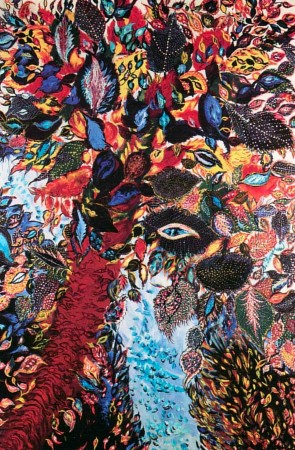
The above image is a painting by early 20th century artist Seraphine Louis. Last night, I watched a recent film about her life, and the unusual relationship she had with a well known German art critic and dealer, Wilhelm Uhde, who was also instrumental in bringing to prominence the work of Henri Rousseau. If you can't tell, I'm a bit of an obsessive when it comes to late 19th century, early 20th century art in general, so it was quite fun to discover the story of Seraphine, and her art.

Seraphine was, in 1912, a poor, unknown domestic worker living in a small town just north of Paris when she became the housekeeper for Mr. Uhde. When he discovered one of her paintings, and was told she was the artist, he began to offer support for her work, the same work that had been ridiculed by the few others who knew about it, and which Seraphine spent most of the little money she had on the painting supplies for doing it. The outbreak of World War I forced Uhde to leave France, and leave Seraphine behind, but apparently he never forgot about her. Thirteen years later, he found himself drawn to an exhibit of local artists in which he came upon one of Seraphine's paintings. A well known modern art collector by this time, Uhde immediately began financially underwriting her career, and arranging to exhibit her works.

One might think there's a love story behind all of this. And there was, I think, but not the usual kind. Uhde was gay, a pacifist in war torn Germany, a Jew who later spent the Second World War years hiding in southern France, and a collector of art that, when he began collecting it, was hated or ignored by nearly all the prominent art critics of the time. Louis was a secretive, marginalized, and mostly isolated artist, who was religiously inspired (her paintings were said to be offerings to the Virgin Mary) in such an intense way it seems to have sent her over the edge. So, when I say there was a love story, it is that of two people who recognized each others' uniqueness and, for a time, were intimately connected through that recognition.

This post is thus, in some ways, piggy backing off yesterday's post about the relational quality of Buddhist practice. There is something quite important about being able to recognize the uniqueness of each other, just as it is important to realize that at the bottom of it all, there are no individuals or real differences. It's one of the paradoxes of Buddhist teachings that people enjoy soundbyting, but which probably makes most of us uneasy when we sit with it long enough.

One of the beautiful things about the story of Seraphine and Udhe is how improbable it is on a conventional level. They were from completely different economic classes. Their meeting was, it seems, almost accidental, as was the way in which Udhe stumbled upon an early painting of Seraphine's at a neighbor's house. There was no romantic tie that often is the glue that brings together seemingly disparate people. And then there was the reunion after a World War, and over a decade's worth of time and distance.

In my view, the power of stories like this are in the ways in which they shatter cherished views about how the world works, and what we believe the future will be based upon our past. It's so easy to think you're doomed because of past failures, or that you're bound to be successful because of past "good deeds," but truly, the world functions in it's own way. That's not to say that the past isn't important - it certainly is. But it's not the one to one correspondence that pop culture views of karma often say it is.

The tragedy of Seraphine's later years also, you might say, speaks to this. The Great Depression forced Udhe to suspend the financial support he'd been offering, and Seraphine began having visions of coming of the end of the world, which eventually led to her commitment in a psych ward, where she spent the last ten years of her life, isolated again and uninterested in painting.

One of things I have wondered about for a long time is the intensity that comes with dedication to artistic expression and/or spiritual life. Often found in tandem, the lines between piercing through to the great truths of this life, and going insane, seem very thin and I think this is why many people shy away when they get anywhere near that edge. Van Gogh is probably one of the easiest to recognize modern cases of this edge - an intense young man with a missionary passion who has an equally intense burst of artwork that ends up astonishing people over a hundred years later. And it was all too much for him to handle.

The kinds of intensities experienced by Van Gogh and Seraphine probably feel quite remote for most of us. But I do think their stories can be somewhat instructive to modern Buddhist lay practitioners, trying to "fit it all in" or who might be, in spite of all the teachings, trying to achieve enlightenment, or something of the like. Somewhere along the line, both Seraphine and Van Gogh ceased to be able to navigate the waters of their visions. Although the full stories won't ever be known, regardless of what evidence is available, a few things connect their stories.

1. Isolation. Both artists had intense spiritual longings and visions that were coupled with deprived or strained social lives. The relational aspect was broken down for much of the lives of both of these artists, which I'd say was a major factor in their final breaking points.

2. Marginalized living with "bad habits." Although a lot isn't known about Seraphine's life, it's probable the the years of poverty she experienced had an effect on her physical and emotional health. And certainly, the smoking and lousy diet Van Gogh lived on had a negative impact on his health and well being.

3. Overworking and overdoing it. This is, in my view, where the connection between these artists and modern Buddhist lay practitioners might be most useful. Both Van Gogh and Serphine over did it when it came to their art, and the other work needed to support their art. And it's probably also the case that they both were driven to do this by a spiritual passion, a desire to embody the visions they had into a concrete form - a longing I have had myself, and also see embodied in the art and writing of masters from all periods of recorded human history.

But the danger, it seems, lies in the slide away from some sort of balance, from understanding one's internal compass well enough to know when to push and when to pull back. This has been precisely the place I have been exploring over the past year or so, and it is where many of my comments about lay practice, including the repeated undercutting of the primacy of meditation retreats and hours of sitting practice, are coming from. It's not about denying their impact on people; it's about a deep inquiry into what balance means for a spiritually focused person living in the everyday, busy world.

Just as Seraphine and Van Gogh were compelled to draw and paint the world they saw and experienced, I have, for most of my life, been compelled to write the world I experience in some form or another. And I feel that instead of idealizing the struggles past artists and writers had, and/or loving their art but dismissing their lives as failures in some sense, I feel called to learn from them as the whole people they were.

In a way, I am similar to Zen teacher Brad Warner in viewing Buddhist practice as an art form which, over the course of one's life, can change it's appearance many times. Sometimes, it might be deeply introspective, highly meditative. Other times, it might be radically social, pushing across established social norms and oppressive practices. Sometimes, it's full of faith and joy. Other times, it's almost all doubt and suffering.

These changes are all, in their own ways, quite beautiful. But learning to ride the horse of those changes is difficult, and I think not completely respected by even most spiritually-minded folks. People like routines, conformity, predictability, comfort, and knowing - all qualities that disappear at times if you are truly riding your horse, and not the horse someone else thinks you should have.

So, in writing this, I am offering a vow to my own "horse of life," and perhaps in doing so publicly, it might inspire others. At the very least, maybe you'll discover an obscure, but powerful artist in Seraphine, and find her story compelling in some way or another.