Showing posts with label art. Show all posts

Saturday, March 5, 2011

Art as a Gateway to Early Western Buddhist History


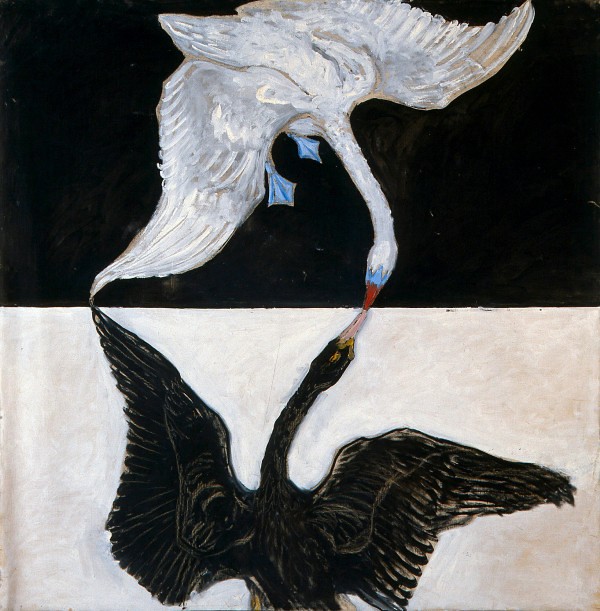
*Painting by Hilma af Klint, 1862-1944.

Those who have been longtime readers of this blog know that I have an affinity for late 19th and early 20th century painting. I also am quite fond of reading about the artist's lives, in great part because some of them were really wild folks. In addition, the vast majority of my favorites were interested in "Eastern" religion and philosophy, to the point where their artwork is influenced to a greater or lesser extent by it. In addition, in terms of this blog, this time period was the beginning of more deliberate movement of Buddhists and Buddhist teachings to North America and Europe, and thus is important for developing an understanding of the ways in which teachings, rituals, cultural and religious structures were adapted in response to new surroundings, both by Asian immigrant Buddhists and by the mostly white North American and European types who either studied, cherry picked, or eventually converted to Buddhism.

Swedish artist Hilda af Klint was, like many others of the period, influenced primarily by the teachings of Theosophy. In a lot of ways, theosophy paved the way for the New Age movement, especially with it's emphasis on blending spiritual and religious teachings and focus on the evolution of consciousness. It's an interesting, if odd mixture of things, and certainly one can argue that Blavatsky and others cherry picked and culturally appropriated a myriad of traditions to suit their needs. However, it also can be viewed as the spirited, if overreaching reaction of spiritual people to a world that suddenly was becoming globally connected right before their eyes. We are in a similar period now, with the internet and other technology, making the gap between nations even smaller - and in the process, shaking up the entire way we - as humans - understand and interact.

Klint was, by all accounts, a sane and balanced artist, who also happened to be regarded as a clairvoyant, driven to paint by an unseen "guide," and whose art somehow repeatedly anticipated and demonstrated principles that would appear years later on the canvases of famed European and American modernists and abstractionists. In addition, she was fairly secretive about her work, showing little of it publicly during her life. Her dying wish, in fact, was that her paintings not be shown in public for twenty years. Perhaps she wondered if people would be able to handle them.

Several of her paintings have to do with the integration or merger of two figures, or dualities. Of this, Ronald Jones and Liv Stolz wrote:

Between 1906 and 1915 she completed ‘Paintings for the Temple’ (182 paintings divided into a number of different series) in which she sought to represent the path towards the reconciliation of spirituality with the material world, along with other dualities: faith and science, men and women, good and evil.


I have often felt that a central feature of our life's work, and which is demonstrated in Buddha's teachings, is reconciling ourselves with the myriad of dualities at play in our lives.

In addition, it's interesting to consider that Klint often painted following a period of meditation. Yes, her meditation probably looked little like "our" meditation, but that's of secondary note in my view. What's fascinating is the merger of meditation with a focus on reconciling the opposites, something Buddhists can certainly appreciate, if anything.

I suppose some of you might be thinking. Ok, so what? Well, even if you could care less about art or weird occult stuff, there is still something worth considering from a Buddhist practitioner standpoint. Late 19th and early 20th century white Westerners who ended up adopting Buddhism were products of this time. For better or worse, they were influenced by the synthesizing processes present in both the philosophies of the time (such as theosophy), as well as the art of the time (which included more famous artists influenced by synthesized spirituality. Searching for the "essence" of traditions, and "stripping away cultural baggage," two highly contested issues amongst contemporary Western Buddhist circles, were the calling cards of the day back then. People wound up about Stephen Batchelor and friends today might consider that Henry Steel Olcott, one of the first white convert Buddhists, was merging Buddhist teachings with Western science, philosophy, and rationalism, over 120 years ago.

In other words, issues that seem to be the product of our current wave of Buddhist expansion have their roots in the past. So, while we continue to struggle with defining what it is that we mean by Buddhism in the West, perhaps it would be valuable to go further back in time, and consider more thoroughly how the planks we stand on today were laid. And if nothing else, there is plenty of beautiful artwork and interesting life stories just waiting to be re-discovered.

Wednesday, November 17, 2010

The Art of Buddhist Practice


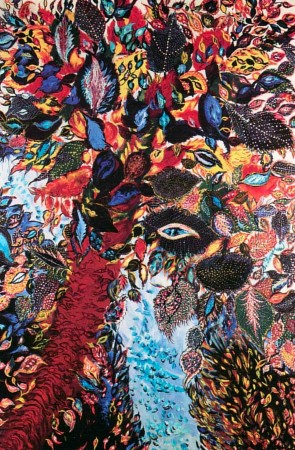
The above image is a painting by early 20th century artist Seraphine Louis. Last night, I watched a recent film about her life, and the unusual relationship she had with a well known German art critic and dealer, Wilhelm Uhde, who was also instrumental in bringing to prominence the work of Henri Rousseau. If you can't tell, I'm a bit of an obsessive when it comes to late 19th century, early 20th century art in general, so it was quite fun to discover the story of Seraphine, and her art.

Seraphine was, in 1912, a poor, unknown domestic worker living in a small town just north of Paris when she became the housekeeper for Mr. Uhde. When he discovered one of her paintings, and was told she was the artist, he began to offer support for her work, the same work that had been ridiculed by the few others who knew about it, and which Seraphine spent most of the little money she had on the painting supplies for doing it. The outbreak of World War I forced Uhde to leave France, and leave Seraphine behind, but apparently he never forgot about her. Thirteen years later, he found himself drawn to an exhibit of local artists in which he came upon one of Seraphine's paintings. A well known modern art collector by this time, Uhde immediately began financially underwriting her career, and arranging to exhibit her works.

One might think there's a love story behind all of this. And there was, I think, but not the usual kind. Uhde was gay, a pacifist in war torn Germany, a Jew who later spent the Second World War years hiding in southern France, and a collector of art that, when he began collecting it, was hated or ignored by nearly all the prominent art critics of the time. Louis was a secretive, marginalized, and mostly isolated artist, who was religiously inspired (her paintings were said to be offerings to the Virgin Mary) in such an intense way it seems to have sent her over the edge. So, when I say there was a love story, it is that of two people who recognized each others' uniqueness and, for a time, were intimately connected through that recognition.

This post is thus, in some ways, piggy backing off yesterday's post about the relational quality of Buddhist practice. There is something quite important about being able to recognize the uniqueness of each other, just as it is important to realize that at the bottom of it all, there are no individuals or real differences. It's one of the paradoxes of Buddhist teachings that people enjoy soundbyting, but which probably makes most of us uneasy when we sit with it long enough.

One of the beautiful things about the story of Seraphine and Udhe is how improbable it is on a conventional level. They were from completely different economic classes. Their meeting was, it seems, almost accidental, as was the way in which Udhe stumbled upon an early painting of Seraphine's at a neighbor's house. There was no romantic tie that often is the glue that brings together seemingly disparate people. And then there was the reunion after a World War, and over a decade's worth of time and distance.

In my view, the power of stories like this are in the ways in which they shatter cherished views about how the world works, and what we believe the future will be based upon our past. It's so easy to think you're doomed because of past failures, or that you're bound to be successful because of past "good deeds," but truly, the world functions in it's own way. That's not to say that the past isn't important - it certainly is. But it's not the one to one correspondence that pop culture views of karma often say it is.

The tragedy of Seraphine's later years also, you might say, speaks to this. The Great Depression forced Udhe to suspend the financial support he'd been offering, and Seraphine began having visions of coming of the end of the world, which eventually led to her commitment in a psych ward, where she spent the last ten years of her life, isolated again and uninterested in painting.

One of things I have wondered about for a long time is the intensity that comes with dedication to artistic expression and/or spiritual life. Often found in tandem, the lines between piercing through to the great truths of this life, and going insane, seem very thin and I think this is why many people shy away when they get anywhere near that edge. Van Gogh is probably one of the easiest to recognize modern cases of this edge - an intense young man with a missionary passion who has an equally intense burst of artwork that ends up astonishing people over a hundred years later. And it was all too much for him to handle.

The kinds of intensities experienced by Van Gogh and Seraphine probably feel quite remote for most of us. But I do think their stories can be somewhat instructive to modern Buddhist lay practitioners, trying to "fit it all in" or who might be, in spite of all the teachings, trying to achieve enlightenment, or something of the like. Somewhere along the line, both Seraphine and Van Gogh ceased to be able to navigate the waters of their visions. Although the full stories won't ever be known, regardless of what evidence is available, a few things connect their stories.

1. Isolation. Both artists had intense spiritual longings and visions that were coupled with deprived or strained social lives. The relational aspect was broken down for much of the lives of both of these artists, which I'd say was a major factor in their final breaking points.

2. Marginalized living with "bad habits." Although a lot isn't known about Seraphine's life, it's probable the the years of poverty she experienced had an effect on her physical and emotional health. And certainly, the smoking and lousy diet Van Gogh lived on had a negative impact on his health and well being.

3. Overworking and overdoing it. This is, in my view, where the connection between these artists and modern Buddhist lay practitioners might be most useful. Both Van Gogh and Serphine over did it when it came to their art, and the other work needed to support their art. And it's probably also the case that they both were driven to do this by a spiritual passion, a desire to embody the visions they had into a concrete form - a longing I have had myself, and also see embodied in the art and writing of masters from all periods of recorded human history.

But the danger, it seems, lies in the slide away from some sort of balance, from understanding one's internal compass well enough to know when to push and when to pull back. This has been precisely the place I have been exploring over the past year or so, and it is where many of my comments about lay practice, including the repeated undercutting of the primacy of meditation retreats and hours of sitting practice, are coming from. It's not about denying their impact on people; it's about a deep inquiry into what balance means for a spiritually focused person living in the everyday, busy world.

Just as Seraphine and Van Gogh were compelled to draw and paint the world they saw and experienced, I have, for most of my life, been compelled to write the world I experience in some form or another. And I feel that instead of idealizing the struggles past artists and writers had, and/or loving their art but dismissing their lives as failures in some sense, I feel called to learn from them as the whole people they were.

In a way, I am similar to Zen teacher Brad Warner in viewing Buddhist practice as an art form which, over the course of one's life, can change it's appearance many times. Sometimes, it might be deeply introspective, highly meditative. Other times, it might be radically social, pushing across established social norms and oppressive practices. Sometimes, it's full of faith and joy. Other times, it's almost all doubt and suffering.

These changes are all, in their own ways, quite beautiful. But learning to ride the horse of those changes is difficult, and I think not completely respected by even most spiritually-minded folks. People like routines, conformity, predictability, comfort, and knowing - all qualities that disappear at times if you are truly riding your horse, and not the horse someone else thinks you should have.

So, in writing this, I am offering a vow to my own "horse of life," and perhaps in doing so publicly, it might inspire others. At the very least, maybe you'll discover an obscure, but powerful artist in Seraphine, and find her story compelling in some way or another.

Thursday, June 3, 2010

Hunter Clarke's Surprising Buddha


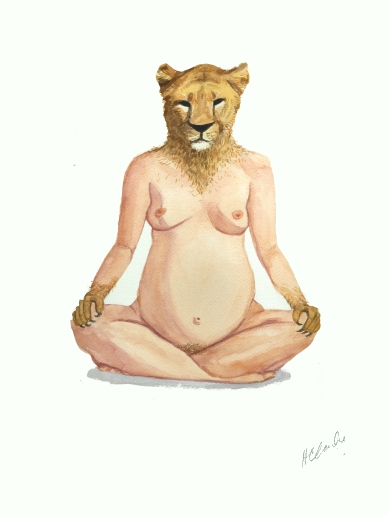
Who is Hunter Clarke? Well, she's a fairly young artist whose work I just discovered, and also the painter of the above image.

This watercolor is from a series of paintings entitled "Bestiarius" that involve various animal heads attached to nude, mostly pregnant, female bodies.

The author of her circle ezine, a web journal exploring "the feminine experience in the world community," wrote the following about Clarke's series in 2008:

Clarke is comfortable with her ties to traditional aesthetics. And, like many symbolic representations, her work conveys universal themes while at the same time, are connected to her personal experiences. Her fascination with flight, for example, changed when she became pregnant and her attention seemed to take a natural turn toward more “grounded” subject matter as represented by the egg.

Her own experiences during pregnancy influenced the themes of “Bestiarius”, connected to changing responses and feelings that began to surface, and an awareness of more “Instinctive, primal” feelings as a pregnant woman: her sense of protection, of the relationships between nurturing and predator behavior, the strangeness of having a life growing inside. All of these feelings made their way into the series, as did that desire to continue representing women with a presence of strength.


Being a man, I'll never know these experiences quite so intimately. I have to rely on stories, poems, music, and paintings like this to get any real sense at all.

But what initially struck me about this image is that it's very Buddha-like. And yet, also not. Personally, I love when someone deliberately makes an effort to disturb the accepted, commonplace, or traditional in a way that doesn't destroy the disturbed, but certainly displaces it. I have no idea if Hunter Clarke has any interest in Buddhism, or had any thoughts at all about Buddha images when she painted this. But this entire series of paintings is certainly about disruption of commonplace images, which is why I felt all the more that this one was worth sharing with you all.

What do you think?

*Check out more of her work here.