Yesterday was my final post over at Buddhist Peace Fellowship. They have a rotating Guest Editorship that is designed to feature a new writer every quarter, and I invite everyone here to continue checking out the work over there. You can also read co-director Katie Loncke's send off post on my efforts here.
What's next isn't fully determined yet. I have a few writing project ideas, and maybe someone else will come calling for more of my work :) Meanwhile, I'll be writing here again more.
Talk with you all soon!
Showing posts with label writing. Show all posts
Showing posts with label writing. Show all posts
Friday, November 1, 2013

Sunday, August 21, 2011
Elephant Journal's Got Issues
This post might ruffle some feathers. For others, it's probably been their opinion for a long time.
It started with some reactions to the following video, which has been making the rounds on various websites.
I'm not going to comment on the video itself, but want to focus in on one site of "discussion" in regards to the content of the video: Elephant Journal. For anyone not in the know, Elephant Journal is a fairly popular web-journal that centers itself around yoga , Buddhism, and environmentalism. A few years back, I was a regular reader of EJ. More recently, I have been on the fence about EJ - liking some of the content, but also finding some of the content fluffy and feel-good. Yet, while others took shots at the journal's editor, Waylon Lewis, last year after an incident involving one of his former writers, I tried to focus on the issues being brought up by the former EJ writer about some potential corruption in an American Buddhist sangha.
However, with the following display of stupidity and arrogance, all in the name of shits and giggles, I'm leaping off the EJ fence on the side of something else, anything really that is willing to handle issues with more maturity and integrity.
Now, in full disclosure, I was contacted by one of EJ's editors last month, seeking new Buddhist columnists. My subsequent attempts to return that correspondence and find out more details about their writing policies, at multiple e-mail addresses, including the main EJ e-mail address, went unanswered. In addition, about a year and a half ago, another blogger recommended my writing to EJ, and when I sent a few sample columns in, they first got lost, and then were received, but never commented on.
I bring this up because as a former journal editor, I'm aware of the challenges that come with dealing with unsolicited material. We occasionally lost pieces that were sent to us as well, even after taking care to keep everything organized in piles by genre. And so that, in and of itself, is something any writer should be aware of. However, it's quite different if you either have solicited work from someone, or had work recommended to you by another writer. Dropping the ball on those as an editorial team is a screw up, the kind that can negatively impact your reputation. My literary journal lost a set of poems by a fairly well known author and had to send her an apology letter and ask for second copies. Fortunately, she handled it gracefully.
So, I didn't plan on offering the story about what felt to me like fumbled communications regarding my writing with Elephant Journal. However, after reading the post I cited above, as well as this one, from the yoga blogger whose comments sparked the EJ post, and finally this post by another yoga blogger, I felt compelled to say something.
What exactly? Well, first off, when done well, spiritual
humor is absolutely illuminating and sometimes the best teaching anyone could have. That said, much of the humor on EJ doesn't hit that mark. And if you're choosing to raise the bar, and add race into the mix, like the video above does, then you better damned well get it right. Or your flop is gonna be fucking massive. And frankly the comments from Waylon Lewis in response to disagreements about the "humor value" of the Yoga for Black People video are a fucking massive flop.
Secondly, any publication that has 48,000 readers needs to recognize that it has some responsibility on it hands. Even if you cut that number in half - considering the inflation of stats that occur online - that's still 24,000 readers. Not chump change in other words. I have no interest in detailing out what constitutes "responsibility" because that depends upon what you ultimately decide your target audience is, who your writers might be, and what you wish your publication to do in the world.
Which brings me to the third point - Elephant Journal is a publication with an identity crisis. Is it a spiritual humor website? Is it aiming to offer serious content that might teach people? Is it a political website using spiritual content as an enticing companion to pro-Democratic Party propaganda?
What is it?
Perhaps if it were easily identified as a spiritual humor website, for example, people looking for anything other than that might avoid it all together. There still might be heated discussion about issues like the Yoga for Black People video, but at least the focus of the journal, as well as the intent of the editorial team, would be much less in question.
But as it is now, the mission and direction of EJ seem pretty unclear to me. I actually was surprised that anyone from EJ contacted me about my writing, seeing as the work I sent over previously never was responded to, and since then I haven't really seen what I do here at Dangerous Harvests as compatible with a lot of what Elephant Journal is doing. Which again isn't a total dismissal of what's happening over there - I do enjoy some of the writers they have very much. However, I'm just really unclear how my writing would fit in at EJ, which leads me back to the point about mission and direction. If you don't have enough clarity, it's damned easy to stir up confusion and misery.
So, I write all of this knowing that a lot of folks online have already taken a stance on Elephant. Some will defend it nearly to the death. Others desire its death post haste. I'm not in either of those camps. Knowing how much work it is to establish a readership and develop a quality journal, I'm not one to flippantly wish death to a publication. And also knowing how much bs occurs behind the scenes and sometimes on the pages of many journals and magazines, I'm also not one to go soft on criticism when criticism is due.
So, this post is an offering to EJ's editorial team, and to anyone else who is running well read blogs, spiritual magazines, or web-journals. I fully admit that I am not an impartial observer, and that I may not have every last fact available. In fact, I'm not completely sure that I have maintained right speech throughout this article. However, I felt compelled to say something, and share the blog posts of others who had something to say about these recent happenings over at Elephant Journal.
May something beneficial come out of all of this.
It started with some reactions to the following video, which has been making the rounds on various websites.
I'm not going to comment on the video itself, but want to focus in on one site of "discussion" in regards to the content of the video: Elephant Journal. For anyone not in the know, Elephant Journal is a fairly popular web-journal that centers itself around yoga
, Buddhism, and environmentalism. A few years back, I was a regular reader of EJ. More recently, I have been on the fence about EJ - liking some of the content, but also finding some of the content fluffy and feel-good. Yet, while others took shots at the journal's editor, Waylon Lewis, last year after an incident involving one of his former writers, I tried to focus on the issues being brought up by the former EJ writer about some potential corruption in an American Buddhist sangha. However, with the following display of stupidity and arrogance, all in the name of shits and giggles, I'm leaping off the EJ fence on the side of something else, anything really that is willing to handle issues with more maturity and integrity.
Now, in full disclosure, I was contacted by one of EJ's editors last month, seeking new Buddhist columnists. My subsequent attempts to return that correspondence and find out more details about their writing policies, at multiple e-mail addresses, including the main EJ e-mail address, went unanswered. In addition, about a year and a half ago, another blogger recommended my writing to EJ, and when I sent a few sample columns in, they first got lost, and then were received, but never commented on.
I bring this up because as a former journal editor, I'm aware of the challenges that come with dealing with unsolicited material. We occasionally lost pieces that were sent to us as well, even after taking care to keep everything organized in piles by genre. And so that, in and of itself, is something any writer should be aware of. However, it's quite different if you either have solicited work from someone, or had work recommended to you by another writer. Dropping the ball on those as an editorial team is a screw up, the kind that can negatively impact your reputation. My literary journal lost a set of poems by a fairly well known author and had to send her an apology letter and ask for second copies. Fortunately, she handled it gracefully.
So, I didn't plan on offering the story about what felt to me like fumbled communications regarding my writing with Elephant Journal. However, after reading the post I cited above, as well as this one, from the yoga blogger whose comments sparked the EJ post, and finally this post by another yoga blogger, I felt compelled to say something.
What exactly? Well, first off, when done well, spiritual
humor is absolutely illuminating and sometimes the best teaching anyone could have. That said, much of the humor on EJ doesn't hit that mark. And if you're choosing to raise the bar, and add race into the mix, like the video above does, then you better damned well get it right. Or your flop is gonna be fucking massive. And frankly the comments from Waylon Lewis in response to disagreements about the "humor value" of the Yoga for Black People video are a fucking massive flop.
Secondly, any publication that has 48,000 readers needs to recognize that it has some responsibility on it hands. Even if you cut that number in half - considering the inflation of stats that occur online - that's still 24,000 readers. Not chump change in other words. I have no interest in detailing out what constitutes "responsibility" because that depends upon what you ultimately decide your target audience is, who your writers might be, and what you wish your publication to do in the world.
Which brings me to the third point - Elephant Journal is a publication with an identity crisis. Is it a spiritual humor website? Is it aiming to offer serious content that might teach people? Is it a political website using spiritual content as an enticing companion to pro-Democratic Party propaganda?
What is it?
Perhaps if it were easily identified as a spiritual humor website, for example, people looking for anything other than that might avoid it all together. There still might be heated discussion about issues like the Yoga for Black People video, but at least the focus of the journal, as well as the intent of the editorial team, would be much less in question.
But as it is now, the mission and direction of EJ seem pretty unclear to me. I actually was surprised that anyone from EJ contacted me about my writing, seeing as the work I sent over previously never was responded to, and since then I haven't really seen what I do here at Dangerous Harvests as compatible with a lot of what Elephant Journal is doing. Which again isn't a total dismissal of what's happening over there - I do enjoy some of the writers they have very much. However, I'm just really unclear how my writing would fit in at EJ, which leads me back to the point about mission and direction. If you don't have enough clarity, it's damned easy to stir up confusion and misery.
So, I write all of this knowing that a lot of folks online have already taken a stance on Elephant. Some will defend it nearly to the death. Others desire its death post haste. I'm not in either of those camps. Knowing how much work it is to establish a readership and develop a quality journal, I'm not one to flippantly wish death to a publication. And also knowing how much bs occurs behind the scenes and sometimes on the pages of many journals and magazines, I'm also not one to go soft on criticism when criticism is due.
So, this post is an offering to EJ's editorial team, and to anyone else who is running well read blogs, spiritual magazines, or web-journals. I fully admit that I am not an impartial observer, and that I may not have every last fact available. In fact, I'm not completely sure that I have maintained right speech throughout this article. However, I felt compelled to say something, and share the blog posts of others who had something to say about these recent happenings over at Elephant Journal.
May something beneficial come out of all of this.
Tuesday, July 5, 2011
Downloading Dharma Books and Ethics
There's an excellent discussion going on over at American Buddhist Perspective about the ethics of downloading dharma books. The post centers around a site called Buddhisttorrents, which I have visited once or twice, but never really looked at closely. In fact, it's only now that I see the site has an extensive collection of dharma books available for free download. The few times I glanced at it, I thought it was a book review website.
Here's a clip from the ABP blog post:
I definitely agree that new business models are needed. As a writer in multiple disciplines - from spiritual blogging to poetry, I find the current flux in the publishing world quite confusing. Just a decade ago, I was in a graduate level creative writing program, learning how to write query letters and locate which print journals I could publish work in to build a case for getting, for example, poetry books published. Online publishing, including blogs, was mostly the realm of hacks, tech nerds, and amateurs with little interest in actually going through the hoops to get their work published "legitimately." It's amazing how quickly things can change. Although the old ways of getting your writing published still work to some extent, the internet has opened up so many other opportunities, and with that, a lot of questions.
Of course, as a Buddhist, all this brings to mind the second precept. Here are a few translations.
Thich Nhat Hanh's version is very specific.
And here's a more simple version from a dharma talk by Kusala Bhikshu
One of the challenges of the economic system many of us currently live under is the lack of generosity it displays in it's very roots. The intellectual property rights laws and framework, which I and any publisher might use to "protect" whatever writing we seek to publish, create a logjam around it that frequently discourages sharing. At the same time, simply ridding ourselves of this system basically means leaving millions of writers, artists, and others in a financial lurch.
In some ways, I have always thought that finding ways to decouple the income of artists and writers from the specific "end products" they make is part of the answer. Having to sell every last piece of writing or chunk of pottery to make ends meet financially has always seemed like a crazy expectation to me. And yet, if you talk to the average middle level manager of a Fortune 500 corporation, or rank and file elected official, you'll probably find little sympathy for writers and artists. Produce a crap load of marketable stuff, have a "real" job, or stop doing it all together will be the three comments you'll most likely hear from these folks, and many others. Some of these same people will have offices filled with art and books, and can't imagine a life without some "culture," as long as that culture comes as a cheap afterthought of course.
So, it's hard for me - as one of those writers and artists who makes next to nothing on his work - to know how to respond to something like pirated dharma books. I can say I have downloaded maybe four or five books over the years, almost exclusively things I figured I would never see a paper copy of in a bookstore. I also had a short phase of downloading music files, but that was years ago, before Napster's downfall and the lawsuits that followed. There are other things I do download, like articles and podcasts, which mostly are being offered freely by the people who made them. Overall, though, I'm just less of a collector than I used to be. So, even if I'm really into something like a writer or musician, I'm rarely rushing out to find all the material he or she has produced anymore.
But I keep coming back to a question. How can we all be more generous? What can be done to maximize generosity towards writers, artists, publishers, and the rest of us participating in the circle?
That's what I'll offer today. Those questions. Feel free to add to the discussion with your comments and questions as well.
Here's a clip from the ABP blog post:
One of the most common defenses of torrents made in the comments at Buddhisttorrents is that the people downloading books are people who could not have bought them otherwise. To the extent that this is true, torrents don't hurt authors or publishers. Another comment made many times is that the torrents actually increase sales by exposing more material to people. To the extent this is true, torrents actually help authors and publishers. I would love to see some empirical evidence for either of these.
The same goes for the music industry. In reading up a bit on the laws of music downloading, I found this:
And album sales aren't haemorrhaging in the doom-mongering way we have been led to believe. Single sales have dropped, but 28 million more albums were sold last year than a decade ago, including digital sales. Live performances, which account for more than half of the industry's profits, are unaffected by downloads – and may even be boosted by the opportunity they offer for young people on tight budgets to sample the music they might like to hear at a concert.
So the music industry survived, and continues to thrive. And movie box-office numbers don't seem to be going down as more movies end up on the internet. So, can publishers and authors continue on? I hope so.
I think what may be needed is a new business model. Perhaps a Netflix of books. Or more use of advertising so that free content makes money.
I definitely agree that new business models are needed. As a writer in multiple disciplines - from spiritual blogging to poetry, I find the current flux in the publishing world quite confusing. Just a decade ago, I was in a graduate level creative writing program, learning how to write query letters and locate which print journals I could publish work in to build a case for getting, for example, poetry books published. Online publishing, including blogs, was mostly the realm of hacks, tech nerds, and amateurs with little interest in actually going through the hoops to get their work published "legitimately." It's amazing how quickly things can change. Although the old ways of getting your writing published still work to some extent, the internet has opened up so many other opportunities, and with that, a lot of questions.
Of course, as a Buddhist, all this brings to mind the second precept. Here are a few translations.
Thich Nhat Hanh's version is very specific.
"Aware of the suffering caused by exploitation, social injustice, stealing, and oppression, I undertake to cultivate loving kindness and learn ways to work for the well-being of people, animals, plants, and minerals. I undertake to practice generosity by sharing my time, energy, and material resources with those who are in real need. I am determined not to steal and not to possess anything that should belong to others. I will respect the property of others, but I will prevent others from profiting from human suffering or the suffering of other species on Earth."
And here's a more simple version from a dharma talk by Kusala Bhikshu
I accept the training precept not to steal, not to take what is not given.
One of the challenges of the economic system many of us currently live under is the lack of generosity it displays in it's very roots. The intellectual property rights laws and framework, which I and any publisher might use to "protect" whatever writing we seek to publish, create a logjam around it that frequently discourages sharing. At the same time, simply ridding ourselves of this system basically means leaving millions of writers, artists, and others in a financial lurch.
In some ways, I have always thought that finding ways to decouple the income of artists and writers from the specific "end products" they make is part of the answer. Having to sell every last piece of writing or chunk of pottery to make ends meet financially has always seemed like a crazy expectation to me. And yet, if you talk to the average middle level manager of a Fortune 500 corporation, or rank and file elected official, you'll probably find little sympathy for writers and artists. Produce a crap load of marketable stuff, have a "real" job, or stop doing it all together will be the three comments you'll most likely hear from these folks, and many others. Some of these same people will have offices filled with art and books, and can't imagine a life without some "culture," as long as that culture comes as a cheap afterthought of course.
So, it's hard for me - as one of those writers and artists who makes next to nothing on his work - to know how to respond to something like pirated dharma books. I can say I have downloaded maybe four or five books over the years, almost exclusively things I figured I would never see a paper copy of in a bookstore. I also had a short phase of downloading music files, but that was years ago, before Napster's downfall and the lawsuits that followed. There are other things I do download, like articles and podcasts, which mostly are being offered freely by the people who made them. Overall, though, I'm just less of a collector than I used to be. So, even if I'm really into something like a writer or musician, I'm rarely rushing out to find all the material he or she has produced anymore.
But I keep coming back to a question. How can we all be more generous? What can be done to maximize generosity towards writers, artists, publishers, and the rest of us participating in the circle?
That's what I'll offer today. Those questions. Feel free to add to the discussion with your comments and questions as well.
Saturday, May 21, 2011
Mind Tricks

I have been digging through some old photographs, looking for some images to use for a writing project. Seeing several years of images, and thinking about the stories around some of them, has been an interesting process. Experiences that once held such great charges, positive or negative, now don't. Other experiences, long forgotten, suddenly give rise to emotions they didn't at the time they actually happened.
Memory can be a pretty strange animal, kind of like the photo above, which I took in Grand Marais, MN in 2007.
Kind of makes you wonder. How do you go about getting permission to trespass? And what's so special inside that bland ass building anyway?
Saturday, April 2, 2011
The Zen of Pointing at the Moon

I have been writing this blog for a little over two years now. Being a writer has been part of my life since I was a young kid scrawling goofy titles onto otherwise mundane homework assignments. So, you might say that I like to breathe life into words. To do my best to convey the world through this imperfect medium.
After some rocky efforts to explore what I'd call an alternative approach to disaster relief (see posts from the beginning of the week), and continued toe dipping as a man into the muddy world of feminist blogs, I came across this post by Arun from Angry Asian Buddhist. He writes:
Marginalization is a problem, but the issue isn’t race. I’ve typically framed the place of Asians in Western Buddhism as one where we’re marginalized by White Buddhists, but this framework glosses over the very same marginalization between different Asian communities. How often do you see Cambodian Buddhists attending Korean Zen centers, or Chinese Buddhist publications open their pages to Sri Lankan writers? And just as Asians Buddhists marginalize each other, so do White Buddhists.
One of the main themes of Arun's post is that the language he has been using failed to capture what he wanted to say. Furthermore, the language he used may have limited both his own vision, and that of his readers influenced by what he has said.
Now, my toe dipping on those feminist blogs has gone off and on for several months now. There are a lot of disagreements on these blogs, some of them extremely nasty, in part due to the same kinds of language problems. Say a word, phrase, or sentence that sounds like it supports some kind of oppression, and all hell breaks loose. On a few of those blogs, if you're a man who says it, it's almost certain all hell will break loose.
Like the race issues that lead to the argument Arun was in, gender issues are a deeply complex territory filled with people from various "schools of thought" trying to claim to have all the answers. Using language. Something that any of us Zen students worth a lick of salt know can't capture it all.
So, all of this has gotten me thinking about the ways in which people might be reading my writing, and others' writing. How I might be reading others' writing.
Writing that meta post the other day was a lot about the disaster relief discussion I was trying to have, but actually it was also about how everything I offer is partial. It's hopefully pointing in the right direction, a direction that leads towards a more liberated mind, body, and "spirit." However, even so, it's still partial, just as every last spiritual teaching on the planet is partial. Pointing to the moon, but not the moon. Right?
This doesn't mean that all writing is equally valuable. Equally helpful. Equally liberating. Some work aids moving towards liberation, while other work is just a hindrance. There's probably 1000X as much hindrance as there is liberation-centric material.
Yet, one of the things that witnessing and participating in all of these discussions has shown me is that, in order to find a way to speak, to write, in a manner that might spark liberation, a person must wade into the mud. You have to struggle to convey yourself, your understanding, your views, and your confusion - and through dialogue, experience, and even some conflict - the false and inaccurate parts are worn away, and the stone of truth comes forth.
Sometimes, this happens fairly quickly, and sometimes, it might take lifetimes. Battles over gender and race have been going on for centuries; there's no knowing if in my lifetime, enough of us will have liberated ourselves of oppressive narratives in order to shift the social tides. And regardless, it won't happen through language alone. No one can write the way to freedom for themselves, or the world. It's only one piece, an important one perhaps, but still only one form of expressing the total dynamic functioning of this life.
In fact, it's important to remember this even if someone is writing about something seemingly simple, like mindfulness while washing the dishes. That, too, might be a great lesson, or not. Perhaps they haven't found the language yet to truly express their understanding. And perhaps they're trying to express something they have no understanding or experience of at all. I've been on both those tracks. I doubt anyone is immune from doing so.
Every day is an opportunity to work with the particular mud before you, to see it and step right into it as best as you can. In my own life, writing has been one of the major tools I use to do this. It helps me to discern which mud is mine to work with, and which mud isn't.(There's plenty out there that isn't "your mud" or isn't "yours anymore," if you catch my drift.)
Maybe some of you have other major tools you use. Obviously, things like meditation and yoga would fit in here. But maybe you have other things - gardening, dancing, making music, painting - the list is probably endless. What points you in the direction of the moon (enlightened living)? And how do you offer as moon pointers to others?
I'll leave you all with a poem from Ryokan (1758-1831). Enjoy the rest of the weekend!
You stop to point at the moon in the sky,
but the finger's blind unless the moon is shining.
One moon, one careless finger pointing --
are these two things or one?
The question is a pointer guiding
a novice from ignorance thick as fog.
Look deeper. The mystery calls and calls:
No moon, no finger -- nothing there at all.
Sunday, December 12, 2010
Writing Violence: Thoughts on Authenticity and Spiritual Bypassing

Here in Minnesota, we woke up to over 16 inches of fresh snow on the ground. Most of the city was shut down last night, and people are trying to dig out today. Me? I was out taking pictures, including the one above of my street.
So, I was interested to see what might come of the last post, which isn't my regular writing style. In particular, what I am curious about is the ways that we can write authentically about difficult, disliked patterns and ways of being in the world. Friday's post was about aggressiveness. Competition. Excessive effort. Turning one's spiritual practice into a contest. And also the voices in our heads that can arise from such energies.
Peter left the following comment, which I can imagine was how others felt that read the post:
I enjoy the energy in your post -- but find all that hard-ass, motherfucker language of little interest. too testosterone-laden and agressive for my taste. neither meditation nor blogging (nor living for that matter) is a contest.
i find that there's enough suffering in the world, without creating more under the guise of practice.
First off, those like Peter who are regular readers of this blog know that I'm not given to tossing foul language around carelessly. Most of my writing steers clear of it because it's not necessary for the situation. I actually tend to respond in a similar way to profuse cussing as Peter did to this particular post. Adding cuss words to angry writing tends to bend both the reader and writer towards more anger. And adding cuss words in other kinds of writing often just causes distraction, confusion, and/or aversion in readers.
However, one of the weaknesses, in my opinion, of much spiritual writing out there is a failure to express the fullness of experience, and then use that expression as a way in to understanding the deep truths of this life. What I find is that the bluntness, rawness, even nastiness that sometimes litters our minds and even our actions gets abstracted, shunted, even turned aside out of a belief that presenting such stuff will just cause more suffering. Or is categorically wrong, a no-no for people on a spiritual path.
Let's take a specific example from Friday's post.
Zazen posture seems to be a big deal for a lot of people. Those who can't do the full lotus posture often spend months and even years trying to emulate it, thinking that this it is a requirement for awakening. And when the body inevitably gets sick and/or old, there's a certain amount of grief and suffering that comes up for those who are attached to sitting full lotus, and now can't.
Being in a group, especially during retreats, can ramp up this kind of energy. I've experienced this myself. You've been doing zazen all day, your entire body aches, and yet you look around, and most everyone else is still in full lotus, or half lotus. And what do you do? You stay in lotus, even though you're literally on fire with pain.
What's the mind look like under these conditions. Well, it's probably something like this: Better do full lotus motherfucker - none of that half-assed seiza bench shit.. If you are honest, that's what it looks like. Maybe your mind doesn't have the cuss words, but the aggression that brought you to keep sitting when you really shouldn't includes an aggressive, sometimes really nasty narrative. There's no getting around that.
So, here's the thing. How do we write about such experiences?
How do we convey them authentically, embedded in the teachings we've been given, so that others might gain some insight?
Maybe more importantly though, how do we stay true to where we are at, express fully where we are at, without minimizing or exaggerating?
Because what I see in myself, and also in so many others doing spiritual writing, from the most beginner student to the most seasoned teacher, is a tendency to dance around the heat of that which we collectively have deemed taboo.
Anger. Hard-assed aggression. Violent thoughts. Rage.
These are some of the experiences that we "spiritual types" avoid, minimize, cloak in psychological or other abstract language. And why? We're triggered. We're afraid. We don't know how to handle it. The teachings tell us these things are destructive, cause suffering, and shouldn't be indulged in.
And it's absolutely true that violence, rage, aggression, excessive anger - all of that is destructive, suffering producing, and blinding us from our inherent wisdom.
Yet, I also think it's no coincidence that these very same places tend to be the most common shadows of people who are in religious and spiritual communities, or who have committed themselves to such a path. We have a sense of the destructiveness of those various forms of violence, and yet instead of truly facing it within our selves, we do all sorts of bypassing and then wonder why we can't seem to be open around conflicts that appear in our lives, our communities, even online.
Consider, in contrast, something that is more palatable to work with. Like grief. Or guilt. Or fear.
I have heard some amazingly beautiful, detailed talks linking deeply personal experiences of grief to profoundly universal teachings about grief. No mincing words. No avoidance. Just raw experience, which is then transformed into wisdom, and in doing so, is an expression of compassion for all of us who also are experiencing grief.
The same doesn't seem to be true when it comes to working with violent tendencies. Grief is embraced by spiritual types, whereas rage, for example, is almost universally rejected from the beginning. And that's the problem. It's rejected from the beginning, instead of taken in, fully experienced and documented, until it drops away.
It is any wonder there is so much war and violence in the world.
I'm fiercely interested in how I, and others, might navigate this territory more honestly, more clearly, exposing enough of the rawness to ourselves and others without falling into the swamp of it. What did the mind of the man who was shaking his fist at that bus Friday afternoon look like exactly? Who was that "me" which came and then went, but will come again and again if it goes unexamined?
Because just saying he was angry, he was indulging in anger, he was attached to an outcome, he was this he was that - just saying that doesn't cut it. It cuts what IT was off.
Last night, I was snowed in. I listened to a podcast interview with Buddhist teacher Reggie Ray, during which he describes a practice called "Dark Meditation." Essentially, it's going into complete darkness and staying with whatever comes up. After the interview, I went into my bathroom, covered up all the entry points of light, and sat for an hour in the darkness. Very interesting. You know your body is there, the bathtub is there, the toilet is there - but you can't see any of it. And it doesn't take long before you start feeling disoriented, not in an awful way, but in a "what is this experience" kind of way. The natural curiosity each of us has, but which often is blocked, comes forth rather easily from the darkness.
Where is the natural curiosity towards the violent, rage-driven aspects of our lives? Why is it that instead of curiosity, so often what arises in response to "internal" violence is guilt, shame, and/or fear?
What was so interesting to me about writing that post on Friday was that when I began, it was mostly going to be about calling out the aggression and attacks I saw in The Zennist's and Uku's posts. And yet, as I wrote the post, it became clear to me that doing that wasn't really fair or helpful. In fact, not only that, but it would have been reproducing the very patterns I'm talking about here. Take a look at these guys. Talking shit about their fellow practitioners. Look at how angry their words are. We should be kinder to our fellow practitioners. Blah. Blah. Blah. All of that is true, but it's only part of the story. I'm like them too. You are like them too. The only difference is that I didn't put a post out like that.
So, what's behind the desire to shame them? What is it about angry and/or violent writing, angry and/or violent thinking, that either seductively draws us in or makes us run far, far away? And what can we do about it?
That's what I became interested in while writing that post Friday. And this post is a continuation of that, in it's own meandering way.
p.s. The Blogisattva Awards are out. This blog won the Best Achievement Blogging Opinion Pieces or Political Issues award. Thank you all for the recognition. But mostly, as I said Friday, seeing all those Buddhist blogs located in one place, where anyone can access them and drink in the wisdom, experience, and folly, is really excellent. Bows to us all.
Wednesday, November 17, 2010
The Art of Buddhist Practice
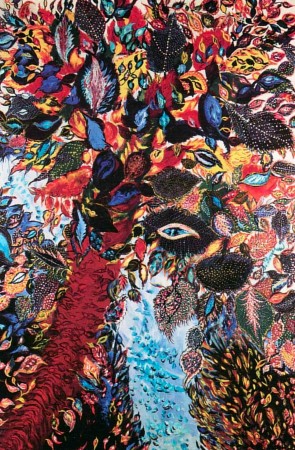
The above image is a painting by early 20th century artist Seraphine Louis. Last night, I watched a recent film about her life, and the unusual relationship she had with a well known German art critic and dealer, Wilhelm Uhde, who was also instrumental in bringing to prominence the work of Henri Rousseau. If you can't tell, I'm a bit of an obsessive when it comes to late 19th century, early 20th century art in general, so it was quite fun to discover the story of Seraphine, and her art.
Seraphine was, in 1912, a poor, unknown domestic worker living in a small town just north of Paris when she became the housekeeper for Mr. Uhde. When he discovered one of her paintings, and was told she was the artist, he began to offer support for her work, the same work that had been ridiculed by the few others who knew about it, and which Seraphine spent most of the little money she had on the painting supplies for doing it. The outbreak of World War I forced Uhde to leave France, and leave Seraphine behind, but apparently he never forgot about her. Thirteen years later, he found himself drawn to an exhibit of local artists in which he came upon one of Seraphine's paintings. A well known modern art collector by this time, Uhde immediately began financially underwriting her career, and arranging to exhibit her works.
One might think there's a love story behind all of this. And there was, I think, but not the usual kind. Uhde was gay, a pacifist in war torn Germany, a Jew who later spent the Second World War years hiding in southern France, and a collector of art that, when he began collecting it, was hated or ignored by nearly all the prominent art critics of the time. Louis was a secretive, marginalized, and mostly isolated artist, who was religiously inspired (her paintings were said to be offerings to the Virgin Mary) in such an intense way it seems to have sent her over the edge. So, when I say there was a love story, it is that of two people who recognized each others' uniqueness and, for a time, were intimately connected through that recognition.
This post is thus, in some ways, piggy backing off yesterday's post about the relational quality of Buddhist practice. There is something quite important about being able to recognize the uniqueness of each other, just as it is important to realize that at the bottom of it all, there are no individuals or real differences. It's one of the paradoxes of Buddhist teachings that people enjoy soundbyting, but which probably makes most of us uneasy when we sit with it long enough.
One of the beautiful things about the story of Seraphine and Udhe is how improbable it is on a conventional level. They were from completely different economic classes. Their meeting was, it seems, almost accidental, as was the way in which Udhe stumbled upon an early painting of Seraphine's at a neighbor's house. There was no romantic tie that often is the glue that brings together seemingly disparate people. And then there was the reunion after a World War, and over a decade's worth of time and distance.
In my view, the power of stories like this are in the ways in which they shatter cherished views about how the world works, and what we believe the future will be based upon our past. It's so easy to think you're doomed because of past failures, or that you're bound to be successful because of past "good deeds," but truly, the world functions in it's own way. That's not to say that the past isn't important - it certainly is. But it's not the one to one correspondence that pop culture views of karma often say it is.
The tragedy of Seraphine's later years also, you might say, speaks to this. The Great Depression forced Udhe to suspend the financial support he'd been offering, and Seraphine began having visions of coming of the end of the world, which eventually led to her commitment in a psych ward, where she spent the last ten years of her life, isolated again and uninterested in painting.
One of things I have wondered about for a long time is the intensity that comes with dedication to artistic expression and/or spiritual life. Often found in tandem, the lines between piercing through to the great truths of this life, and going insane, seem very thin and I think this is why many people shy away when they get anywhere near that edge. Van Gogh is probably one of the easiest to recognize modern cases of this edge - an intense young man with a missionary passion who has an equally intense burst of artwork that ends up astonishing people over a hundred years later. And it was all too much for him to handle.
The kinds of intensities experienced by Van Gogh and Seraphine probably feel quite remote for most of us. But I do think their stories can be somewhat instructive to modern Buddhist lay practitioners, trying to "fit it all in" or who might be, in spite of all the teachings, trying to achieve enlightenment, or something of the like. Somewhere along the line, both Seraphine and Van Gogh ceased to be able to navigate the waters of their visions. Although the full stories won't ever be known, regardless of what evidence is available, a few things connect their stories.
1. Isolation. Both artists had intense spiritual longings and visions that were coupled with deprived or strained social lives. The relational aspect was broken down for much of the lives of both of these artists, which I'd say was a major factor in their final breaking points.
2. Marginalized living with "bad habits." Although a lot isn't known about Seraphine's life, it's probable the the years of poverty she experienced had an effect on her physical and emotional health. And certainly, the smoking and lousy diet Van Gogh lived on had a negative impact on his health and well being.
3. Overworking and overdoing it. This is, in my view, where the connection between these artists and modern Buddhist lay practitioners might be most useful. Both Van Gogh and Serphine over did it when it came to their art, and the other work needed to support their art. And it's probably also the case that they both were driven to do this by a spiritual passion, a desire to embody the visions they had into a concrete form - a longing I have had myself, and also see embodied in the art and writing of masters from all periods of recorded human history.
But the danger, it seems, lies in the slide away from some sort of balance, from understanding one's internal compass well enough to know when to push and when to pull back. This has been precisely the place I have been exploring over the past year or so, and it is where many of my comments about lay practice, including the repeated undercutting of the primacy of meditation retreats and hours of sitting practice, are coming from. It's not about denying their impact on people; it's about a deep inquiry into what balance means for a spiritually focused person living in the everyday, busy world.
Just as Seraphine and Van Gogh were compelled to draw and paint the world they saw and experienced, I have, for most of my life, been compelled to write the world I experience in some form or another. And I feel that instead of idealizing the struggles past artists and writers had, and/or loving their art but dismissing their lives as failures in some sense, I feel called to learn from them as the whole people they were.
In a way, I am similar to Zen teacher Brad Warner in viewing Buddhist practice as an art form which, over the course of one's life, can change it's appearance many times. Sometimes, it might be deeply introspective, highly meditative. Other times, it might be radically social, pushing across established social norms and oppressive practices. Sometimes, it's full of faith and joy. Other times, it's almost all doubt and suffering.
These changes are all, in their own ways, quite beautiful. But learning to ride the horse of those changes is difficult, and I think not completely respected by even most spiritually-minded folks. People like routines, conformity, predictability, comfort, and knowing - all qualities that disappear at times if you are truly riding your horse, and not the horse someone else thinks you should have.
So, in writing this, I am offering a vow to my own "horse of life," and perhaps in doing so publicly, it might inspire others. At the very least, maybe you'll discover an obscure, but powerful artist in Seraphine, and find her story compelling in some way or another.
Subscribe to:
Posts (Atom)