Showing posts with label anger. Show all posts

Tuesday, August 13, 2013

Zen Action

Another week has flown by. This summer has been a whirlwind, filled with lots of writing, adventure, gardening, biking and hard work. I find myself barely able to keep up with it all. An opportunity to let go of needing to be "on top of it all," to just do what I am doing thoroughly and completely.

On Sunday, I gave the dharma talk for morning service at zen center. It's always interesting to notice the differences between sitting in the crowd and sitting in front of the crowd. How various worries about self image arise, attached to fear in the belly. How meditation seems over in a split second when I'm on the teacher seat. How there's so much more going on than talking. How listening while speaking somehow seems to both happen, and be required for connection.

The talk was focused on anger and the ninth precept. If that intrigues you, I invite you to take a listen.

Meanwhile, I've been plugging away over at the Buddhist Peace Fellowship's website. Yesterday's post takes on the issue of fossil fuel addiction and how that impacts the way we view/practice the dharma. Another post, from last week, contains the follow lines that were incorporated into my Sunday dharma talk:

What I also find is that convert Buddhists on the whole are terribly averse to anger and rage. They’re highly prone to suppression, deflection, and other spiritual bypassing techniques. In my opinion, we need to actively experience the anger and outrage that comes from living in conditions of injustice, oppression, and environmental destruction. We absolutely must be willing to plunge into the depths of the despair, greed, hatred, and ultimately fears of various forms of annihilation that lay beneath the surface of that anger and outrage. We cannot simply toss around statements about love and expect to create a society built on love. Just as we actively work to dismantle forms of oppression and violence in the world, we also have to actively be vigilant on the anger and outrage that compelled us to do so in the first place. To transform it at the roots, and learn from it what might become steps towards a better society for all.

And there are multiple excellent interviews, including one posted today with dharma teacher Larry Yang on diversity in our sanghas and renouncing what he calls the "colonial self," as well as an interview I conducted a few weeks back with Lakota activist and hiphop artist Troy Amlee.

May you all be well. Talk to you soon!

Tuesday, December 4, 2012

Anger as Entertainment

I wrote this a few years back, but it seems like a good thing to re-post right now for some reason. The frantic holiday season? Too many Zen scandals? Anyway, here you go.

I have had one of those days where, for whatever reason, the longer the days goes, the less I want to interact with others. In fact, the past three or four hours, I've had waves of crankiness that haven't been so pleasant. Crossing a busy street, and getting cut off by cars in both crosswalks when the light was green didn't help. Nor the struggles I'm having with my second ESL class, which recently became a combined level class due to a colleague resigning. The old "leave the position empty" and "reallocate" game.

What's interesting about all this is that I work up early and did a longer period of zazen than I have been recently. Most mornings, I'm lucking to get 10 minutes and/or chant the refuges and bodhisattva vows before going out the door for the bus. Not only did I sit a half an hour, but also did a longer chanting service. I've always been more of a evening/night meditator, so whenever I can start a weekday morning doing both a morning sit and chanting service, it's always a plus.

Given this, the emotional contrast between this morning and this evening is vast.
Pema Chodron, writing about karmic momentum, has some interesting commentary to consider. She writes:

We entertain ourselves with anger, with fear, with grief —All kinds of thoughts are better than nothing— is our motto. The bodhichitta practices, and actually all meditation practices, are about learning to stay still and going through what I always refer to as the detox period of finally connecting. Sometimes it feels like stillness and peace, but if that happens it will also alternate with this restlessness and this unease.


Curious. I didn't feel like I was "entertaining" myself. However, if we broaden the definition a bit, it actually fits. With the class, the anger was really a diversion from experiencing disappointment, loss of my old, higher level class, and also just exhaustion with the seemingly endless rounds of change in the student body. In term of the cars in the crosswalk, the anger was a response to pedestrian unfriendly city planning, as well as a quick leap from the fear of getting hit.

I'm not one of those people who considers anger always an inappropriate response. The three poisons are greed, hatred, and ignorance - but many translations have it as "anger' instead of "ignorance." There are times when a flash of anger might be the appropriate response, but it's far less than what most of us express on a daily basis.

The thing is that it's hard to stay with what's coming up when the world seems to be calling for some kind of action from you. In fact, even in situations like the street crossing, where you need to get to the other side, afterward it's terribly easy to get lost in stories about "those assholes" blocking the crosswalk. The opportunity to hang with what's coming up is there, and yet it gets lost pretty fast if you allow yourself to get hooked.

Tuesday, January 31, 2012

Buddhist Anger and Conflict

Arun posted an excellent commentary by another Buddhist writer, Dolma, on his blog recently. It takes up the sticky issue of anger, in particular the ways in which Buddhists are stereotyped. Let's consider the following selection:

many individuals, whether they have any knowledge of Buddhism or not, seem to be comfortable with hushing a Buddhist critique. A patronising “calm down,” some poorly recited Sutras, and a “Well, I’ve read Siddhartha.” That’s what we get. Fantastic.

These dismissals truly stem from Orientalist ideologies. Asians are perceived as submissive and obedient, and therefore, adherents to an Asian religion must contain themselves in a similar manner. This is where my anger truly stems from, which is why I feel disheartened when my fellow Buddhists suggest that I’m overreacting. I always welcome discussion on religion, theology and spirituality. However these situations are not respectful engagements, they’re the layering of weary prejudices that are inherently violent. They’re disrespectful to my religion, ethnic community, and to my identity as a whole. In his teachings on anger, the Buddha encouraged us to avoid harmful speech, and to apply lovingkindness where there is anger.


It's important to note that the "positive" stereotyping of Buddhists as "always calm and peaceful" is probably as harmful as the "negative" stereotyping of Buddhists (especially Asian and Asian-American Buddhists) as passive and submissive. I can't tell you how many times I have been praised for my relative calm and ability to act in non-violent manners, and then have that linked to the idea that Buddhists never get angry anyway. It's sometimes subtle. Beginning with sincere respect and appreciation, but then swerving, for example, into muddled thoughts about what "Zen" is. Sometimes, though, it's absolutely not subtle. I get upset. Or speak in a somewhat raised voice about some issue I'm passionate about, and there's shock and confusion.

What's interesting is that over the years, I have ingested just enough of the stereotyping and pressures to conform that I probably don't express anger enough. Although actually, when I think about it, for me it's less about "anger" and more about variations on the theme that get suppressed. I don't consider myself someone who is filled with repressed anger. However, I am a man who is quite passionate about numerous issues, and who feels - sometimes intensely - the suffering of the world. The various oppressions. The injustices. And all of it pisses me off sometimes, and frankly, I think that's a good thing.

Beyond all of that, though, there's the issue of conflict. Because honestly, what people label as anger or angry is often really about the way they experience conflict with others. Something said feels fierce. Or stirs up some old wound or grief. And suddenly the label "anger" comes forth to the rescue. that's it. It's anger. The problem is that sometimes, it's not anger. And even if it is, so what? It's another human expression, one that need not control us or destroy is - and yet, so often ends up doing just that.

Going back to Dolma's post, I recall a conversation over the summer with a Christian guy who was certain Buddhists couldn't do the "hard work" of social activism. That Buddhists "are too passive and individualistically focused" to ever help bring about any significant social change. The levels of obnoxiousness in that conversation went through the roof at times. I spoke about my own experiences and involvements over the years, and the ways in which Buddhist teachings deeply informed that work. I spoke about social movements around the world designed by, and led by, Buddhists of all different backgrounds. None of it seemed to break through. At the end of the conversation, he stuck by his initial assertion that Buddhism is mostly about "individual peace," something he had a vague respect for, but which really didn't register as that valuable in terms of dealing with the big social issues of the day.

Ironically, the similar kinds of commentaries have come from folks within our sanghas as well. And from members of the worldwide online sangha as well.

And yet, the issues with anger and Buddhists are much larger than that which stems from social issues. I have witnessed interpersonal conflicts in my own Zen community that lingered on for weeks, months, perhaps years in some cases, in part - in my opinion - due to the ways in which the stereotypes around what a "good Zen student" is and isn't have saturated our community culture. As one of the sangha's leaders, I have often struggled with how strong and fiercely to present certain ideas I have out of a knowing that we sometimes collectively collapse around conflict.

One of the mistakes that gets made in my opinion is that strong, fierce, and even passionate presentations of views and ideas gets immediately linked to a deep, problematic attachment. Over the weekend, we had a board retreat during which I spoke quite candidly about wanting to keep our sangha in an "urban" environment. Desiring diversity and community engagement, as well as seeing ways in which "deep practice" can be done regardless of "where" one is located, I felt compelled to advocate for staying in the city. At points during that discussion, I kind of wondered if some might have mistook my passion for problematic attachment. Maybe not. I honestly don't know. Part of the reason I kept pushing in the first place was to help unearth what I believe are some unspoken differences about sangha lying beneath the general sense of agreement and consensus we tend to have as a board. And yet, this kind of purposeful, deliberate moving towards conflict could have been felt threatening or troubling because of how intimate conflict seems to be linked with "bad" or "not Zen-like."

Dolma sites the application of lovingkindness when anger arises. Yet, if we are constantly striving to be "perfect little serene Buddhas" within our Buddhist sanghas, how will we learn how to apply that lovingkindness? In all honesty, I have learned more about applying lovingkindness outside of Zen center in the face of anger - others and my own - than within. And sometimes, it's been quite a rough ride exploring different ways to be with and express anger with the teachings in mind. Lay Buddhist communities might need to consider ways they can set up deliberate "laboratories of anger" to help students practice dealing with anger in a safer, more contained setting.

Overall, the way many Westerners view Zen - insiders and outsiders - is broken down into a limited binary. On the one hand, you have the calm, serene monk meditating, studying texts, and perhaps washing some dishes and chopping wood. On the other hand, you have the koan caricatures of Zen teachers making dramatic, sometimes physically violent movements or short bursts of "enlightened" speech. What about all the territory in between? Stories about the abuses under samurai culture, for example, sometimes get referenced and offered as warnings by people who have studied a bit more about Zen. However, there's so much unexplored territory around how conflict and anger has actually been handled by Zen teachers and students throughout the centuries. And obviously Zen is only one of the myriad of branches of Buddhism out there, each of which has their own particular flavor of dealing with anger and conflict.

Whenever I or others online have written about power and sex scandals in Buddhist communities, the gawkers come out in full force. Many of them fellow Buddhists. Which gives me pause. Is part of the collective obsession with these scandals coming from an unspoken desire to somehow come to "understand" conflict through these situations, and then be able to construct "defenses against it" so that we can somehow move on?

Because I don't think there is a moving on really. More and more, I'm seeing conflict as an opportunity to grow and evolve. To awaken even. And sometimes that requires holding on to your views a little longer. Pushing a little harder. Being a bit more "difficult." Being fully human, including at times, angry and even outraged.

I personally feel the world is at a major crossroads. And how we approach anger and conflict will probably make a major difference in terms of what the world is like for our future descendents.

Sunday, October 2, 2011

What is Productivity? Why Do So Many of Us "Need" to Be Productive?

A political post I made yesterday on Facebook suddenly, and kind of surprisingly to me, exploded into a debate between several friends that continues a day later. The specifics of the debate aren't terribly interesting, however a short exchange between my friend John and I seemed quite worthy of posting.

John: Our society seems to place a fundamental value on "productive" citizens. I think thorough internalization of that value is nearly universal.

Nathan: That's a totally interesting point. And one that people really ought to reflect on. What's productive mean? Is it our main mission in life?

The conversation rolled on from there into other issues, but I remain fascinated by this issue of productivity. Probably because it ties in with a lot of the other questions I've been having as repeat visitors over the past few years.

When I hear people speak about a strong need to be productive, I often wonder what's motivating it. Sometimes, I get the sense that they're trying to produce or achieve something in the world to make up for a poor sense of self esteem. If only I get that promotion or finish that project, then maybe I won't feel like such a loser. In other words, they basically think "I am only valuable in the world if I am doing X, Y, or Z."

Other times, it's fairly clear that productivity is tied to survival. The person is always running around, getting things done, because if they don't, they think the boss will fire them, or their children won't get fed and clothed, or a whole host of other things. Some of the fear driving this behavior is very real and accurate. However, odds are, some of the things they're "getting done to survive" aren't really needed.

I often wonder this: How much of our "need" to be productive is driven by external pressures that are more about making someone else rich and/or powerful, than about fulfilling some internal human desire?

If we structured our society differently, so that basic needs weren't an issue the way they are now, how might productivity look different? Would we even be talking about such a thing?

Are you driven by a need to be "productive"? If so, what is behind that drive?


Friday, April 15, 2011

Buddhist Anger Strategies


My old friend anger has shown up in discussions here, as well as on some other blogs over the past couple of days. Given how powerful, confusing, and often destructive anger is, it's really good let discussions and teachings around it come right in whenever they appear. Because you never know when you might need them.

Here's a quotefrom Buddhist teacher Sharon Salzberg:

When we step back and re-vision our understanding of life then we don't need to get so lost in our anger. When we look at anger as it arises, what's important is to look at the very feeling, flavor, and texture of anger. We don't say, "This is wrong," "This is bad," "I shouldn't have this anger." Just pay attention to the feeling.

Once I was sitting at the Insight Meditation Society, the center I cofounded in Massachusetts, and one of my teachers, Munindra, who was visiting from India was guiding us. I was very upset at this moment. Anger had come into my mind and I was thinking, "I've been practicing for four years, I shouldn't be angry anymore but I am. What's this still doing here?!" Munindra could hear how disgruntled I was, how dismayed I was, and he said, "Imagine that a spaceship has landed on the front lawn and these martians have come out and come up to you and asked, 'What is anger?' That's how you should relate to anger."

You don't think "I'm righteous. I'm going to do this or that, get revenge, etc." You just ask, "What is anger?" "What's it like in my body?" "What are the layers of this mood?" "How much sadness is there in it? How much fear?"


I like the "What is this?" focus here. Instead of thinking you know what's happening, you investigate. I know that there have been many times when I have thought I was angry, and actually saw something else when I looked. Grief. Confusion. General irritation. Physical illness developing. Hunger. So, it makes a lot of sense to pay attention, and see if you can see what's there, even if you are in the middle of an argument with someone.

But you know, I also find that Salzberg's example typifies the way privileged, middle class Buddhists tend to talk about anger. Anger is considered in the context of individual relationships, and mostly in individual relationships where the potential for grave damage - like rape, murder, or some other awfulness is unlikely.

Petteri and I had a discussion that bled over into a new post, and which offers some challenge to the "standard Buddhist" view. He writes:

Rather than face the anger, I pretend it's not there; pretend that I'm the kind of person I want to be, or you're the kind of person I want you to be.

I think a great many of our problems comes from this turning away.

Maturing kamma is a messy business, and I don't think there are any magic solutions to completely get rid of the mess, even if there are particular medicines that work, to an extent, against particular poisons.

The upshot is a particular pattern of unskilful behavior. Covert aggression. Exhortations to "abandon the ego" and "let go," to become a Zen zombie floating above it all, like a corpse in a river. Resolution avoidance by walking away from conflicts. Hidden vices. Things left to fester, sometimes for years, until they explode in a fountain of pus. I have a hunch that many of the Zen scandals that have been plaguing the scene lately have to do with this pattern, and I think I can see it playing out in a small way among a quite a few Buddhists.


Avoidance is something I'm aware of in myself. And it's also something I have watched members of my sangha being forced to face in recent years - fallout from our own teacher scandal. Too often, I, we, stuck to just watching, just sitting, and trying our damnedest to speak and act non-violently. Some of that was very skillful, and some of that was noble stupidity.

Petteri talks about times when maybe the best way to "mature karma" is to go at it with each other - to get the pissed off out in some manner or another. I think that might be true, but it also might be a poor idea. I'm convinced that one of the skills to being an awakened being is learning to read situations, so that you have a much better sense of how to approach what's happening. Which is almost impossible if you're really angry. But it might be the case that if you've trained yourself to read situations well, you might get a decent sense of things before you get pissed off. And then perhaps be able to handle being angry within such a situation. Does that make sense?

But there's another level here that isn't on the table. The anger that arises during life threatening situations. The anger that arises from deep, collective injustices. The anger of entire cultures, groups of people who have been oppressed for generation after generation.

Working with this might include a lot of the above discussion, but also requires a different view. A different set of "solutions." For example, shuttling the collective anger of indigenous peoples into individualized patterns and approaches is actually not changing the roots. Collective rage requires working towards collective transformation. And that means working towards justice, and seeing that rage as a manifestation - at least in part - of conditions that must be changed by the multitudes.

While it might be true that certain individuals within a group might have entirely too much attachment and fixation on being enraged - and thus might really benefit from something like doing zazen or examining their fear - it's also the case that there's something much larger than any individual going on there. Which is actually why - going back to Salzberg - the skill of paying attention and saying "what is this?" is really valuable. When enough people experiencing and/or witnessing injustice recognize that what they are experiencing is injustice, then there's an opportunity to address the roots.

So, the way I see it, understanding and working with anger requires that we widen our views of what skillfulness might mean, and realize that while there probably is an individual piece within any manifestation of anger, it's possible that said anger is also arising from some broader, more collective place. Maybe 80% of a given person's anger is just attachment, fear, and shoddy attempts to claim power. But the other 10-20% - that might be something bigger, something calling for larger questions and larger answers.

Thursday, March 24, 2011

Yoga Meets TV

This was one of my first blog posts, originally published in the Yoga Journal's online community back in 2008, before I started DH. The neighbor in question has quieted down significantly since then, and my mind during yoga asana practice also tends to be quieter these days. I still don't like TV, however.


I've come to really dislike television. I haven't owned one for about 6 years now, and other than a few hours with friends or family, I simply don't have any interest. Given that, I've found it especially funny, and difficult at times, to have moved into a building with a neighbor that watches her television all day and often late into the night. And very loudly, so much so that I spoke in person with her a dozen times. When that failed, a few months ago, I asked the landlord to do something about it, which he did - but still maybe once a week or every two weeks, I end up pounding on ceiling to get her to turn it down. It once was driving me to look for a new apartment; now it's a small annoyance, and interesting experience as far as my practice goes.

This evening, I was doing an immunity sequence from the new Yoga Journal. There I was just beginning my warm up salutations, when the sound of - you guessed it, TV commercial dialogue and music - crept into my ears. Now I've practiced compassion meditation for this woman, have tried to be friendly when I see her, have even returned her mailbox key to her when she left it in the mailbox - yet, it's amazing how quickly my mind can return to nasty thoughts about her and waste of time all that TV is, etc, etc.

So, here I am in prasarita padottanasana (a yoga pose), feeling my legs stretching and having this dialogue/argument in my head about the sound of the TV. It's kind of embarassing, and yet fascinating because I remembered a basic teaching which goes something like if you can do something about it, do it and if you can't, let it go. And so, I went into the next pose, standing forward bend, and watched my mind and also listened as the TV seemed to creep up a little more (I sometimes wonder if I'm imagining it getting louder, or if it's really all about the volume fluctuation for the commercials). Anyway, at the end of the pose, I decided it had gotten too loud, and I hit the wall a single time. She turned it down, as she pretty much always does, but I then worked into the next pose, and watched as a rush of irritation and adrenaline filled me and then passed through.

It's amazing how much I crave silence sometimes, and struggle when I can't get it. I know partly this has to do with working at an overly cramped little school, where my attention in constantly challenged. And also living in the middle of the city, which I love, but sometimes probably need a break from. Maybe you, too, have similar cravings you struggle with?

Somehow, it seems so silly to have spent so much energy on thoughts about a TV, and yet I have. So be it, that too will be compost for the pile.

Friday, February 11, 2011

Zen Teacher Scandals, Group Dynamics, and The Swamp of It All


I'm feeling a bit disturbed today. My great grandmother, at almost 102, is probably on the way out of this life. It's amazing that this spunky, sassy woman has lived so long, and mostly in pretty good health, so it's hard to feel to down about it. But there's still some sadness.

Secondly, I was thoroughly dressed down on the thread of this post from a prominent feminist website. I enjoy learning about new issues and theories, especially when they might aid me in seeing through some of the warped cultural conditioning I have inherited. My only comments about what happened there was that my mistake was not shutting up earlier, and that I feel this kind of behavior amongst people "on the left" for lack of a better term is one of the main reasons social movements have gone nowhere in recent decades here in the U.S. (Please, no feminist bashing in response to these comments; it's not about that, it's about how people struggle to work together across differences, and end up tearing each other to shreds in the most uncompassionate ways.)

Finally, this Zen teacher scandal business moved from wherever it had been down to my gut this morning. An anonymous commenter left a comment on my recent Genpo Roshi post that basically defended Genpo through absolutism, and I kind of went off on that person.

This whole defend the "victims" at the total expense of the "victimizer", or defend the "victimizer" at the total expense of the "victims" is a pair of sick delusions that we all need to wake up from.

James Ford over at Monkey Mind has some great comments this morning about the state of "Western Zen":

There are those who say we need to grow up and walk away from Zen teachers.

I respectfully say you can. And you may well find a true and useful and healthful path. It won’t, however, be Zen.

The Zen way has evolved within a system of training, or rather a cluster of training systems, all of which require spiritual direction.

The way Zen came west, through individual teachers with limited supervision, and then establishing centers that are more or less isolated from each other has created a cultish system. That’s the problem, aggravated, of course, by the inflated language of transmission. I’ve explored both of these issues before.

I’m confident we are also at the edge of a time where people are no longer dependent upon keeping a relationship with a specific teacher or giving up the practice. In some ways the scandals reflect that reality. We don’t have to put up with the inappropriate in order to have access to the way.


Over at Sweeping Zen, Erik Storlie has an even more provocative essay about Lineage, Dharma Transmission, and teacher scandals.

So long as American Zen relies on dharma transmission as a credential, there will be one Shimano after another – and dharma heirs who will go to great lengths to protect the master that conferred authority upon them. For if the master who has declared me awakened has erred, if he does not, indeed, “dwell in the Absolute,” then my own credential is called into question – along with my prestige and authority in the community and my ability to confer this power upon others.

Even if the magical claims of dharma transmission are discarded and it is recognized as an ordinary human institution, it still should not be retained as a method of training Zen meditation teachers. No truly meaningful credential can be conferred simply at the pleasure of one person. Indeed, as a method, it creates toxic interpersonal dynamics in communities, for the future recognition or preferment of a student is entirely dependent upon pleasing a dharma heir, or a presumptive dharma heir. If I wish to rise in this hierarchical system, I must pay court to the dharma heir and his or her favorites, and as a courtier in such a system, I can never openly acknowledge my self-interested pursuit of attention, for my goal is always, theoretically, “spiritual” development. Yet, of course, my ability to please a dharma heir and receive, in my turn, recognition and/or authorization will give me status and even employment opportunities. The dynamics of court, courtier, and courtship create endless distortions of human behavior even in ordinary institutions – a business, political party, or college. These run wild when the king, queen, pope, or dharma heir has imputed “special” powers. Anyone connected for a length of time to a Zen Center can cite examples.


This is perhaps a bit cynical. I don't think that dharma transmission has created "a toxic" environment in all the "Western Zen centers" out there. Or even a majority. However, the delusions around the student/teacher relationship on both sides of the equation are certainly exploding all around us, and I agree that attachment to stories about lineage, dharma transmission, and teachers as mostly perfected bodhisattvas are major concerns that need to be addressed.

Anyway, it's all very swamp-like to me today. I'll be heading over to see my friends at the local college meditation group this afternoon, which seems like good timing. Take care everyone.

Sunday, December 12, 2010

Writing Violence: Thoughts on Authenticity and Spiritual Bypassing


Here in Minnesota, we woke up to over 16 inches of fresh snow on the ground. Most of the city was shut down last night, and people are trying to dig out today. Me? I was out taking pictures, including the one above of my street.

So, I was interested to see what might come of the last post, which isn't my regular writing style. In particular, what I am curious about is the ways that we can write authentically about difficult, disliked patterns and ways of being in the world. Friday's post was about aggressiveness. Competition. Excessive effort. Turning one's spiritual practice into a contest. And also the voices in our heads that can arise from such energies.

Peter left the following comment, which I can imagine was how others felt that read the post:

I enjoy the energy in your post -- but find all that hard-ass, motherfucker language of little interest. too testosterone-laden and agressive for my taste. neither meditation nor blogging (nor living for that matter) is a contest.

i find that there's enough suffering in the world, without creating more under the guise of practice.


First off, those like Peter who are regular readers of this blog know that I'm not given to tossing foul language around carelessly. Most of my writing steers clear of it because it's not necessary for the situation. I actually tend to respond in a similar way to profuse cussing as Peter did to this particular post. Adding cuss words to angry writing tends to bend both the reader and writer towards more anger. And adding cuss words in other kinds of writing often just causes distraction, confusion, and/or aversion in readers.

However, one of the weaknesses, in my opinion, of much spiritual writing out there is a failure to express the fullness of experience, and then use that expression as a way in to understanding the deep truths of this life. What I find is that the bluntness, rawness, even nastiness that sometimes litters our minds and even our actions gets abstracted, shunted, even turned aside out of a belief that presenting such stuff will just cause more suffering. Or is categorically wrong, a no-no for people on a spiritual path.

Let's take a specific example from Friday's post.

Zazen posture seems to be a big deal for a lot of people. Those who can't do the full lotus posture often spend months and even years trying to emulate it, thinking that this it is a requirement for awakening. And when the body inevitably gets sick and/or old, there's a certain amount of grief and suffering that comes up for those who are attached to sitting full lotus, and now can't.

Being in a group, especially during retreats, can ramp up this kind of energy. I've experienced this myself. You've been doing zazen all day, your entire body aches, and yet you look around, and most everyone else is still in full lotus, or half lotus. And what do you do? You stay in lotus, even though you're literally on fire with pain.

What's the mind look like under these conditions. Well, it's probably something like this: Better do full lotus motherfucker - none of that half-assed seiza bench shit.. If you are honest, that's what it looks like. Maybe your mind doesn't have the cuss words, but the aggression that brought you to keep sitting when you really shouldn't includes an aggressive, sometimes really nasty narrative. There's no getting around that.

So, here's the thing. How do we write about such experiences?

How do we convey them authentically, embedded in the teachings we've been given, so that others might gain some insight?

Maybe more importantly though, how do we stay true to where we are at, express fully where we are at, without minimizing or exaggerating?

Because what I see in myself, and also in so many others doing spiritual writing, from the most beginner student to the most seasoned teacher, is a tendency to dance around the heat of that which we collectively have deemed taboo.

Anger. Hard-assed aggression. Violent thoughts. Rage.

These are some of the experiences that we "spiritual types" avoid, minimize, cloak in psychological or other abstract language. And why? We're triggered. We're afraid. We don't know how to handle it. The teachings tell us these things are destructive, cause suffering, and shouldn't be indulged in.

And it's absolutely true that violence, rage, aggression, excessive anger - all of that is destructive, suffering producing, and blinding us from our inherent wisdom.

Yet, I also think it's no coincidence that these very same places tend to be the most common shadows of people who are in religious and spiritual communities, or who have committed themselves to such a path. We have a sense of the destructiveness of those various forms of violence, and yet instead of truly facing it within our selves, we do all sorts of bypassing and then wonder why we can't seem to be open around conflicts that appear in our lives, our communities, even online.

Consider, in contrast, something that is more palatable to work with. Like grief. Or guilt. Or fear.

I have heard some amazingly beautiful, detailed talks linking deeply personal experiences of grief to profoundly universal teachings about grief. No mincing words. No avoidance. Just raw experience, which is then transformed into wisdom, and in doing so, is an expression of compassion for all of us who also are experiencing grief.

The same doesn't seem to be true when it comes to working with violent tendencies. Grief is embraced by spiritual types, whereas rage, for example, is almost universally rejected from the beginning. And that's the problem. It's rejected from the beginning, instead of taken in, fully experienced and documented, until it drops away.

It is any wonder there is so much war and violence in the world.

I'm fiercely interested in how I, and others, might navigate this territory more honestly, more clearly, exposing enough of the rawness to ourselves and others without falling into the swamp of it. What did the mind of the man who was shaking his fist at that bus Friday afternoon look like exactly? Who was that "me" which came and then went, but will come again and again if it goes unexamined?

Because just saying he was angry, he was indulging in anger, he was attached to an outcome, he was this he was that - just saying that doesn't cut it. It cuts what IT was off.

Last night, I was snowed in. I listened to a podcast interview with Buddhist teacher Reggie Ray, during which he describes a practice called "Dark Meditation." Essentially, it's going into complete darkness and staying with whatever comes up. After the interview, I went into my bathroom, covered up all the entry points of light, and sat for an hour in the darkness. Very interesting. You know your body is there, the bathtub is there, the toilet is there - but you can't see any of it. And it doesn't take long before you start feeling disoriented, not in an awful way, but in a "what is this experience" kind of way. The natural curiosity each of us has, but which often is blocked, comes forth rather easily from the darkness.

Where is the natural curiosity towards the violent, rage-driven aspects of our lives? Why is it that instead of curiosity, so often what arises in response to "internal" violence is guilt, shame, and/or fear?

What was so interesting to me about writing that post on Friday was that when I began, it was mostly going to be about calling out the aggression and attacks I saw in The Zennist's and Uku's posts. And yet, as I wrote the post, it became clear to me that doing that wasn't really fair or helpful. In fact, not only that, but it would have been reproducing the very patterns I'm talking about here. Take a look at these guys. Talking shit about their fellow practitioners. Look at how angry their words are. We should be kinder to our fellow practitioners. Blah. Blah. Blah. All of that is true, but it's only part of the story. I'm like them too. You are like them too. The only difference is that I didn't put a post out like that.

So, what's behind the desire to shame them? What is it about angry and/or violent writing, angry and/or violent thinking, that either seductively draws us in or makes us run far, far away? And what can we do about it?

That's what I became interested in while writing that post Friday. And this post is a continuation of that, in it's own meandering way.

p.s. The Blogisattva Awards are out. This blog won the Best Achievement Blogging Opinion Pieces or Political Issues award. Thank you all for the recognition. But mostly, as I said Friday, seeing all those Buddhist blogs located in one place, where anyone can access them and drink in the wisdom, experience, and folly, is really excellent. Bows to us all.

Thursday, July 1, 2010

Men Getting Angry and the Hook of Self-Righteousness


I wrote about anger as entertainment a few days ago, and would like to add a little to that discussion with the help of another voice. The following is from this guest post by Don Mead over at the blog Metta Refuge:

But, one might say, “My anger is Vajra (spiritual) anger. There is no hate in it. My anger works for the good of all sentient beings.” Luckily for us, there is a very easy test to check if our anger is ego-centric or not.

If there is even the slightest bit of self-righteousness, then we, are 100% in the wrong. In fact, I would go so far to say that self-righteousness is the Ninth Precept’s best friend. It is so easy to recognize in ourselves that all excuses to indulge our anger are washed away. But we need to examine ourselves honestly. “Do we, in fact, like the energy of anger?”


Now, his conclusion that we "are 100% in the wrong" seems a little clunky. Wisdom is contained within our delusion-riddled responses, and I also believe that getting into labeling things "right" and "wrong" misses the mark. However, I think his focus on self-righteousness is a good one to pay attention to.

One example I used when speaking about anger in my previous post had to do with cars blocking the crosswalk while I was trying to cross. Even a momentary glance at the anger that arose during that situation is enough to see how I felt superior to those drivers involved. I was following the laws, and also was not polluting the planet as I walked, while those drivers were both breaking crosswalk laws and, by being in cars, adding pollution to the environment. There is a certain truth in these statements, and anyone who reads my blog knows that I always try to take the social context into account. It's never just about "me" or "you" or some "others."

However, at the same time, I can see how hanging onto statements like that, and even pointing immediately to the larger context in situations can be a dodge of responsibility. If I look closely at the anger in that situation, it's really more about two things: fear, and a deeper woundedness.

The fear is easy to see. Drivers often forget in their haste and/or being surrounded by a half ton or more of plastic, metal, and whatnot that in any crash between a car and a pedestrian (or bicyclist), the pedestrian (or bicyclist) probably will be hurt, frequently hurt badly. I've been hit twice by cars while on bicycles, and know this intimately. So, whenever a car gets too close, some fear is bound to arise. In addition, the blocking of the crosswalk usually means stepping out into traffic part of the way, or attempting somehow to get the driver to back the car back, both of which are scary if you ask me.

The second, deeper issue for me in this situation is a sense of woundedness I feel when it comes to my own impact, and the rest of humanity's impact, on the planet. Car-centric urban and suburban planning, where people on foot, bicyclists, and others are de-emphasized in favor of increasing the speed and mobility of cars - experiencing the results of this always brings up grief, sadness, and helplessness in me. And behind these emotions is a story about how the world "should" be different, more eco and community friendly. I don't want to accept the situation as it is, and in fact, believe that accepting the situation as it is means giving up on any kind of work towards things like an eco and community friendly place to live.

I think this is a struggle for most of us who become involved in social, environmental, racial, and other forms of justice-oriented work. Accepting the present conditions feels like defeat, and people who aren't involved, or could care less about the world around them really don't understand why we "justice work types" get so attached to our visions, and also have a hard time accepting the realities that are currently present.

When it comes to anger, though, it's a more acceptable expression than all of this complex grief, attachment, justice narrative stuff, especially for men. Getting pissed off can give you instant street cred amongst activists, or just plain frustrated people, like the ones at the bus stop with me this morning, waiting for a late bus. (Half the people waiting were pissed off, and I started to act angry about the bus being late when the reality was that I really didn't care if I was a few minutes late to work, and mostly just wanted to blend into the conversation that was already around me.) In "ordinary" situations like this, getting angry allows us men to cover up all the other stuff I mentioned above that takes time to explain, and might make us "look weak" or "odd" in the process. At the bus stop this morning, I didn't want to expend the energy to have a real conversation with the people standing there, getting upset because I was already thinking about how much energy teaching my classes was going to take. So, I opted for faux anger, which allowed me to blend in, and not have to actually say or do much. The sad thing about this is that it just added a few drops of misery to the collective pot, and really didn't save much energy for my teaching either. Maybe if I had expressed some calm, and the actual sense that I wasn't really worried about a late bus, I could have helped lessen the anger load for everyone else. Or at least not added to it.

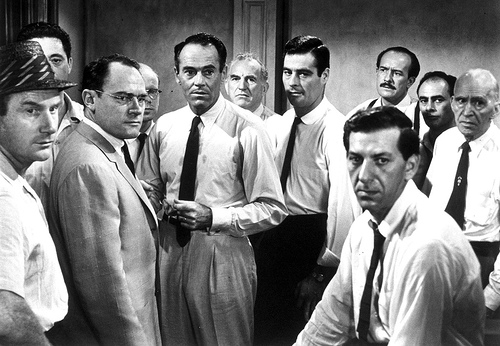
*11 of the 12 angry men from the 1957 film 12 Angry Men

Monday, June 28, 2010

Anger as Entertainment


I have had one of those days where, for whatever reason, the longer the days goes, the less I want to interact with others. In fact, the past three or four hours, I've had waves of crankiness that haven't been so pleasant. Crossing a busy street, and getting cut off by cars in both crosswalks when the light was green didn't help. Nor the struggles I'm having with my second ESL class, which recently became a combined level class due to a colleague resigning. The old "leave the position empty" and "reallocate" game.

What's interesting about all this is that I work up early and did a longer period of zazen than I have been recently. Most mornings, I'm lucking to get 10 minutes and/or chant the refuges and bodhisattva vows before going out the door for the bus. Not only did I sit a half an hour, but also did a longer chanting service. I've always been more of a evening/night meditator, so whenever I can start a weekday morning doing both a morning sit and chanting service, it's always a plus.

Given this, the emotional contrast between this morning and this evening is vast.
Pema Chodron, writing about karmic momentum, has some interesting commentary to consider. She writes:

We entertain ourselves with anger, with fear, with grief —All kinds of thoughts are better than nothing— is our motto. The bodhichitta practices, and actually all meditation practices, are about learning to stay still and going through what I always refer to as the detox period of finally connecting. Sometimes it feels like stillness and peace, but if that happens it will also alternate with this restlessness and this unease.


Curious. I didn't feel like I was "entertaining" myself. However, if we broaden the definition a bit, it actually fits. With the class, the anger was really a diversion from experiencing disappointment, loss of my old, higher level class, and also just exhaustion with the seemingly endless rounds of change in the student body. In term of the cars in the crosswalk, the anger was a response to pedestrian unfriendly city planning, as well as a quick leap from the fear of getting hit.

I'm not one of those people who considers anger always an inappropriate response. The three poisons are greed, hatred, and ignorance - but many translations have it as "anger' instead of "ignorance." There are times when a flash of anger might be the appropriate response, but it's far less than what most of us express on a daily basis.

The thing is that it's hard to stay with what's coming up when the world seems to be calling for some kind of action from you. In fact, even in situations like the street crossing, where you need to get to the other side, afterward it's terribly easy to get lost in stories about "those assholes" blocking the crosswalk. The opportunity to hang with what's coming up is there, and yet it gets lost pretty fast if you allow yourself to get hooked.