Showing posts with label men. Show all posts

Monday, April 13, 2015

Mansplaining Away Rape Culture: Waylon Lewis' "Strange" Partial Defense of Yoga Guru Bikram Choudhury


Waylon Lewis of the popular spiritual webzine Elephant Journal has a history of ... ahem ... troubling behavior. In 2011, I wrote a post about racism on EJ, which Waylon sought to defend as humor. The same post and comments section goes into other problematic editorial choices, as well as pointing out how criticism tended to receive a combination of snarky and inflammatory responses from Waylon. That was 4 years ago, and for the most part, I haven't given Elephant Journal any attention. However, that post routinely falls in my top 5 weekly reads list, and new comments have come long after the original issue had died down.

This morning, my attention was drawn to a new controversy. For some odd reason, Waylon has chosen to make a video pleading with us to maintain an "innocent until proven guilty" attitude when it comes to the sexual assault and rape case against Mr. Hot Yoga Empire Dude. Aka Bikram Choudhury.

Of all the people in the yoga world, Bikram is probably the last person in need of such "support." He's amongst the uber wealthy in this country. He's taken the privatization of ancient spiritual wisdom and practices to new heights. And, most importantly, there's an endless string of lawsuits and allegations against him going back well over a decade in some cases. Sure, it's technically true that Bikram is in a court of law innocent until proven guilty. However, throwing your weight behind someone with Bikram's track record is a dangerous proposition. Especially if you're another privileged male. The slide from well intentioned supporter to upholding the good ole boys club and patriarchal oppression is swift and almost inevitable.

But this video wasn't just a call to not indict Bikram prematurely. It was a powerhouse load of horseshit commentary on the nature of sexual assault and rape, as well as the supposed responsibilities of victims experiencing threaten, or potentially threatening conditions. Here are several rebuttal comments from women, as reported in the Wonkette article I cited above, that offer some insight into what I mean:

“Hey Waylon, I think it is a mistake to combine rape culture education awareness together with the Bikram case….I think you make a mistake to pit a feminist approach against a men’s group approach.”

“Placing the responsibility for preventing rape on women, and placing blame on women for not saying no, however gently, has been around for decades. It hasn’t prevented rape.”

“I fear that the way you approach these issues and this topic is confirming the reasons why women do not come forward….I hope that you can listen to this feedback, watch this video yourself, and start to have more awareness of yourself and these issues.”

“I just found it to be a regurgitation of society’s lack of understanding of the depth and breadth of this issue.”

“The way that you have attacked commenters who have had the courage to speak to the confusing and upsetting tone of this video is disturbing to me.”

“The video is a mass of contradictions and confused thinking about rape/sexual assault. Consensual sex is not sexual assault….Weirdly, despite your entire video lamenting acts of sexual assault, you appear not to know the difference.”

As a survivor of a sexual assault via a visiting male professor during my undergraduate days, I find so much of Waylon's take on these issues painfully ignorant and highly damaging. He's since apologized for producing an "offensive" video, but really, offensiveness is the least of my concerns. If Waylon were just some random yoga blogger dude offering such tropes as go report your concerns to the police and they'll take care of it and "just say no" I'd probably just shake my head and perhaps leave a brief comment with some educational links attached to it. However, for better or worse, Waylon runs a magazine with a fairly large following and has become a public figure of some standing in the American yoga and Buddhist communities. Which frankly is a big problem.

I'm guessing that this post will be dismissed by some in spiritual circles as being "personal," coming from "wrong speech," or lacking compassion. In my opinion, though, staying silent on such issues when you have to opportunity and ability to say something corrective is lacking compassion. Furthermore, as a man who is bone tired of the numerous ways in which patriarchy and colonialism have oppressed, damaged, and destroyed people of all genders, I feel that it's long past time for men to see it as normal to call out the bullshit of other men, and work towards creating a more liberated society for all.

So, Waylon and any other man tempted to defend his take on rape and sexual assault: YOU DON'T HAVE ANY IDEA WHAT YOU ARE TALKING ABOUT! Please, go educate yourselves. You can find some eyeopening statistics and other information here to start with. I can tell you that I didn't say a word to anyone about my assault for a year and a half. I lived with feelings of guilt, shame and confusion that no one sans other survivors really can fully understand. Men are even less likely than women to report such incidents than women, but overall reporting rates are really low, and attitudes like your own only help to guarantee a continuation of that.

Furthermore, don't - in response to what I just wrote - offer "sorries" to me or other survivors for what we went through. Sorry does nothing to put an end to rape culture and the patriarchy that spawned it. Instead, do your homework and start asking what you can do to change the culture.

And whatever you do, stop putting out videos defending notorious male yoga gurus. Just stop. Bikram is more than well equipped to defend himself as it is. So much that even in the face of piles of damaging evidence, he might go free when the odds are he shouldn't.




Saturday, March 22, 2014

The Economics of Male Grief

It's been a bit quiet over here lately. I've been writing about topics that didn't naturally fit here, and also doing a lot of behind the scenes work at zen center. I also planted a flat of seeds, and hope that it warms up enough in the next few weeks to get the garden going. Lots of waiting and needing to be patient.

I have a new post over at Life as a Human webzine. It focuses on male grief and economics. Here's a short selection from it.

"Although it’s probably the case that socialization at school and other places put it into my head that crying isn’t okay for men, the day that solidified it for me was my grandfather’s funeral.

I was 13 years old. As one of the pallbearers, I stood at the end of the line, watching the casket coming out of the hearse. Suddenly, I felt weak in my legs and turned away, just at the time when I should have been reaching up. My uncle screamed something nasty at me, jolting me back into place, to do my “job.” I think I didn’t forgive him for years for that.

Later that day, my grandmother came around and told all of us “Don’t cry. You’re grandfather wouldn’t want you to cry.” She was trying to support us, but this is often how grandma’s support has been – kind of off. Anyway, her words that day, as well as my uncle’s, stuck with me, leading the charge of all the other comments and views I’d heard saying that men don’t cry, that we best be “tough,” no matter what."


Wednesday, February 23, 2011

Sexism in the Sangha Scandals


I have felt disturbed by some aspect of the ongoing discussions, both within my sangha and also online, concerning the various Zen teacher scandals. Up until now, it was really just a feeling, some sense that something was off, but what that was wasn't very clear.

As I read through this letter from the eldest daughter of Maezumi Roshi, and the subsequent comments, suddenly it started to dawn on me: there is sexism going on here.

Kirsten Maezumi's letter details the painful fallout that occurred during and after an "affair" between Maezumi and Zen teacher Chozen Bays. This was before Bays was a teacher, but after Bays had gotten married, and become the Maezumi's family doctor. It's quite a messy tangle, one that really doesn't reflect the majority of cases where Zen teachers have treated students like sex objects as part of an abuse of power pattern.

What struck me about Ms. Maezumi's letter was her utter defense of Genpo Roshi as a teacher, coupled with a lack of defense of Chozen Bays as a teacher. While acknowledging that Genpo's repeated offensives were greatly harmful, she goes on to write quite glowingly about the future of Zen and Genpo's place in that.

Of course what Genpo Roshi did was wrong and caused a great deal of hurt and pain to his wife Stephanie, his children and the sangha.

Does this mean as punishment he should be cast out and not allowed to teach or be recognized as a senior Zen successor?

To do this is throwing the baby out with the bath water.

Genpo Roshi is a wonderful teacher and humanitarian, and I feel that his contributions to Zen in America and the raising of consciousness now and in the future are of great importance to continue on my father’s work and his own personal vision as an American teacher of Zen.

I think to deny what he can offer in the evolution of Zen in America would be a travesty.


On the other hand, Chozen Bays receives forgiveness, but no glowing account of her value as a Zen teacher. Even though Chozen has led peace missions to Japan to honor those killed by American atomic bombs, has done endless amounts of work around various spiritual forms of healing, and has co-led a growing sangha for over two decades, without the accompanied power abuse baggage since becoming a teacher, her value as a teacher to Ms. Maezumi is decidedly low. Certainly, this is a personal issue - that she's probably too close to the situation to offer anything more than forgiveness, but there's such an uneven sense of adoration for Genpo presented, especially since his offenses have impacted more lives in similar ways to what happened in Ms. Maezumi's family.

What's more interesting, though, are the comments that follow. At one point, a male commenter dismisses Ms. Maezumi as "delusional," never mind that she does raise some troubling questions about a relationship that involved multiple power line bending over each other (Zen teacher and family doctor). Moving beyond Ms. Maezumi, there are multiple arguments that display a decidedly sexist (in my opinion) approach to all of this.

One commenter, Mary Rosendale, writes the following:

Can we please get away from this idea that female practitioners are low-hanging fruit for any Zen teacher? It is sexist and demeaning to women. I think I know a fair number of Dharma sisters who are devoted to their teacher. Without exception, all of them have a strong moral compass, do their best to keep the precepts and do good for others. Kirsten reminds us that it takes two to tango and points out that the other willing partner in the relationship with her father broke more than one vow; she slept with a patient; slept with the father of other of her patients and consistently lied to a friend (and probably her husband) for 5 years. This is not a passing indiscretion. These are wilful and deliberate acts. Both consenual participants were responsible for the break-up of Maezumi’s family.


This comment is fascinating to me because Rosendale points out that sexism is at play and then goes on to use the "it takes two to tango" line, which denies the validity of other women's claims that what happened to them was abuse of power. Consider that in all the prominent cases, it has been male teachers sleeping with female students. And that unlike the Bays/Maezumi situation, most of these students have not had a corresponding power base (like being the family doctor) that they were coming from. Yet, the arguments that 1) it's always only been about sex and 2) that the sex was consensual are commonplace.

Beyond this post, there have been a fair number of calls for Zen students to take responsibility for themselves, to reclaim their power, etc. I support this, and believe that blind faith and idealization on the part of students have aided in teachers going wrong. However, let's consider the circumstances again. These calls for Zen students to basically grow up are coming as a result of scandals in which female students are the main victims. And yet, sanghas are not all women working with a male teacher. What about all those male students? Why is it taking numerous scandals where women have been the primary visible victims to get us to call for students to "grow up"?

I was a male student in my sangha under a teacher who crossed the power lines. As a relative newcomer, I didn't have enough insider knowledge or status to do a whole lot about our situation, but there were plenty of male practitioners who could have. We men, too, needed to grow up as students, and stop idealizing and/or blindly following our teacher. And this is true of the men in Genpo's sangha, and Shimano's sangha, and all the rest.

What it comes down to is that the male students of these broken sanghas are mostly invisible. Whatever mistakes they made, including ways they ignored or allow abusive behavior to go on, are also invisible for the most part. While at the same time, the women, especially those who were involved sexually with the teacher, are totally exposed.

So, even though calls for zen students to reclaim their power and responsibility are evenhanded in intent, I believe the appearance of the calls is directly tied to a stereotypical image of a female Zen student who is emotionally vulnerable, and idealizes her teacher.

In my view, it's important to note that these questionable at best gendered lenses are being used by both women and men. That despite all the efforts of numerous women and feminist-minded men in the broader Western Zen community, there are still unexamined patterns of sexism that I would argue are influencing who we consider to be "great teachers" and also how we treat those who have been in abusive situations.

If Genpo Roshi were a women with the same sordid track record, would there be so many people willing to defend his teaching, and offer that he's a "humanitarian" and that his "contributions" to Zen must be continued? Somehow I think not so much. And that should make all of us pause.

For those interested in learning more about the dynamics of power and sexual abuse in spiritual communities, check out Scott Edelstein's excellent book.

Sunday, February 13, 2011

Yoga and Men


As a male yoga practitioner, I have long found it interesting that most studio-based yoga classes are dominated by women. Given the history of yoga in it's various forms, and how men dominated it, it's quite interesting to see the reversal happening now. The core class for my yoga teacher training, which started last week, is split almost right down the middle - 5 men and 6 women. The studio owner was excited, and said it was the first time this had happened.

Makes me wonder what it is about yoga right now that has attracted so many women, and not all that many men comparatively? I have some theories, but nothing that really feels like it addresses the whole works.

There has been some discussion online about the current issue of Yoga Journal, which has a man on the cover for the first time in nearly a decade. Media representations of yoga certainly have played a role in the great disparity in numbers between male and female yoga practitioners.

The discussion over at the blog Yoga Dork has an interesting mix of views. If you want to read a few rants by yours truly about consumerism, racial and gender stereotypes, it's there in the comments as well. Here is a snippet from the original post:

Meet LA yoga teacher and George Clooney’s cousin’s doppelganger, Matt Pesendian. Rumor has it this is the first time in 8 years a male yogi has graced the glossy face of YJ. Congratulations! Men are yogis, too, even if some still think ‘that shit is hard.’

Yet, as another commenter deftly pointed out, this yoga thing is also about accessibility. Matt doesn’t teach a separate “meat and potatoes” dude yoga, but he is, essentially, a man who practices yoga. A helpful thing when yoga culture in the West is fem-dominated. (it is. see Yoga Journal)

So sure, it’s easy to pick on YJ, being the biggest publication of yoga representation, currently, and in all fairness, we have certainly seen men featured within the pages here and there, and naturally we admire this gent, but you tell us, does this help you men out there more inclined to get the yoga-ing?


What do you think about all this?

Thursday, July 1, 2010

Men Getting Angry and the Hook of Self-Righteousness


I wrote about anger as entertainment a few days ago, and would like to add a little to that discussion with the help of another voice. The following is from this guest post by Don Mead over at the blog Metta Refuge:

But, one might say, “My anger is Vajra (spiritual) anger. There is no hate in it. My anger works for the good of all sentient beings.” Luckily for us, there is a very easy test to check if our anger is ego-centric or not.

If there is even the slightest bit of self-righteousness, then we, are 100% in the wrong. In fact, I would go so far to say that self-righteousness is the Ninth Precept’s best friend. It is so easy to recognize in ourselves that all excuses to indulge our anger are washed away. But we need to examine ourselves honestly. “Do we, in fact, like the energy of anger?”


Now, his conclusion that we "are 100% in the wrong" seems a little clunky. Wisdom is contained within our delusion-riddled responses, and I also believe that getting into labeling things "right" and "wrong" misses the mark. However, I think his focus on self-righteousness is a good one to pay attention to.

One example I used when speaking about anger in my previous post had to do with cars blocking the crosswalk while I was trying to cross. Even a momentary glance at the anger that arose during that situation is enough to see how I felt superior to those drivers involved. I was following the laws, and also was not polluting the planet as I walked, while those drivers were both breaking crosswalk laws and, by being in cars, adding pollution to the environment. There is a certain truth in these statements, and anyone who reads my blog knows that I always try to take the social context into account. It's never just about "me" or "you" or some "others."

However, at the same time, I can see how hanging onto statements like that, and even pointing immediately to the larger context in situations can be a dodge of responsibility. If I look closely at the anger in that situation, it's really more about two things: fear, and a deeper woundedness.

The fear is easy to see. Drivers often forget in their haste and/or being surrounded by a half ton or more of plastic, metal, and whatnot that in any crash between a car and a pedestrian (or bicyclist), the pedestrian (or bicyclist) probably will be hurt, frequently hurt badly. I've been hit twice by cars while on bicycles, and know this intimately. So, whenever a car gets too close, some fear is bound to arise. In addition, the blocking of the crosswalk usually means stepping out into traffic part of the way, or attempting somehow to get the driver to back the car back, both of which are scary if you ask me.

The second, deeper issue for me in this situation is a sense of woundedness I feel when it comes to my own impact, and the rest of humanity's impact, on the planet. Car-centric urban and suburban planning, where people on foot, bicyclists, and others are de-emphasized in favor of increasing the speed and mobility of cars - experiencing the results of this always brings up grief, sadness, and helplessness in me. And behind these emotions is a story about how the world "should" be different, more eco and community friendly. I don't want to accept the situation as it is, and in fact, believe that accepting the situation as it is means giving up on any kind of work towards things like an eco and community friendly place to live.

I think this is a struggle for most of us who become involved in social, environmental, racial, and other forms of justice-oriented work. Accepting the present conditions feels like defeat, and people who aren't involved, or could care less about the world around them really don't understand why we "justice work types" get so attached to our visions, and also have a hard time accepting the realities that are currently present.

When it comes to anger, though, it's a more acceptable expression than all of this complex grief, attachment, justice narrative stuff, especially for men. Getting pissed off can give you instant street cred amongst activists, or just plain frustrated people, like the ones at the bus stop with me this morning, waiting for a late bus. (Half the people waiting were pissed off, and I started to act angry about the bus being late when the reality was that I really didn't care if I was a few minutes late to work, and mostly just wanted to blend into the conversation that was already around me.) In "ordinary" situations like this, getting angry allows us men to cover up all the other stuff I mentioned above that takes time to explain, and might make us "look weak" or "odd" in the process. At the bus stop this morning, I didn't want to expend the energy to have a real conversation with the people standing there, getting upset because I was already thinking about how much energy teaching my classes was going to take. So, I opted for faux anger, which allowed me to blend in, and not have to actually say or do much. The sad thing about this is that it just added a few drops of misery to the collective pot, and really didn't save much energy for my teaching either. Maybe if I had expressed some calm, and the actual sense that I wasn't really worried about a late bus, I could have helped lessen the anger load for everyone else. Or at least not added to it.

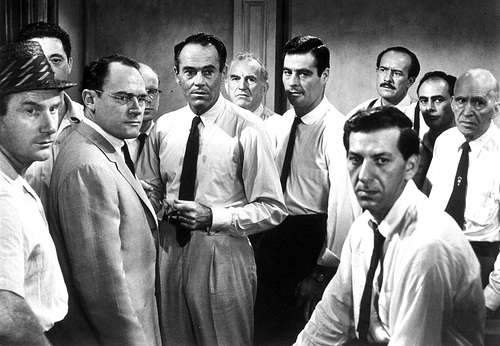
*11 of the 12 angry men from the 1957 film 12 Angry Men