In the Bhaddekaratta Sutta, the Buddha taught, "Looking deeply at life as it is in the very here and now, the practitioner dwells in stability and freedom," a teaching that echoes Patanjali's definition of asana (yoga postures) as "stable and easeful". In both the Anapanasati Sutta (Awareness of Breathing) and the Satipatthana Sutta (Foundations of Mindfulness), the Buddha tells us to observe the breath and then extend our awareness out to include the whole body. He says that the practitioner should be aware of the movements and position of the body, "bending down, or standing, walking, sitting, or lying down."
--from Breath and the Body by Frank Jude Boccio
I found this quoted today on the blog Blue Lotus Seed, and thought, yes! There it is! An example of yoga teachings and Buddhist teachings brought together. Now, this is hardly novel, but often the link is made without specific reference points, in a sort of abstract way.
During yoga teacher training class last night, we were asked to speak a little about how we would run a yoga class, and what might be guiding the ways in which we are choosing to do so. I have been setting up practice class structures, with postures and meditation and whatnot, getting ready to do a bit of practice teaching. Anyway, when I started talking about how I was approaching teaching, it always came back to how to bring people into the present. How to help folks develop awareness and mindfulness. And how to plant the seeds that these practices are really gateways to liberation, not simply a way to feel good or be physically fit.
One rub I have had during this program is that many of my fellow students haven't spent much time with meditation, the yoga sutras, or other deeper aspects of the practice. It's harder for some of my classmates to view the physical postures as a form of moving meditation, which they can be if approached in certain ways. And so, what has happened is that there is a lot of energy around discussions of alignment, posture variations, health benefits of poses, and the like, and less around meditation, yoga philosophy, and mantra practices. It's not a lack of interest, nor is it a lack of attention given by the program - it's more about where the bulk of the students are at.
One of our instructors recently spoke of coming into yoga from the opposite end that most Americans seem to do. Like me and one other guy in my core class, she has had a long term meditation practice. And because of this, the way she approaches yoga classes is much different from the average yoga teacher. I have found that there are a few other instructors like her in our program, as well as a few more students in the larger group like me and the other "meditation-based" guy in my core group. But we're in the minority, a fairly small one I'd say.
So, it was interesting to speak about how I'd run a class to my classmates. How I would bookend any asana practice with meditations, or how I'd sacrifice excessive talk about alignment in favor of drawing students to stay with whatever they are experiencing in the pose they have come into. Or just the use of silence, of allowing people to be without too much teacher talk. Even the little bit of yoga teaching I did with my old ESL classes, I offered some silence to my students - in fact, I did that a lot even during the language class itself, developing activities that allowed for group silence at times, knowing how busy and chaotic many of my student's lives were.
As I told another classmate who spoke of having a fast flowing class with lots of music: "I love that kind of thing too, in small doses." My way isn't necessarily the better way. I have been in fast moving, intensely physical yoga classes with a teacher who had a deep sense of the whole of the practice and was able to convey that depth regardless of the outer form. Which was pretty amazing to me.
It all comes back to how best to point people in the direction of "stability and freedom." There isn't a single way, but certain approaches are much more likely to get people there than others.
Showing posts with label anapansati sutra. Show all posts
Showing posts with label anapansati sutra. Show all posts
Thursday, July 14, 2011

Wednesday, October 6, 2010
Anapansati Sutra
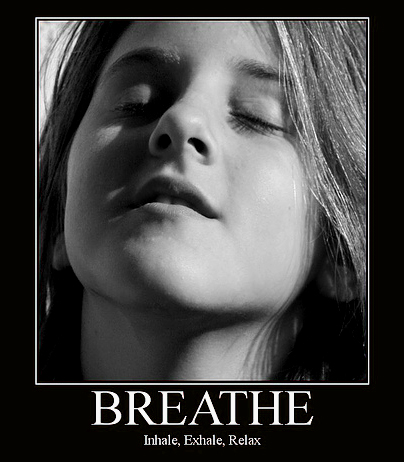
Sitting in the central branch of the public library right now, listening to a pair of women discuss the obituary of another woman they are trying to locate in a newspaper from 1974. I am about to head off to my class at the zen center on the Anapansati Sutra, which is essentially a condensed training manual for awakening through breath study. Outside, red, yellow, orange and brown leaves are blowing across the sky and across the busy downtown streets. It's the end of another workday for many, although for me, it has been another day in the bardo I currently am in.
The life of the breath is something I have paid some attention to for many years now, but if I'm honest, not terribly closely. Just as the appearance of a tiny field mouse in the park yesterday surprised me, so too does the ebb and flow of breathing. How does it keep changing it's appearance in my life as it does? No two breaths are alike, which points to the fact that there is no "self" that is stable either. It's always moving, always changing, even if only in the slightest way.
The field mouse I saw had a short, happy gallop across the grass behind me. That is, until a blue jay broke ranks, doing it's best raptor, swooped down and gobbled it up, before disappearing into a tree above the nearby waterfalls.
Subscribe to:
Posts (Atom)