Showing posts with label fear. Show all posts

Tuesday, December 3, 2013

Louis CK's "Boredom" Routine Meets the "Mindful" Parent


I've never been one to look to celebrities for great wisdom, or profound opportunities to learn something about life. However, they're still people. Living on this planet. Which means they need not be ignored, or treated as all fluff and emptiness.

Skewering pop culture icons is a favorite past time of hip spiritual types these days. It's usually a different flavor from the fire and brimstone condemnations of religious conservatives, but in the end, both groups tend to display an "above it all, holier than thou" attitude. Something I'd argue derives from a false sense of separation, as well as an allegiance to some form of "transcendence" from the muck of this world.

I say all this because I have been guilty of such hip skewering. And recognize the subtle (and sometimes not so subtle) superiority complex that lingered beneath those criticisms. It's a form of criticism that moves beyond examining particular people and social structures, and goes into the territory of "don't bother looking for wisdom or insight here. Because you won't find any." And by here I mean from this person, or this form of pop culture, or in such and such activity. No doubt, there are plenty of tried and true paths for humans to embark and wake up on. However, it's also the case that every last one of our paths to awakening is unique, with points of awareness and wisdom discovery coming from all sorts of unlikely places.

By now, many of you have probably seen the clip of comedian Louis CK talking about boredom with his young daughter. Specifically, in response to his daughter repeatedly saying she was bored, he says:

“I’m bored’ is a useless thing to say. I mean, you live in a great, big, vast world that you’ve seen none percent of. Even the inside of your own mind is endless; it goes on forever, inwardly, do you understand? The fact that you’re alive is amazing, so you don’t get to say ‘I’m bored.”

It's not exactly the response of a heartfelt, gentle parent. I don't think I'd say it exactly that way myself. In fact, I kind of wonder if some of the extra bluster there is simply Louis playing it up to get us to laugh and pay attention to how we feel about such interactions with our children.

Anyway, fellow 21st Century Yoga author Matthew Remski doesn't care much for Louis CK's humor on this one. In fact, he basically rejects the idea that CK's comments are a point of spiritual wisdom.

his now-famous admonishment that his daughter shouldn’t be allowed to be bored is not a borderline-spiritual encouragement for her to seize the day. It’s a transference of anxiety. If we’re laughing, it’s to protect ourselves, as he does, from the most difficult question a child will ask: “What should we do now?” The truth is that nobody knows. If we wanted we could let that soften us, but that softness won’t make anyone laugh.

What to make of this? Even though I'm not a parent, I have had more than enough experience with children and their questions to agree with him that questions like "What should we/I do now?" when you don't have an answer can be anxiety producing. Uncomfortable. In part, I think, because the lack of a ready made answer blows through the idea of being the "all knowing adult." Which is great in one way, because it's an instant opening for co-creation between child and adult. On the other hand, it can leave both with a sense of confusion or even heightened fear. The child thinking, "If he/she doesn't know, then what do we do? Who can help us find the answer?" The adult thinking, "I'm useless here." Or "This kid is seeing through me now." Or "How long will it be before they reject me as trustworthy or as an 'authority figure' all together?" Which eventually could lead the adult to the same question as the child: who can help us find the answer?

However, is the laughter about protection? Or is it, at least for some folks, about recognition of the mucky challenge of that situation?

After making what I would call an unfounded character assumption about Louis CK, Remski goes on to offer this:

Let’s focus instead on the fact that his answer is both untrue and ineffectual. On the untrue side, every four year-old knows that the world is great, big, and vast. And no four year-old has seen none of it. In fact, her entire being is trembling at the threshold of the all of it. The four year-old has had plenty of time to navigate her internal worlds. She knows that stories, dreams and fantasies go on forever. So yes, Louis. She understands these things, and feels much more than she understands. “I’m bored” doesn’t mean “I’m uninterested”. It means “I don’t know who I should be. I feel empty and full. I feel confused and sad. What should I bother doing?”

On the ineffectual side, the answer pretends to kindle the girl’s wonderment, but it actually burns the tenderness of her question. She’s asking a question about how to manage emptiness, and his answer is to overwhelm her with stuff. Instead of letting it be an open moment in which the parent can share in the revelation of uncertainty that the child makes new for him, Louis crams irritated gumption and panicked work-ethic down her throat, guilting her with what she already knows but was too innocent to accept, guilting her for naming a condition to which we dare not confess, guilting her for being so rude as to ask for help. We laugh because he releases the valve on our own guilt over doing the same thing.

My initial response to this is that Remski over estimates the "knowing" of a young child. Personally, I'm not convinced that every child, or even most children, fit the vision he's putting forth. It feels like an adult projection on children. The whole children are adults in small bodies kind of thing. Regardless of whether that's accurate or not, I think it's more useful to come from a place of not knowing here.

CK assumes that boredom means uninterested. Remski assumes the child knows and understands a whole lot about the world and is interested, but confused. Both are assumptions. Assuming the latter might be more expansive and helpful, but it still creates a limited story around the situation that limits the possible responses. Sometimes, children are flat out uninterested in the current situation. If you say otherwise, you've totally forgotten your own childhood.

The problem is that adults are far too prone to coming from a place of knowing in general with children. Because we're supposed to know. Because they usually expect us to know. And because our social structures reinforce the idea that the only right way to interact with children is to be the authority, the leader, the one who knows.

What I see in these pair of responses (from Louis CK and Matthew Remski) are the flip sides of the "adult as knower" coin. One is the gruff, no nonsense side and the other is the soft, tender side.

Where is not knowing in all of this? How might it look different (even just a little bit) if entered into without managed scripts?

As a side note, the feeling tone I get from Louis CK's comments is kind of hostile towards children. Whereas Remski's comments feel hostile towards adults. He goes on to speak about how adults often shift their own self criticism and doubts on to their children. Which is totally true. And yet, his commentary feels devoid of compassion for the struggles of parenting (or being an adult role model) adults face everyday. There's also a particular skewering of Louis CK that in my view seems almost a desire for us - the readership - to see him as an untrustworthy narrator. Someone we'd never look to for wisdom, and also someone who is probably a poor parent to boot.

The way I see it, the brilliance in some of Louis CK's commentary about parenting is that he deliberately unearths all the contradictory, mucky thoughts that adults feel when with children. Especially children who ask lots of questions that have no clear or ready answers. Questions we've been struggling with our entire lives. Sure, if it's true that he's saying all of this stuff to his daughter, that wouldn't be too great. However, I'm not convinced that his comedy stick is a verbatim blow by blow account of his interactions with his daughter. It feels like a compressed version of those moments when the well of energy, caring, and compassion have dried up. And no matter how much you want to be the "best" parent or role model, you just can't offer much. So, a little of that inner crap spills out. Maybe the words sound good, but the tone is standoffish or curt. Or maybe the tone is right, but the words aren't so helpful.

I agree with Remski that Louis CK only offers one side of boredom to us. However, his response to the whole thing feels like a rejection of adult struggles, and also perhaps a subtle rejection of adulthood (beyond being a mentor/parent to children) itself. He writes:

We have to let our children be bored, so they can explore safely the endless horizons of time, and softly confront the abyss. If we take their lead, we can also let ourselves be bored, but not with resignation or apathy. We can be comfortably bored with the endless Big Red Dog, the counting of spaces on board-games.

On the one hand, yes - we can totally share boredom with children. Without trying to come up with some great answer or resolution for it all. And furthermore, there has to be space for kids to get bored and not know what to do in the first place, something the hyper scheduled world we more and more seem to inhabit is failing us - all of us, children and adults alike.

And yet, boredom need not always be shared. In my view, there's a bit of the sacrifice mentality behind these words, and this article as a whole. As if an adult is always selfish or guilty of poor role modeling if they opt to not read the Big Red Dog for the 1000th time today. Or if they respond to "I'm bored" for the 50th time by saying something a little like what Louis CK did. With much younger children, there's definitely less room for this without also doing some harm, even if unintentional. But part of learning how to deal with issues like boredom involves having the space and time alone to face the unknown of it all. And also learning, little by little, that adults have lives beyond you. That you aren't the only person in their world in need of something, even if they are your parent. And that they, too, have needs, which sometimes conflict with yours.

I may be wrong in reading it this way, but Remski's commentary sounds like the flip to the opposite extreme of adult children whose parents frequently sounded like Louis CK's comedy routine. The distant, dismissive, authoritarian, gruff parent, is replaced by the soft, self sacrificing, doting, parent who idealizes their child, in large part out of fear of "damaging" them in some way or another.

Odds are I will get some flack - either written or unwritten in some reader's minds - for writing so much about this as a non-parent, but I'm convinced that both of these extremes are pretty damned common in our society, and neither is leading to more enlightened children, nor healthy, fulfilled parents and adult role model figures.







Thursday, October 3, 2013

Violence Will Not Cease Without Facing Our Fears of Death


The first Buddhist precept is a vow of non-killing. It’s not an injunction against all killing, and indeed we are always, even in taking a breath, killing something. If we want to embody a non-violent way of being and acting in the world, we have to come to terms with life and death as unified. Inseparable. That living and dying are occurring in every moment, no matter what we choose to do or not do. On the whole, American’s don’t handle the death side well. When faced with any inkling of it, we’re prone to turn away, minimize, or deny it. The increasing, mostly male obsession with “self defense” and resorting to violent measures to carry out such defense, feels intimately tied to this issue. Men look around and see other men killing each other and they don’t want to be next. Never mind that 2/3rds of gun deaths in the U.S. annually are self inflicted, the fear of being mowed down by some other is widespread. It’s not the slow fading away from chronic illness or quick passing during an accident that haunts many of us. It’s the messy end by bullet.

You can read the rest of the post here.

Friday, September 7, 2012

Stop Wasting Your Life! But how?

"I respectfully urge you who study the mystery, do not pass your days and nights in vain."

Last lines of the Sandokai
What does it mean to not waste your life? How do we do it, not pass our days and nights in vain?

Over the past few years, I have been much more intimate with "don't know" than in the past. Sometimes, it feels like I'm drifting along, which my little mind associates with "wasting life." Other times, it makes total sense. I really didn't know what all was going in the past either; I just thought I did. It's easy enough when you have a lot of the "normal" markers (like a steady job, home to take care of, etc.) in an adult life to forget about not knowing. And to assume that what you are doing is "not a waste," or not a total waste anyway. When you strip away a lot of those normal markers, however, you start to see that your stories might not be terribly accurate.

I'm really getting a sense these days as to why so many of us do everything in our power to resist liberation. In the depths of our hearts, we want to be in touch with our boundlessness. But even small shifts towards that, like letting go of some of the conventional things that once defined you (or so you thought anyway) brings with it a palpable fear, confusion, and desire to get back some stable ground.

A friend of mine, who has been struggling to make a few key decisions in her life, recently said something like "I don't want to live the rest of my life doing the same things." But then she goes back to doing so, for now (that's what we all think, for now).

Like my friend, I have done the "for now" return many times.

This returning doesn't define either of us, but it does make me think that the mind is so desperate for things to be stable and predictable, even if it's causing a crap load of suffering.

In living in a more stripped down way over the past two years, I have been trying to break through whatever it is that makes that "for now" so attractive. Attachment. Fear. Stories about success and failure. Desiring that things are stable and predictable.

It's a long list; I'm not through it all yet, and may never be in this lifetime.

What does it mean to not waste your life? How do we do it, not pass our days and nights in vain?

Keeping questions like these close, refreshed daily. That's the best answer I have to offer right now.

How about you?

Friday, June 22, 2012

Hope Isn't Really a Buddhist Teaching

Hope is important because it can make the present moment less difficult to bear. If we believe that tomorrow will be better, we can bear a hardship today.

By Thich Nhat Hanh

I disagree with this statement. It panders too much to the stickiness that lies behind hope. The longing for a future that may not come. The desire for something comfortable and stable to rely on. The fear that things will "get worse." I have written on this blog before, and continue to believe, that hope is mostly a hindrance. Thus my disagreement.

Given that many of us live in places where hope narratives are really strong, using the word "hope" can be a skillful means. Telling someone "I hope you feel better soon" can be skillfully supporting them, as can offering optimistic views of the future. That's where comments like Thich Nhat Hanh's above might be pointing us in a useful direction, but you have to reflect on where that might be.

We can come from a place of offering that is open, and not caught up in the futurizing of hope. I can imagine hospice workers and chaplains have to work with such language all the time, and must consider the people before them and what is most skillful in the given situation. But I think there are ways to work with really difficult situations like families facing terminal illnesses that are both realistic in the now, but also optimistic about life as a whole.

Optimism is different from hope in my opinion. Although it tends to be linked with hope, I think optimism is grounded in confidence and a trust in the boundlessness of the world.

My mother is a pretty optimistic person. And although she gets caught up in misleading hope narratives like the rest of us, what I tend to see from her is a great trust that things will unfold in the way they need to unfold. The other day, her car broke down on a freeway ramp. She was initially irritated about it, and worried about having to get a new car. However, within a few hours, she had shifted all of this. With a friend of hers, she'd considered some of the possible outcomes, and then let it go to the mechanics to deal with. And although she had a hunch that it wouldn't be too bad (which it wasn't), what I mostly saw was that she trusted that what needed to happen would happen.

Optimism also, in my view, is seeing everything as an opportunity to learn, to become more fully yourself. That whatever comes, there's a way to integrate it into the whole of your life. I don't see hope doing that. Hope is usually about a desired outcome or set of outcomes. And a rejection or avoidance of other outcomes.

Now, even the word optimism is tied to a binary: pessimism. It feels a little clunky to me as I write this, but I'll opt to use it anyway.

As a final thought, I'd like to ask people who feel hope is essential a few questions. When you say hope, what exactly do you mean? How does it actually function in your body and mind when you hope for something? And what happens in your body and mind when you don't get what you hope for?

Thursday, September 1, 2011

Mindful Community Building


What we let fear do to us. The list is endless, isn't it? Petteri has an excellent post on the topic, of which I'd like to take up the following:


I read a bit of news reporting a few months ago where they had interviewed three people, one born in the 1950's, one in the 1970's, and one in the 1990's, in a certain part of Helsinki. They'd asked them to map out the physical territory they roamed as children below the age of 12. The 1950's kid was all over the place, shooting rats at the harbor with a BB gun, climbing the rocky vacant lots in Kallio, getting into scraps with the kids from the neighboring neighborhood, taking long walks to Seurasaari, and so on. The 1970's kid's map covered the general quarter of the town pretty well, but had none of the 1950's kid's expeditions. The 1990's kid went to school, some friends houses nearby, and was driven by his parents to do sports and other hobbies. His map had a few disconnected spots on it.


It's really similar here in the States. And there are many reasons behind this shift. A heavy emphasis on the privatized, nuclear family model as the "best" way to raise children. A huge increase in reporting about child abductions and like situations, to the point where people think there's a bad guy lurking behind every tree, waiting to take their kids. Another factor is the increased reliance on cars and other motor vehicles, to the point where our towns and cities are constructed to compliment motor vehicles, and often at the expense of safe places to play, bike, and recreate.

Petteri goes on to say that while Helsinki is a safer city now than it was in the 1950's, people live as if the opposite were true. Which is something I've seen here as well.

And like Petteri, I also feel that there are various fears underlying these attitudes, some maybe legitimate, but also some completely concocted and reinforced socially.

However, I can't help but think about, for example, the ways in which how we choose to structure communities impacts our heart/minds. Or how we choose to group ourselves, such as our family structures, and how that also impacts our heart/minds.

Actually, when I read Petteri's post, the first thing that came to mind is something I have thought about off and on for years.

How do we mindfully build communities? How can we shift both physical and social structures in order to live together in a more awakened way?

Because having more and more people living in securitized, suburban-styled places where the only safe way to move in and out is by car is a recipe for disaster. And while there are signs of different models of community development gaining traction, it's amazing how much fuss putting a single bike lane on a city street causes, or how much resistance there is to efforts to create a park out of a stretch of a shoddy freeway access road (both things I've seen here in St. Paul, Minnesota). Because so many people have structured their lives around driving quickly between various points, that still seems to trump nearly everything else, even in this age of higher gas prices and assumptions that the oil age is slowly (or even quickly) on it's way out.

Over the years, I have watched the planning processes unfold for a series of inner city bike trails, for a light-rail train network, and for creating more "green space" within our two cities (Minneapolis-St. Paul). And while some great strides have been made, I have noticed that even the planners are at odds with themselves. On the one hand, sharing the visions they have for what probably would be a healthier, more integrated community, and on the other hand, saying and doing anything and everything to appeased the pissed off people that show up complaining about reduced speed limits, reduced car parking, and any general loss of ease in getting around quickly.

And yet, as someone who has never been a car driver, I look at wonder when people claim to "know their community." How can you truly know your community when you spend the majority of your time whizzing through it in a plastic and metal bubble? When you don't even know your neighbor's name?

Again, I know this doesn't describe everyone. I can even think of counter-examples in my own community here, like the highly connected block where my mother lives. I also think of all the community gardens that have sprung up in the past decade, sometimes bringing together large parts of entire neighborhoods. However, these examples haven't really translated for the most part into how we collectively handle the larger communities we live in. Big business, the whims of building contractors, and car-centric design still rule most of the day, even in fairly progressive places. It's like there are these little enclaves tucked away here and there within a sea of people living in the same space, but sharing little if anything else.

Which just leads me back to the question: how do we mindfully build communities?

Tuesday, January 18, 2011

Buddhist Without Money


Not having a job for the past three and half months, I have had a lot of time to think about money, and my relationship with it. If I were to characterize the dominant theme of my adulthood, it would be fears of lack and actions based on stinginess. Both of these views have loosened over the past couple of years, but they still tend to dominate.

Given the society I live in, that's exactly what is desired. It's the most "beneficial" outcome for a human being in the United States (and many other countries). A belief in lack and scarcity, and deeply seated fears of having nothing, going bankrupt, and being abandoned to starve or die of some untreated illness are hallmarks of a good consumer. Trying to fill the empty pit in your gut is the way the economy runs, the way fat cats get their millions, the way the government has enough money to conduct extravegant wars in far off nations to procure more power and resources to keep the whole thing going. Not only does having material wants and being able to satisfy them make me "a good citizen" in the eyes of others, but it also is one of the very "skills" that supposedly defines me as a person at all.

There's very little I'm fully certain of these days. But I'm quite certain that this way of living, and determining the value of human lives, and other lives for that matter, is entirely deranged.

Heidemarie Schwermer has spent the last 13 years living without money. It's been a deliberate series of choices she made, slowly ridding herself of nearly everything she owns, finding that at each step of the way, she felt healthier, happier, and more alive. Others have does this before her, notibly a woman who renamed herself Peace Pilgrim, and walked over 25,000 miles, criss crossing the North American continent spreading a message of peace.

Schwermer's story, like Peace Pilgrim's, is probably extreme looking to the average eye. However, I'm a firm believer that the world needs people willing to step completely out of the norm and give birth to something entirely different, in order for a new way of thinking and being to spread.

Ideally, Schwermer would like to lead by example and give other people courage to change their attitudes towards money and how they live in and contribute to society. The pressure to buy and to own, she feels, has intensified in recent years. Consumerism is essentially about “an attempt to fill an empty space inside. And that emptiness, and the fear of loss, is manipulated by the media or big companies.” There is a fear, she says, that in not buying or owning an individual will fall out of society. The irony, she claims, is that material goods can never plug a spiritual hole and shopping and hoarding are more likely to isolate people than bring contentment. Does she intend to start a revolution?

“No, I think of myself as planting the seed,” she says. “Perhaps people come away from my lectures or seeing me being interviewed and decide to spend a little less. Others might start meditating. The point is that my living without money is to allow for the possibility of another kind of society. I want people to ask themselves, ‘What do I need? How do I really want to live?’ Every person needs to ask themselves who they really are and where they belong. That means getting to grips with oneself.”


It's been quite interesting to me how often thoughts have come up in recent months that tie my "worth" to monetary earnings and the ability to purchase things and experiences. I have been slowly venturing back into dating again, and those thoughts are often with me. She's going to turn the other way when she learns you're not working right now. It's bad enough you don't drive, don't own a house, etc. I used to feel terrible about all this. I had the intellectual understanding that having money and stuff isn't correlated with joy and awakening, but couldn't break through my fears around "identity," and specifically being a person who doesn't go along with the norm. There was lots of internal battles, and movements back and forth between not giving a crap about money and possessions, and thinking I needed to "keep up" in a modest way so I'd pass for being "ok."

Now, I find that the inner turmoil has lessened greatly, and I'm groping along for a new way to think and be around money and things. It's exciting, but scary at times. I can imagine many people reach this place, and then find the lack of a clear direction just brings up too much fear, so they leap back into the old model: taking some job they tolerate or faintly enjoy, buying more stuff, and trying to prove to their lovers, family, friends, and the world that they, too, are "worthy."

In my opinion, people like Heidemarie are trying to remind us that there is more power, joy, and depth in healthy communities than in privatized, individual lives. Some would say she's an idealist caught in a utopian dream. Some would say she's a Communist. Some would say she's a lunatic. I've been called all of these myself, and I haven't even taken the drastic steps she has.

In addition, the kind of bartering that Heidemarie's life thrives on is actually part of an emerging trend around the world. In some places, skills and material sharing have always been a constant, out of necessity and/or out of a belief that it's the best way to treat others and keep a community alive. In other places, like the U.S. and Germany, skills and material sharing are being rediscovered as people struggle finanically, and also have discovered that having material wealth hasn't brought the kind of happiness and depth of experience they thought it would.

And it's no accident, in my view, that part of the process Heidemarie has gone through has included meditation practice. How do you make these kinds of radical shifts without paying close attention the life you have now, the thoughts and feelings you have now?

Early on, Schwermer wanted to help the homeless. Like a lot of people, she really didn't know anyone who was homeless, or even much about being homeless, and as a result, her efforts flopped. Although she has changed so much through the years, she still hasn't had much "success" with her initial goal.

“I haven’t managed to reach the homeless,” she says. “I did hold lectures for the homeless but only six or seven showed up. They didn’t want to hear it. One of the men there accused me of having ‘connections’, that I’d only been able to do what I have been able to do because I knew people. I do have contacts, that’s what this new world is all about, forging links and contacts. Otherwise it wouldn’t work.”


Lectures probably aren't the way. Who wants to listen to someone who had a middle class life in the past lecture about how to live without money?

However, I think she's totally right that making connections and forging links is a huge part of shifting one's way of thinking and living with money and material possessions.

One of the deepest sicknesses of the modern, "market driven" world is a heart-crushing isolation and disinitigration of community. Some people stay homeless for decades because they can't get anyone to pay attention to them, and/or feel unworthy of that attention. Others lives lives that appear to be functioning "fine" - have jobs, homes, stuff - but are equally bereft of the ability to connect with others, and feel worthy of being connected to. Within all of this there is a personal responsibility to pay attention to one's life, and be willing to cross into an unknown future, often with fears in hand. However, that's only a small part of the story.

The brave few will continue to break through, and offer different ways to live and be. However, until more of us take them up on the offer to fully, deeply, and thoroughly examine our lives - individually and collectively - then they will remain the brave few.

Blaming poor people for having nothing, and not being willing change that, is the garbage of the current model. Striving for more stuff, and fearing profound lack, is also the garbage of the current model. It's a hallmark of this model of living actually: producing garbage.

May we find a healthier, more liberated set of ways.

Friday, December 31, 2010

Screw New Year's Resolutions - Part II


At the beginning of the year, I offered the following post. It remains true to me as 2010 comes to a close. It's really interesting how the same themes arise again and again, isn't it? Like this:

Even though I think there is something in the spiritual life that might be called Great Hope, most of what we call "hope" - even in a spiritual context - is simply fraud by another name. If you can find a hope that is not intimately attached to fear, then maybe that is worth having. But be honest, have you ever made a New Year's resolution that wasn't laden with the fear of failure, or some other fear?

I like the idea of beginning anew. Of starting again and again - with fresh eyes. Beginning anew is akin to "don't know mind" in that both, in their process, breaking through fixed views of what is.


Hope and fear. Guess I've been deliberately working with those two for awhile now. I imagine a lot of others are as well.

Here are a few poems to send off the old year, and ring in the new. May we all be liberated, again and again.

On Top

All this new stuff goes on top
turn it over, turn it over
wait and water down
from the dark bottom
turn it inside out
let it spread through
Sift down even.
Watch it sprout.

A mind like compost.

Gary Snyder


now begins
the Future Buddha's reign...
spring pines

Issa (1763-1828)


*Image - winter whimsy from my neighbor's garden.

Monday, December 27, 2010

Dark Tunnel Dukkha


For various reasons, this time of year tends to bring out the worst in me. Or that which I don't want to look at, have avoided, am afraid of, etc. This year, it feels quite fierce, given where I am in my life.

After three months of not working, I'm getting a crash course in how difficult it is to let go of external identities and desired support from others, and just be yourself right now. Here is a short list of what's been coming up for me over the past few weeks:

1. Lots of questions about who I am and where I am going.

2. Lack of confidence.

3. Fear. Lots and lots of fear.

4. Avoiding. Lots of avoiding.

5. Frustration with an inability to articulate what's going on to others.

6. Irritation with unsolicited advice.

7. Guilt. I mean, after three months, why don't you have something figured out?

8. Surprise. Why has the harsh critical voice suddenly returned with full force?

9. Anger. A more recently returned guest.

10. The usual seasonal depression, that came later this year, and which I thought I had a decent handle on, but now am swamped in again.

When I left my job at the end of August, my intention was to take time and listen deeply for what it was that my life was really calling for me to do. I had grown tired of doing what a lot of people do - keeping a job that slowly kills them because they're totally afraid of the economic and/or social consequences of leaving it without the safety net of another job lined up.

The thing is, it was always more than about work for me. All signs in my life had pointed to it being time to figure out a way to synthesize what I love into how I live more fully, on a day to day basis. This kind of thinking tends to be dismissed by the conventional world as pipe dream bullshit, and it might turn out to be just that, but I don't want to be on my death bed thinking "Maybe I should have taken a risk to do X."

Anyway, when I left in August, I didn't expect the following to occur.

1. Most of my "in the flesh" friends either growing extremely busy, or simply vanishing from my life all together.

2. The flickering in and out of my life old romances that stirred up various unresolved issues/griefs connected to them.

3. Discussions about what it means to be a dedicated lay practitioner at my zen center, and subsequent requests by a few students in a group I am a part of for added practice requirements (more retreat time and responsibilities for upholding aspects of formal practice at the center).

4. Frequently interrupted sleep patterns and various minor illnesses over the past month.

All in all, I'm finding that other than my immediate family, many of the relationships in my life are either dormant, strained, or disappearing. And I'm seeing how this has sent me spinning more often than I'd care to admit. Even though I have had wonderful people supporting me throughout my life, and know that the universe itself is always supporting each of us in a myriad of ways, it's also true that I have had to do a lot of things on my own. That from an early age, I was called on to be a responsible person capable of taking care of his shit. And what this did to me was create a pattern where I feel I should be competent or better in what I'm doing most of the time, otherwise something is way wrong. Intellectually, I know this to be a story, but deep down somewhere, this story is still fighting for control of my life. And in this time of not knowing about so much, it's rearing its ugly head pretty frequently.

The other thing about this pattern, at least for me, is that I have quite weak skills in asking for help or support. Years and years of having to do it myself, or thinking I had to do it myself, have left me in a tough position now. When you're not good at reaching out in these ways in the first place, and then many of those who you have developed a sense of trust with are not available, you're left to face your rotten skills on your own. In fact, whereas when I'm doing fairly well, I have a good sense of what I need and can usually locate it, or figure out how to deal without it. But being in this place of such fierce not knowing about so much, I also don't know what it is I really need. So, not only am I not good at reaching out for support, but I often don't even know what I'd ask for right now.

In posting this, I am not desiring advice on "what to do." Nor am I fishing for sympathy. I've had darker periods in my life, where not having the tools and insights of a spiritual practice meant swirling around in endless rounds of self-criticism and anger at others for not "getting me." That was worse than what I am experiencing now, even though what I am experiencing now feels like it's going straight to the core of my life. Much more palpable and scary than what I went through when I was younger, but the ride is less maddening you might say.

It's also been interesting to watch momentary impulses to post some sad-sack headline on Facebook, or to write some crying in your beer type post on here. I've watched a few friends use Facebook like that over the past few years, and I don't want to join that crowd. Some blogs get like that as well, where post after post is about the latest misery a person is experiencing, or how decision X or experience Y is another example of how "bad" a Buddhist they are. This is mostly just hustling for a self-esteem boost, and that's pretty damned tawdry if you ask me.

One of the reasons I dedicated myself to both zen and yoga practice is that both emphasize total liberation. If you stick with it, experiment with what you learn, and trust the process, major shifts do happen in your life. And even though there's endless talk about dropping all "expectations for any fruition" - especially enlightenment - I think it's foolhardy to believe that you'll just reach a certain point where you'll have a relatively comfortable "external life" supported by your practice. Actually, I'd say this is exactly what happens to those who seek out practice as self-help, which isn't a terrible thing, but certainly is limited.

When I received my dharma name a few years ago, I found myself pondering "devotion." And one of the things I have realized is that even though on the outside, my "practice" sometimes looks a bit slack, I have always, since I was really, really young, had a fire for uncovering the truth. At five years old, I returned home one day from school and told my mother the kids in class were boring. Why? Because they were mostly interested in playing around and picking on each other. They were being kids in other words.

I played too. It wasn't that I was some learning robot, always focused on serious stuff. But that little boy carried an old man's voice in his head from the beginning I think. Which made me kind of different. And sometimes caused trouble. Like the time I took my sister down in the basement to show her the pile of presents, and tell her there was no Santa Claus. She wasn't even five years old yet.

So, the leap to leave my old workplace, and more importantly, to live in this not knowing place is all about that devotion to the truth. To awakening. To liberation.

And this post is part update about where I am at, and also mostly an attempt to say that I'm not finding it terribly easy right now. Here in Minnesota, we keep getting piled on by snowstorm and snowstorm. I feel like the ground, buried in snow. Except the ground just accepts it, whereas with each additional layer, I'm fighting it more than accepting it.

Perhaps this will all change very soon, or maybe not for awhile. I don't know. I'm doing my best to trust the process. Some days that's easier than others.

Wednesday, September 8, 2010

The Misery of Not Making Mistakes


The following little talk is from our center's monthly bulletin. It is from the same lay teacher, Ken, whose zazen in a chair I wrote about last week.

ARE YOU OKAY WITH THAT? By Ken Ford
I began our conversation with a story, oh so important at the moment. Like many of our stories, a self-centered complaint: I had screwed up quite publicly in my sesshin assignment, just how I don’t remember, but it confirmed mistake-making as a tendency of mine, one I didn’t like. Tenshin-roshi’s response took me by surprise. “Are you OK with that?” That’s all he said.

I saw the reactions come up: “Of course not, why would I be OK with my mistakes? Why would I have brought it up?” But I heard him loud and clear. He had simply pointed out that I was only adding suffering to suffering with my story. I had set up camp in a notion of myself as a person who makes mistakes and I wanted to fix that.

We want to get things right, and with care we often do. My presence and clarity of mind are far from perfect, however, and my actions don’t always live up to my standard; I don’t always get it right. Moreover, I live in a radically interdependent way with all beings; “I” am not in control. I remember Katagiri roshi saying that because of our complete interdependence, we cannot live for a minute without forgiveness.

There is suffering in making a mistake: the simple realization that my actions didn’t measure up, and maybe my action caused discomfort for others. Oh, but I said public screw-up didn’t I; how about the everyday suffering of a little bruise on the ego? A mistake and its consequences need to be seen and felt, which is to say fully acknowledged, confessed. But then if I do not see its emptiness, how much suffering do I add by dwelling in the world of regret, by—and this is what it amounts to—hating rather than accepting what arises as the life of this moment?


Spending a lot of time on my own recently, I've been noticing some things about mistakes and my attitude towards them.

First, like Ken, I'm often not terribly happy with screw ups. Especially public screw ups that involve others. At the same time, I seem to be ok when a mistake doesn't appear to impact anyone but myself. Or if it's just a little screw up that doesn't "make much of a difference."

Second, I have a strong coward-bone that pushes me to do all sorts of things when I let it. Instead of taking a risk, I'll avoid something to minimize potential mistakes. Instead saying things directly and clearly, I'll try and soften my words, or make qualifications that will ease disagreements. Why? Because sometimes, my mind tells me that disagreements are mistakes, and sometimes I believe that mind.

Third, I don't regret very often. I'm not one to wallow in that kind of energy, or if I do, it's not too long.

Fourth, I'm coming to see that when you are always "trying to get it right" or "do it right," you are in a prison. Why is that? Because you believe you know where you need to go and what needs to be done, and then inevitably you'll fall short of the story. Living like this also saps creativity, spontaneity, and flexibility. It makes you heavy, anxious, and on guard towards others.

Fifth, I can feel the fears of being abandoned, rejected, and alone behind the concerns I have about mistakes. This isn't a little fear, either; it feels bone-deep at times.

To be honest, I find it challenging to be ok with the fact that much of life is out of my control. That even my best efforts might still result in mistakes. That I can extend all the kindness and generosity possible, and still might be met with abandonment and rejection. And that each of us is alone in a certain sense, even if we are also interwoven with everything else in the world.

The methods of damage control I employ around mistake making really are about avoiding these truths. And, also, fixating on them too much - as if I'm always going to be condemned, no matter what I do, which is just another story.

Most of the mistakes I have made over the years involving others have been quickly forgiven, or brushed off as not important or worthy of worry. In fact, as I have learned to tone my own reactions/judgments down, I have come to also be able to see when someone is over-reacting to something I did. Or over-reacting about something they did.

However, I'm still prone to wanting to "get it right," and might never be rid of that. And you know, I suppose I can learn to be ok with that wanting. It's not like I have to act on it.

Regardless, the way I'm starting to see it, it's kind of miserable to be one who puts extraordinary amounts of energy into not making mistakes. Perhaps you minimize some hurt doing this, but in the end, your life seems to be minimized in the process.

Wednesday, July 21, 2010

Putting on the Filth


"Don't be like the young Buddhist novice, who, after speaking to a woman, washed himself because he believed he had become filthy. It was not the woman, but his own notions that made him 'impure.' Purity has nothing to do with morality."

Sokei-an Shigetsu Sasaki


We dress ourselves in filth everyday. Most of us. It's a habit we have been trained into, believing that doing so will make us the successful, problem solving, smart ones on the planet. Problem is, it's the very way we step into hell and get burned.

I seem to be drenched in fear lately. At work, I walk around thinking all sorts of things about how no matter what I do, it won't be good enough. Not enough students will pass their standards, and I'll get fired before I can find another job and move on. The idea of getting fired plays into all my failure narratives, and also into the hook of drama itself. The reality is, it's probably slim to none I'd get fired anytime soon, so all the stories around that are just filth I'm wading in.

The monk in the story above is not only displaying the mysogenist strain that runs through our tradition's history, but also a variation of the same spin I'm doing at work. Fears of being found out as a failure, a screw up, and not the profound spiritual guy he desires to be.

It's a boring thing, really, seeing these tapes roll on and on in your head, and experiencing the fear, confusion, and dissatisfaction that arises in the body/mind because there's still some hooking on going on. However, trying to wash away the mud in your mind doesn't really work either, so you have to approach it some other way.

I was sitting with the following koan today, which seems to have some connection to this discussion in my mind.

Chao Chou’s Seven Pound Shirt - Blue Cliff Record Case 45

The Koan:
A monk asked Chao Chou, “The myriad things return to one. Where does the one return to?”
Chou said, “When I was in Ch’ing Chou I made a cloth shirt. It weighed seven pounds.”


Most days, maybe everyday, I get the sense that I'm putting on that seven pound shirt. Do you understand what I mean? And as I was sitting the question came to mind "Do I have to remove it, or can I just let it rot right here where it is?"

The first half of the question is about doing something; the second half is about letting be what is. Both require effort, don't you think?

In a way, when I look at the long narrative of my life, and many of the decisions I have made, it has been a lot like this monk - if different in content. Pushing to the edge in workplaces, but bowing down to authority to avoid the black mark of getting fired. Saving money to the point of having a "cushion" in the bank, even though I've never made above twenty thousand in any given year. Making every last payment on time, to the point of getting into a argument with a creditor solely to avoid a black mark on my credit record. Marching in protests and rallies, but running off or standing off the moment things get tense, and arrests are possible. Seeking to find points of agreement too soon in arguments with others. Failing to look people in the eyes when I am angry, scared, or profoundly sad. In other words, more often than not, I have opted to be "on the safe side," even when doing so has sucked some life out of me. And really, this is the kind of error being displayed by the monk in Sokei-an's story above. Like him, I've wanted to be viewed as pure - but we both have mistaken the very nature of purity, thinking it resided in some moral or behavioral code.

Wednesday, July 14, 2010

Losing "Yourselves"


I spent the day watching various strains of bullshit arise in my mind, and then fade away. A few times, I got hooked into it, but that only lasted a couple of minutes at most. I have had this dual - or what feels like dual - experience going on over the past week or so. Various things in my life seem to either be unraveling, or are being revealed as relics in need of letting go. Some of it is job related, some relationship related, and some even related to writing.

To the fellow bloggers I interviewed last winter, both drafts of the article I wrote for Tricycle were rejected. The second rejection came a few days ago. I intend to submit it elsewhere, and will publish sections of the first article on here when I get around to it.

The article rejection came on the heels of a non-interview call from a prospective employer I thought I had a good shot at getting hired by. I was fooled by a general e-mail they sent out telling candidates they were about to set interview dates, and would get back to us.

About a month and a half ago, I was midway through an interview with another prospective interview - one that was going well and seemed equally promising - when I brought up the fact I didn't own a car. I figured given that it was a community gardening organization focused on eco-friendly urban environments, that such an admission would maybe even be a plus, showing some commitment to what I preach. The
job was mostly in an office anyway, and didn't seem to require much outside travel, and all the travel was in the city anyway, all pretty easily accessible by bus. The director ended the interview two minutes after I said "I don't drive."

So, there's this identity thing going on. The tugs of how I have lived, and how I want to live, and how I have probably hung too tightly to certain narratives and ways of acting in the world.

I had a meeting today with the new director at my workplace. Things will be changing there no doubt. Things are already changing there actually. I can feel it, even as the residue of the previous two plus years of fighting, struggling, arguing, bitching, and surviving live on. I shared a little bit of that with the new director, mostly because he asked for it - for an honest assessment of what has been going on from my perspective.

At the same time, I was listening to his responses. The ways in which he both agreed with me and disagreed with me, sometimes simultaneously. It was kind of fascinating to just experience the whole thing - I barely got the words "Expect for this year, we have mostly met our standardized test goals" out of my mouth, and he shot back "No, we didn't. Don't tell me we did because we didn't." And I sat with that about ten seconds before saying "And how do our scores compare with the other schools?" And his tone became a little more quizzical, even as he stuck to the idea that we needed to be more "accountable" as an organization.

We could have been talking about anything - apples, terrorists, the price of printer ink cartridges - but the repetition of the whole accountability issue stood out for me, as it's one of the main reasons I've lost passion for the work I'm doing. More and more, the emphasis is on making sure whatever collective of outside forces (government agencies, wealthy foundations, and hotshot individual donors) are pleased, that they feel like the money is being spent "wisely." I used to think I might have some positive impact on this conversation. Maybe even make some political impact on some of these issues. Now, after about 12 years volunteering and working in this field (adult basic education), I'm just ready to move on.

So, it was totally interesting to be in the middle of what could have been a heated conversation and being able to see that I had the choice to speak or be silent, and also the choice to defend or let pass any given statement he or I said. There was a pause available in other words, one I don't think I often felt in the past at work.

The same, for some reason, has been present as my relationship with my girlfriend has seemed to unravel. I've experienced plenty of sadness, longing, and some anger even over the past three or four days, and yet almost parallel to this has been this calmness that no matter what, things will be alright.

I'm honestly not terribly happy that all this stuff is happening one thing after the other. In fact, it kind of feels like a lot of who I have been is sort of tumbling down a hill, very intent on getting to the bottom as quickly as possible. I can feel the fear around this experience, not really knowing what it means in terms of the future. And yet, why wouldn't there be fear? If anything is universal, it's fear.

And love -
but unlike fear,
the mind has a certain investment in love
that must be watched over
by the heart
again and again.


*Van Gogh's self portraits seem particularly apt for illustrating this discussion.

Saturday, July 10, 2010

Violence, Control, and "Freedom Loving" People


Oscar Grant was a young black man murdered by a white police officer on New Year's Day 2009. A few days ago, that police officer was convicted of a lesser charge of involuntary manslaughter. In one way, the fact that he was convicted of anything is a change from the past, where white law enforcement officers would walk away free men following such killings. On the other hand, both the lack of a stronger conviction, as well as the sickening portrayal of protests in Oakland following the verdict as "riots" requiring more excessive police force are reminders that injustice still is commonplace.

There is some interesting discussion and links on the blog Racialicious.

In addition, one of our own Buddhist bloggers, Katie over at Kloncke, was at the protests and wrote an excellent post giving us an insider view of what people experienced and what those of us on the outside might consider when it comes to police, communities of color, and violence.

Take a good look at that photo of Oscar Grant. He was 22 years old, just beginning his adult life. He'd made some mistakes as many young people do, and yet on the night of his murder, he was basically in the wrong place at the wrong time. For many white Americans, a face like his is the lurking bogeyman of their individual and collective psyches. Including some law enforcement officers unfortunately.

Writing about the protests a few days ago, Katie's words echo this sentiment:

Media and many non-profit folks repeatedly called for “non-violence” from the crowd, but besides one small fight that was quickly broken up, the only violence I witnessed was cops in riot gear beating on protesters. (The blurriest of my photos shows cops taking down and arresting a friend of mine. They whacked him over the head, tackled him to the ground, cuffed him, threw him in a car, and are apparently charging him with a felony.)

Again, it’s important to distinguish between property destruction or the looting of a Foot Locker, which did happen among the crowd, and violence, which is what the police were doing, did to Oscar Grant, and do to poor of-color communities in general.


I'm trying not to disrespect law enforcement officers in general with this post. Many do their best under difficult circumstances, and are in life threatening situations that most of us non-police officers can't even imagine. Police officers should not be considered "enemies," "evil," or "other" in my view. They are us. And I think too often, the majority of people in communities actually expect that the police will use a lot force, will take down "the bad guys," and this only serves to increase the appearance of excessive force in my opinion. In fact, any excessive force done by law enforcement is, in my view, the responsibility of the entire community said officers serve. As such, even if the officer who murdered Oscar Grant had been convicted of the greater charge, the damage done to both his police department and the city of Oakland would still have been present. For better or worse, the people of Oakland and the police of Oakland are intimately tied to each other.

My hometown police department, which had been noted as a regional, if not national, leader in community/police relations, had some of their fragile work damaged in my view because of events that occurred two summers ago. The Republican National Convention came into town, and the mass arrests and general clamp down that came with that convention tossed the image of a police department working with it's community out the window. Granted, a lot of the logistics and decisions were in the hands of federal law enforcement, so it would be unfair to lay responsibility on solely on the St. Paul Police Dept. However, they did eagerly take millions of federal dollars to purchase tons of riot gear, military-style vehicles, and cameras for nearly every intersection downtown (as well as other major intersections around town). In addition, even though 95% of the arrests made during the week-long convention ended up having no grounds, our Dept. repeatedly stood behind nearly everything that was done during the convention. Even though 30 journalists, including Democracy Now's Amy Goodman, were among the arrests, there was barely even an apology to be found from either our police department, or our city's leaders.

Between the cement blockades and wire fences that lined half the streets downtown, to the 2-3000 police officers in riot gear, to the 24 hour a day helicopter surveillance, to the 800 + arrests that had no grounds to them, it was nothing short of overkill. And yet, this kind of militarization done under the claim of "public safety" seems to be trend now whenever mass protests occur, especially amongst people who have long been disenfranchised, like those in Oakland. It should be unsettling, but when I hear people calling for more police control, more head bashing, more prisons, and more violence in the name of safety, it doesn't surprise me in the least.

I'm writing this piece in a very direct, blunt, and "slanted" way because anything less would fail to spark some questions we all need to consider.

What is the nature of our fears? Why are so many of us tossed away by our fears about others, to the point that we'd rather see entire groups of people oppressed than face what we are afraid of?

Why is it that people who claim to want a "free society" are also so quick to call for more police, more military, more video cameras, more prisons, and more generalized state control over their communities?

Why is it that when someone tosses a brick through the window of some corporation, people want "the thugs" dealt with, but when an unarmed black man is killed by a police officer, our nation ends up split almost in half as to whether or not the killing was justified?

All the meditation in the world won't bring liberation if we're blind to how these kinds of issues impact our lives.

Katie's post makes an important comparison between state-sanctioned violence and intimate violence or domestic violence. I think there a link is there, and worth exploring more.

No one who lives in a place controlled by violence or threats of violence escapes unscathed. We owe it to ourselves to examine the origin of violence both within our own lives, and in our communities and nations. And furthermore, we owe it to future generations not even born yet to take action now, in whatever ways we can, to liberate our minds and hearts. Some try to do this on the meditation cushion. Others try to do this in our communities. It's time that more of us bring these two together.

Tuesday, May 25, 2010

What Are You Afraid of?


Yesterday, our class had a short discussion about snakes. A few of my students had the idea that there aren't any snakes in Minnesota because they hadn't seen any. Living in the city can do that to you. But mostly, what was interesting about the conversation is how we ended up talking about some very large snake from Burma that seemed to scare a fair number of people. Things got detailed when discussing this snake - hand gestures to show size, comments about how it can swallow a buffalo - which got me to thinking about how we humans get about the things we fear.

Now, I'm not so afraid of snakes, but that storytelling I experienced yesterday certainly reminds me of favorite approach to fears. Namely, to get lost in exaggerated stories.

What am I afraid of? Well, I still haven't been liberated from good old fear of death yet. And I still have a fear of failure more often than I'd like. And there are days when I get the feeling that I'm completely afraid to fully step into my life as it is.

Life as it is. I've been contemplating the fact that when things aren't going well, I believe stepping fully into them will somehow prolong the misery. This is a curious negation of all I have learned on the path, and yet I can see myself doing it daily when it comes to my current job, and what I need to do to get to the next one. I find myself saying things like "If I just accept everything here," I'll never leave here. Or I'll only leave here if someone pushes me out."

It's a story. I don't know what would happen if I completely accepted things as they are at work because I haven't done it yet. What's interesting is that I've tried everything else I can think of. I've stopped arguing about every last thing I disagree with. I've done zazen on breaks. I've done metta meditations for everyone I work with, even the few people who I really clash with. The list goes on and on. But I have never truly, fully accepted where things are at.

When it comes down to it, I think all fear is tied in some way or another to death. Not just death of the body, but also of parts of our life that have become familiar, comfortable, loved, or even hated. And I've found that when you get to stage where something, or someone is on life support, all sorts of stories arise that can get in the way of letting death come. The roller coaster rides of the end for both of my grandfather's certainly taught me this, if nothing else has.

So, can you let the stories just be stories? Can you accept them too? I say this to myself, but also can imagine you all who are reading this have your own stories to work with.

What are you afraid of anyway?

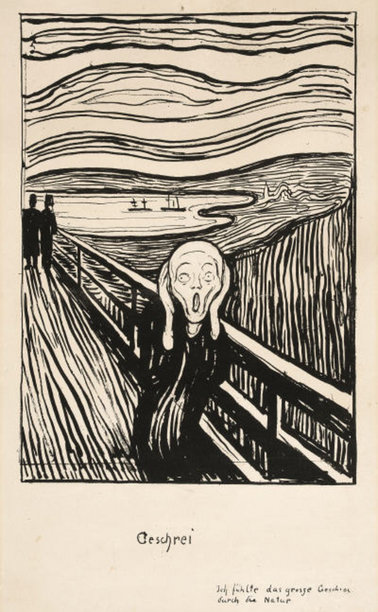
*Litho of Edvard Munch's "The Scream"