Saturday, May 29, 2010

On the Poet Leslie Scalapino's Death


Although I don't write a lot about it, I also have been a member of the poetry reading and writing community for years. A few minutes ago, a friend posted on Facebook that Leslie Scalapino just died. While I was in grad school, she visited our program for a reading and interview. Those of us who enjoyed experimental work, loved the wild ride of her poems, some of which were influenced by Buddhist writings. One of things I found fascinating about Leslie was that her interactions in person felt almost exactly like her poems. She spoke like she wrote, and almost seemed to move through life like her poems did. Sometimes, you had absolutely no idea where she was coming from or what she was talking about, but the way the language appeared on the page, in your ear, rattled what you thought you knew to be true. I don't know what happened to her, but I'm grateful that she's been an influence on my writing, even if only in small ways most of the time.

Many of her writings were the size of novellas. Poems that simply couldn't stop at a single page, or set of pages. So, I'll just offer you a small taste, from Avril, which is from "The Forest is in the Euphrates River."

People cruising

Toyotas the rose desert breaks

everywhere because they are on its surface then

only
a woman ignorant and from eyes blank gloating savaging
others speaking only no one speaks there they’re

not reflected in her eyes her

either for her anywhere

tyranny of inverted in her/gloater’s being defined as the
social outside

their kindness a train hurls on tiers seen in the sky

no sight admitted
into the gloating one savaging others then doesn’t make

sights cattle came to a blossom

in others


Here are a few resources for those of you who love poetry, or who might just be curious.

A short write up of her life and death.

An essay considering her writing, including comments on Buddhist influences.

A blog post about her.

A link to some of her poems.

Another, more complete obit

(Updated) Gulf of Mexico Clean Up Efforts and Human Failures to Change Consumption Patterns


The whole situation in the Gulf of Mexico has been sickening to me. Endless finger pointing. Generations worth of environmental damage. Right wing blathering in support of BP, and against the Obama Administration. The Obama Administration's tepid response. And you know what, I still don't hear many people saying "Damn, maybe I need to figure out a way to drive less and use less oil."

I have a soft spot for pelicans, and it seems that every disaster like this ends up having images of pelicans coated and choking in oil. And to be honest, I think almost no one who hops into their car to drive six blocks to get a loaf of bread or a soda thinks for a second about their connection to these pelicans. And the same is true for all of us who are purchasing endless amounts of plastic crap because we "have to have it!", whatever "it" is.

I'm not feeling terribly charitable or kind about all this today. I've tried not to write about it much because it just makes me so angry, and sad, and not very balanced. Mostly, I look at that pelican in the photo above, and think "I'm letting you down. We are letting you down."

Maia over at Jizo Chronicles has a post today about some clean up efforts being organized. If you have an interest in going down there to help, or offering financial support to those who want to go, check out her post. I can imagine there will be a lot of opportunities to do so for a good long while. May we all wake up to suffering we are causing in the world.

Update: Barry over at Ox Herding has some additional resources to consider in his current post.

Friday, May 28, 2010

The Red Thread of Passion: A Few Thoughts on Buddhist Sexuality


Rev. Harvey Daiho Hilbert-roshi, over at his blog, has been considered the Buddhist precepts, or ethical guidelines one by one. His current post is about the precept on sexuality, which tends to stir up a lot of confusion for most of us.

No sexual misconduct: I vow to use my sexuality to enhance and nurture the lives of others

Consider this vow as it is written. How often do we understand our sexual behavior in the context of its power to enhance and nurture? It seems to me we spend an awful lot of time fretting about the morality of sex and far too little time on considering its humanizing, spiritual, and healing potential.


This spring, our center was planning on having a class to examine these very issues. So few of us signed up that it was canceled. To me, that speaks volumes about our collective baggage around sexuality.

I remember after the debacle in our community, which among other things involved a sexual breach between a student and the former teacher, there was a ton of energy around developing a detailed set of policies and procedures for addressing issues like sexual misconduct. In and of itself, this was necessary, and the work done continues to be a benefit for the sangha. However, when reflecting on the comments Rev. Harvey made, as well as that canceled class, it strikes me that my sangha, collectively, represents the heavy lean in society towards prohibitive, puritanical views about sexuality.

A few upfront observations: Just as we are eating beings, sleeping beings, or breathing beings, we are also sexual beings. Just as killing and stealing can be disruptive to community life, sexual conduct has the power to destroy individual lives within community. Sex is at the center of much of our waking life. We spend an awful lot of time in denial about our sexual nature. We spend the rest of our time trying our best to act it out. Personally, I have little time and patience with our societal neurosis over sex. We do it or we don’t and we should not infuse sexual conduct with notions of moral purity or impurity.


Pretty strong language, don't you think? I personally like it. It's refreshing. No mincing words. No trying to massage things to keep people comfortable.

I don't want to be comfortable with puritanical thoughts about sexuality; I want to be liberated in all that I do. Sex can be wonderful, healing, joy producing, and maybe even a source of liberation. We all know about the horrors of misuse, but most of us haven't deeply explored the flip side. That's my guess. Tell me if I'm wrong. But all nudie mags, how to orgasm books, and sex toys aside, do you really feel like you have fully embraced and experienced your sexuality? Do you have a holistic sense of it? Or is it another part of you life compartmentalized, fragmented off as "not spiritual enough," a "hindrance," etc?

These questions go for those of us who have, or desire to have, active sex lives, and those who are celibate. No one gets around the red thread of passion. Best to go at it head on, with eyes wide open.

* Image is of the painting "Red Thread of Passion" by Patricia Brown. For more of her work, see this link.

Thursday, May 27, 2010

It was 20 Years Ago Today...


A reminder of living history came from Danny Fisher's blog today. Daw Aung San Suu Kyi has been under house arrest for most of the last twenty years, since being elected leader of her nation. Various residents of Burma have experienced miserable oppression not only over the past two decades, but really for much of the last two centuries. My state of Minnesota is now home to a few thousand Karen, one of the many ethnic minority groups from Burma threatened with extinction. Yes, "with extinction" is not an overstatement. Things were bad for them before the military dictatorship came in; since then, it's been a slog for survival for the entire 5-7 million members of the now worldwide Karen community. (Here is some more information about the Karen in Minnesota, in case you are interested.)

For the majority Burmese, the past thirty five years or so have been no picnic either, as the continued imprisonment of Suu Kyi symbolizes. The military not only threatens to destroy all the minority groups, but also has long suppressed its majority brothers and sisters. Obviously, Buddhists around the world remember images of Burmese monks marching and getting beaten in the streets of Rangoon in 2007. More recently, Human Rights Watch put out this report highlighting the continued abuses of monks who were connected to those protests. I've written about all of this before, and I know Danny Fisher and other Buddhist bloggers have posted about conditions in Burma many times as well.

It bears repeating though. We cannot ignore the suffering in this world. Maybe there isn't much tangible people outside of Burma can do right now - but the more of us that are free to speak in support of a Burma liberated from this dictatorship, the better.

Wednesday, May 26, 2010

Fully Enlightened Dharma Heir Required for Establishment of "Western" Buddhism: Film at Eleven


I enjoyed writing that piece on clothing and naked buddhas this morning, but when I looked at it again this evening, it felt a bit too metaphoric. So, I took it down for now. Maybe it will reappear again, but in the meantime, here's a big bone for everyone to chew on, courtesy of today's Tricycle blog:

In Tricycle’s most recent issue there is a piece titled “It Takes a Saint.” In this piece, Tai Situpa Rinpoche shares his beliefs on what it will take for Buddhism to become truly established in the West. He writes,

“I’ll make it simple: One Western person must attain full enlightenment in the same way as Marpa, Milarepa, or Padmasambhava. If one Westerner—man or woman, doesn’t matter—attains that level of realization, then pure dharma will be established in Western culture, Western language, and environment, and so forth. Until that time, dharma can be taught in the West, which is already happening; it can be practiced in the West, which is already happening; and it can be recited in Western languages. But it’s not yet one hundred percent complete.”

Read the whole piece here.

For me, it was love at first sight with this article. I remember reading it for the first time and holding back the urge to cheer while reading certain passages (particularly when Tai Situpa speaks of what would happen if such a Mahasiddha rose above New York City while singing the perfect dharma song for New Yorkers). Yet before long I realized that what was striking me so deeply was not necessarily what he was saying, but where the piece was taking me in my mind—to a West where the Dharma was utterly thriving. THAT is what had me on the verge of joyful cheers. Once I noticed this, I began to question his main point and I realized that while I don’t necessarily disagree, I don’t necessarily agree either. I’m not sure what the answer to the question is.


The writer of the post goes on to interview a few people he knows, asking them what they thought. One said the dharma is established, but just young. Another felt we needed a strong monastic tradition before any claims of established dharma can be made. Neither answer does much for me, but this "established/not established" argument does bring up a question for me. What is behind these kinds of discussions anyway? Are people trying to measure up? Too focused on what has fruited, and not enough on all the seeds being planted? I guess I don't know for sure, but before long - maybe 50 or 100 years - this kind of talk will be history. And then what? Maybe there will be a different issue to deal with - like an "established" dinosaur that doesn't attract anyone's attention.

I personally rather enjoy this somewhat unsettled, often experimental, and sometimes confused thing called Buddhism here in North America. Where else could you have a 100 year old + Buddhist organization be considered both "youthful" and open to major changes? Among other things, said organization, the Buddhist Churches of America, has had an ongoing debate about adding practices like sitting meditation that appeal to non-Japanese practitioners. Now, similar debates and changes are being made in sanghas in places like Thailand, but the difference is that in the United States, the traditional practices aren't really that old. And if you look at the oldest groups, be it the BCA or a place like San Francisco Zen Center, major changes and shifts in emphasis have been more normal than long periods of consistency.

And although it can certainly be a source of confusion, conflict, and sloppy dharma, I have to say that living in the middle of such a flux is pretty damned interesting. Whether or not a viable practice called Buddhism has been established, I'll let the philosophers decide that issue. How about you?

*painting by Rene Magritte

Tuesday, May 25, 2010

What Are You Afraid of?


Yesterday, our class had a short discussion about snakes. A few of my students had the idea that there aren't any snakes in Minnesota because they hadn't seen any. Living in the city can do that to you. But mostly, what was interesting about the conversation is how we ended up talking about some very large snake from Burma that seemed to scare a fair number of people. Things got detailed when discussing this snake - hand gestures to show size, comments about how it can swallow a buffalo - which got me to thinking about how we humans get about the things we fear.

Now, I'm not so afraid of snakes, but that storytelling I experienced yesterday certainly reminds me of favorite approach to fears. Namely, to get lost in exaggerated stories.

What am I afraid of? Well, I still haven't been liberated from good old fear of death yet. And I still have a fear of failure more often than I'd like. And there are days when I get the feeling that I'm completely afraid to fully step into my life as it is.

Life as it is. I've been contemplating the fact that when things aren't going well, I believe stepping fully into them will somehow prolong the misery. This is a curious negation of all I have learned on the path, and yet I can see myself doing it daily when it comes to my current job, and what I need to do to get to the next one. I find myself saying things like "If I just accept everything here," I'll never leave here. Or I'll only leave here if someone pushes me out."

It's a story. I don't know what would happen if I completely accepted things as they are at work because I haven't done it yet. What's interesting is that I've tried everything else I can think of. I've stopped arguing about every last thing I disagree with. I've done zazen on breaks. I've done metta meditations for everyone I work with, even the few people who I really clash with. The list goes on and on. But I have never truly, fully accepted where things are at.

When it comes down to it, I think all fear is tied in some way or another to death. Not just death of the body, but also of parts of our life that have become familiar, comfortable, loved, or even hated. And I've found that when you get to stage where something, or someone is on life support, all sorts of stories arise that can get in the way of letting death come. The roller coaster rides of the end for both of my grandfather's certainly taught me this, if nothing else has.

So, can you let the stories just be stories? Can you accept them too? I say this to myself, but also can imagine you all who are reading this have your own stories to work with.

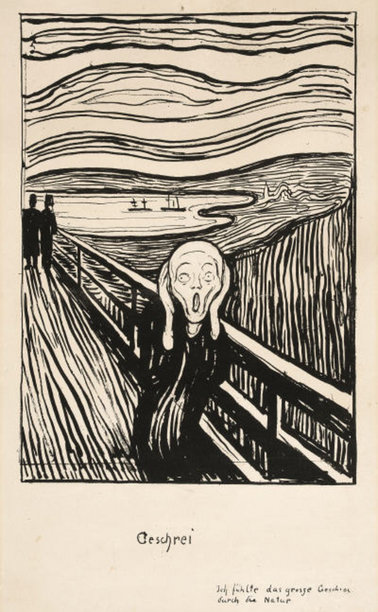
What are you afraid of anyway?

*Litho of Edvard Munch's "The Scream"

Monday, May 24, 2010

A Sangha of Writers


I have a new post over at Life as a Human about meditation and Lake Superior. Check it out.

Also, if you get a chance to pick up the current issue of Inquiring Mind, our center's head teacher, Byakuren Judith Ragir, has an article on addiction I'd like to direct your attention to. After three and half years of focused attention on leading our sangha back to a healthy place, she's finally got some time and energy to do other projects.

Finally, another member of our sangha, Tracy, started a new blog last month. If you like poetry, biking, and a little dharma, you should take a look!

* The photo above is of the center of our zendo. Once a warehouse building, the Northern Warehouse is now a community of artists, a few non-profits, a noodle shop, a coffee shop, and one Zen Center. Pretty cool, eh?